

Sustainability
is at our heart


Methodology note
Functional unit: kg CO₂e per kg of product
Comparison basis: Comparisons are per kg product (not per kg protein), it is highlighted that inclusion rate is 4–20% in finished food. Often soy and pea are included in products although chicken and beef may be 100% products, or 'included' as an ingredient in ready meals.
Boundary: Cradle-to-gate
Assessment: Independent interim LCA by UK Agri-Tech Centre (full report available under NDA)
Comparator values are drawn from widely cited published datasets and industry disclosures and are presented as indicative ranges, reflecting variation by geography, energy mix, and processing route.
Avoided-waste methane benefits are not included in the reported figure.
A further independent LCA will be reperformed after BRCGS certification (when internal processes are 'frozen') and a summary of the results will be published. It is recognised that for upcycled feedstocks, the LCA result depends heavily on whether side streams carry zero burden (treated as waste), or some share of cultivation impacts (economic/physical allocation) and how collection/transport is treated, and that such disclosure of such assumptions (along with energy assumptions, transport distances, uncertainty ranges) are essential for assessing LCA robustness. Specifically, the methodology for avoided waste will be identified and the value of the impact separately identified.
Management recognises that work is required on completeness (missing dry-basis, per-kg-protein, allocation detail, sensitivity ranges), presentation and standardisation to allow cross-comparison, but highlights that the interim independent LCA (accepted as a working estimate, not a final audited footprint) is broadly positive, validates that the “lower than imported commodity proteins” claim is credible, and that the approach taken is superior to many peers at an equivalent stage and supports a positive carbon impact.
An independent LCA has validated our credentials
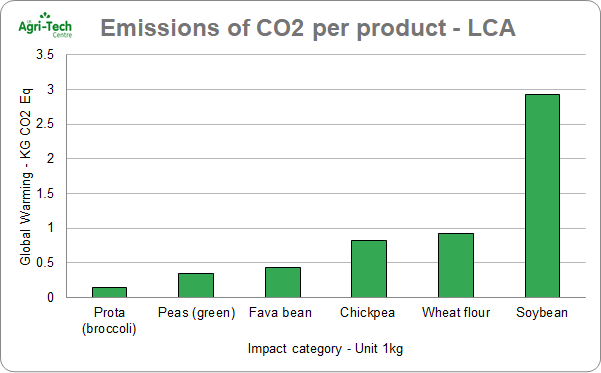
Independent LCA results (cradle-to-gate, as sold moisture basis for 'wet' Prota) indicate UPP’s ingredient has a product carbon footprint of <0.25 kg CO₂e per kg ingredient (interim LCA by the UK Agri-Tech Centre during process development; methane avoidance from reduced field waste not yet included). On a like-for-like mass basis, that is <1% of beef (~60 kg CO₂e/kg [Poore & Nemecek / OWID], widely cited but median/typical figures vary) and up to ~10% of chicken (~3-6kg CO₂e/kg, varies widely by system boundary), and materially below common plant proteins such as soy (~2 -9kg CO₂e/kg). Published LCAs for processed plant and fungal proteins vary by geography and energy mix; against typical ranges for pea protein (~0.5–5 kg CO₂e/kg) and mycoprotein (~0.5–2.75 kg CO₂e/kg[Carbon Trust/Quorn]), UPP is materially lower than both. Published cultivated-meat scenarios typically range ~2.5–13.5 kg CO₂e/kg [CE Delft], putting UPP at <20% on a mass basis. We will publish the full methodology and update figures following our post-certification LCA refresh.
Get in touch
Keep updated
© 2024. All rights reserved.
+44 1952 327 357
welcome@upp.farm
Upcycled Plant Power ('UPP') Limited
trading as "UPP" and "Freya"
Company number: 14171122
VAT Number: 428 2222 17
Registered address:
Agri-Tech Centre
Poultry Drive, Edgmond,
Newport, Shropshire
United Kingdom TF10 8JZ
Connect with us
A list of trademarks/brands can be found here

