
UPP Secures £1.5M in New Investment and Achieves Key Milestones in Sustainable Ingredient Scale-Up
Upcycled Plant Power (UPP) Ltd announced the completion of new investment and the achievement of several significant milestones in its journey toward commercial scale-up, regulatory certification, and international expansion.
10/29/20254 min read
UPP Secures New Investment and Achieves Key Milestones in Sustainable Ingredient Scale-Up
Upcycled Plant Power (UPP) Ltd announced the completion of new investment and the achievement of several significant milestones in its journey toward commercial scale-up, regulatory certification, and international expansion.
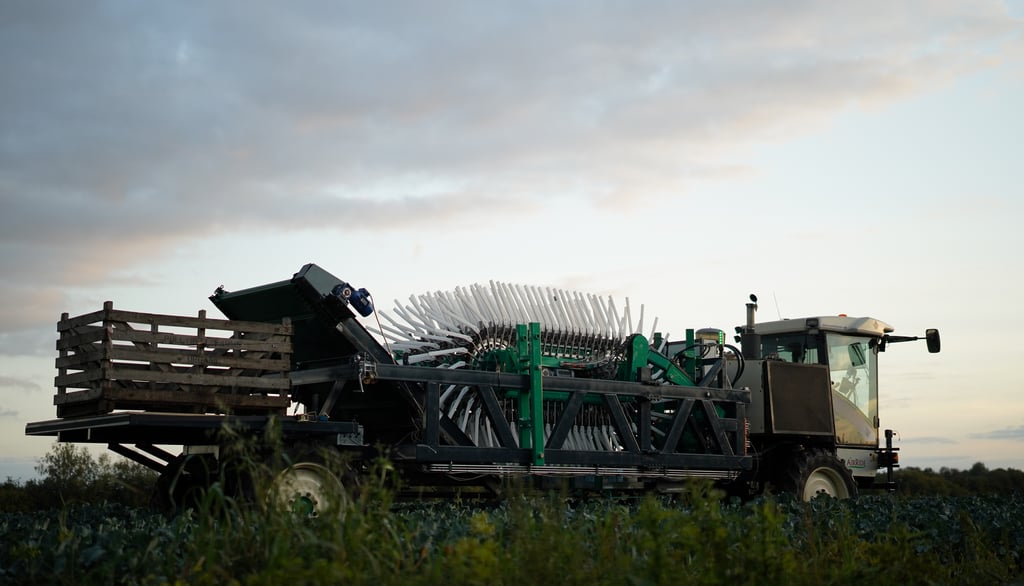
Driven by a mission to make food systems more sustainable, UPP is developing clean-label, planet-positive protein and fibre ingredients while helping broccoli farmers overcome their biggest constraint: harvest labour. By also improving yield efficiency and profitability, UPP is redefining value from field to fork. The company was also one of the first industrial partners of the National Alternative Protein Innovation Centre (NAPIC).
Building on this foundation, UPP has achieved ISO 9001 certification for the production of its Automated Selective Harvester (‘Harvesta’), a self-powered robotic system that identifies market-ready broccoli heads in real time. The 2025 Harvesta model, recently trialled in Lincolnshire and Scotland, can harvest three rows simultaneously at speeds of up to 5 km/h. By automating what has traditionally been a manual process, it transforms the harvest economics of broccoli while capturing valuable side-streams for ingredient production.
Alongside its advances in automation, UPP has completed a pilot plant capable of processing 10 tons of broccoli side-stream per day, producing up to 4 tons of high-quality Fiba™ (fibre) and Prota™ (protein) ingredients. The facility is now in the final three-month work-up toward achieving Brand Reputation through Compliance Global Standard (BRCGS) certification, which is the globally recognised benchmark for food safety and quality and was formerly known as the British Retail Consortium (BRC). UPP expects to secure BRCGS status by January 2026, enabling the start of shipments to several of the 18 major food manufacturers that have already trialled its ingredients. Products featuring UPP’s ingredients are anticipated to reach supermarket shelves in H1 2026, with plans to scale production beyond 100 tons per day in the future.
An independent Life Cycle Analysis confirmed that UPP’s protein has a materially lower CO₂ footprint than soy or pea protein and significantly outperforms pork and beef. The company will soon publish further analysis quantifying methane emissions avoided, demonstrating that its ingredients are genuinely planet positive.
With innovation at the core of its development strategy, UPP has already secured one granted patent family, filed another patent, and submitted three more, with several additional applications now being prepared. These patents span both the harvesting and upcycling processes, reflecting the depth of UPP’s technology and its collaboration with leading institutions including the James Hutton Institute, Harper Adams University, and the UK Agri-Tech Centre.
To drive the next phase of growth, UPP has strengthened its leadership team with the appointment of Dr. Trisha Toop as Chief Technology Officer and Patrick Cohen as Chief Financial Officer, as part of their expansion from seven to twelve team members. The enhanced team will accelerate delivery in the UK, allowing the CEO to focus on planned expansion in the United States and on developing new product lines to maximise both environmental and economic returns from brassica side-streams.
To support this momentum, UPP has secured £1.5 million in new investment from Elbow Beach Ventures, together with the conversion of £1.45 million in existing loans to equity, bringing total investment to £3.6 million. This has been complemented by £1.38 million in government grants, with £0.6 million still to be drawn, supporting the company through to its first commercial revenues.
Mark Evans, CEO of UPP, said: “UPP is redefining how plant-based ingredients are produced by using the crops we already grow, without the need for additional land, water, or emissions. Our technology transforms what was once agricultural waste into cost-effective, nutritious, and hypoallergenic food ingredients. In doing so, we are helping farmers improve profitability, supporting manufacturers in meeting sustainability goals, and contributing to a healthier planet.”
Helen Brookes, Engagement Director at the UK Agri-Tech Centre, said “UPP is a good example of the innovation and collaboration that define the future of UK agriculture and food production. By combining advanced automation with circular bioeconomy principles, they are showing how cutting-edge agri-tech can deliver meaningful impact. Their work demonstrates how technology can turn agricultural challenges, like labour shortages and crop waste, into new opportunities for value creation, sustainability and global opportunity. At the UK Agri-Tech Centre, we are proud to have supported UPP from the outset of the business and to see their ongoing success advancing the resilience of our sector.”
Professor Stewart of the James Hutton Institute, Co-Director of the National Alternative Protein Innovation Centre (NAPIC) and an advisor to UPP said: “UPP’s progress is a powerful example of how UK innovation can accelerate the transition to a more sustainable and resilient food system. As one of NAPIC’s founding industrial partners, UPP has shown how cutting-edge science, automation, and circular thinking can be combined to deliver real-world impact, reducing waste, lowering emissions, and creating new sources of clean, nutritious protein. Their achievements demonstrate the strength of the UK’s alternative protein ecosystem and the value of collaboration between industry, academia, and government in driving the next generation of sustainable food technologies.”
-----------------------------------------------------------
ABOUT UPCYCLED PLANT POWER (UPP) LTD (‘UPP’): UPP provides sustainable, clean-label, low-allergenic plant fibre and protein ingredients for food manufacturers seeking to decarbonise their products. By pairing automated broccoli harvesting with upcycling of the 70% of the plant typically discarded, UPP transforms a high-waste crop into a dual-revenue system that cuts Scope 3 emissions and supports UK food security, nutrition, and affordability goals.
ABOUT ELBOW BEACH CAPITAL: Elbow Beach Ventures is a UK-based investment firm backing high-growth clean technology companies that deliver measurable environmental impact, focusing on scalable solutions such as advanced EV batteries, CO₂-to-product innovations, and agricultural waste reduction to support technologies with the potential to transform industries.
ABOUT UK AGRI-TECH CENTRE: The UK Agri-Tech Centre are the only full-chain agricultural innovation centre in the UK, focussed on supporting commercially viable agriculture solutions and driving their adoption. The UK Agri-Tech Centre works alongside food producers, SMEs, industry, government and world-class research institutions to accelerate impactful agri-tech innovation.
ABOUT NAPIC: The National Alternative Protein Innovation Centre (NAPIC) is an Innovation Knowledge Centre (IKC) funded by BBSRC, Innovate UK, national and international partners including academia, industry, regulators, and third sector. NAPIC are a dynamic nexus of innovators working to leverage the UK’s world-leading science and innovation strengths in alternative proteins.
Get in touch
Keep updated
© 2024. All rights reserved.
+44 1952 327 357
welcome@upp.farm
Upcycled Plant Power ('UPP') Limited
trading as "UPP" and "Freya"
Company number: 14171122
VAT Number: 428 2222 17
Registered address:
Agri-Tech Centre
Poultry Drive, Edgmond,
Newport, Shropshire
United Kingdom TF10 8JZ
Connect with us
A list of trademarks/brands can be found here


An interim Life Cycle Analysis (LCA) is here