Fresh Insights in Sustainable Food & AgTech
We publish here when we see a structural shift the food industry needs to talk about. Recent pieces cover the methylcellulose transition, GLP-1s, the Yuka effect, the question of whether cows can be optimised away, school meals and industry consolidation. The thread connecting them is system design — not behaviour change.

Discover the ideas, people, and practices growing a healthier food future.
The Cocopopification of Food (and Why Fighting the Industry Won’t Fix It)

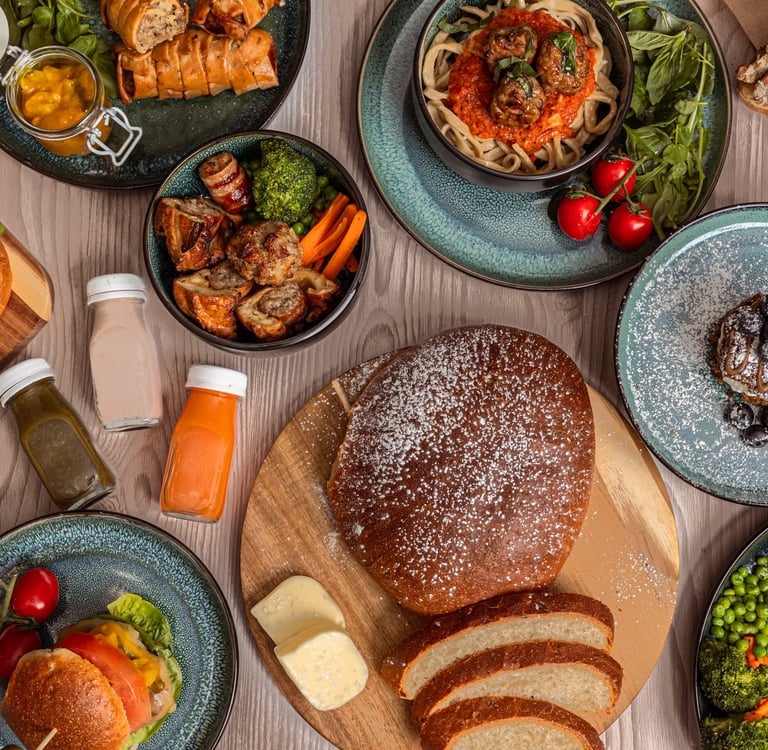
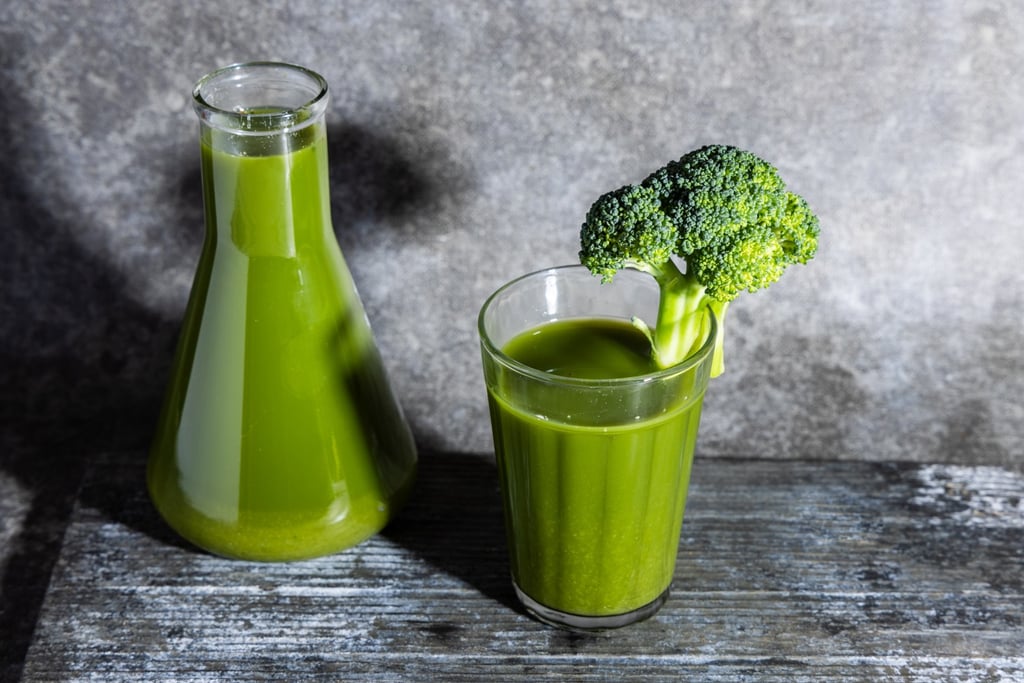




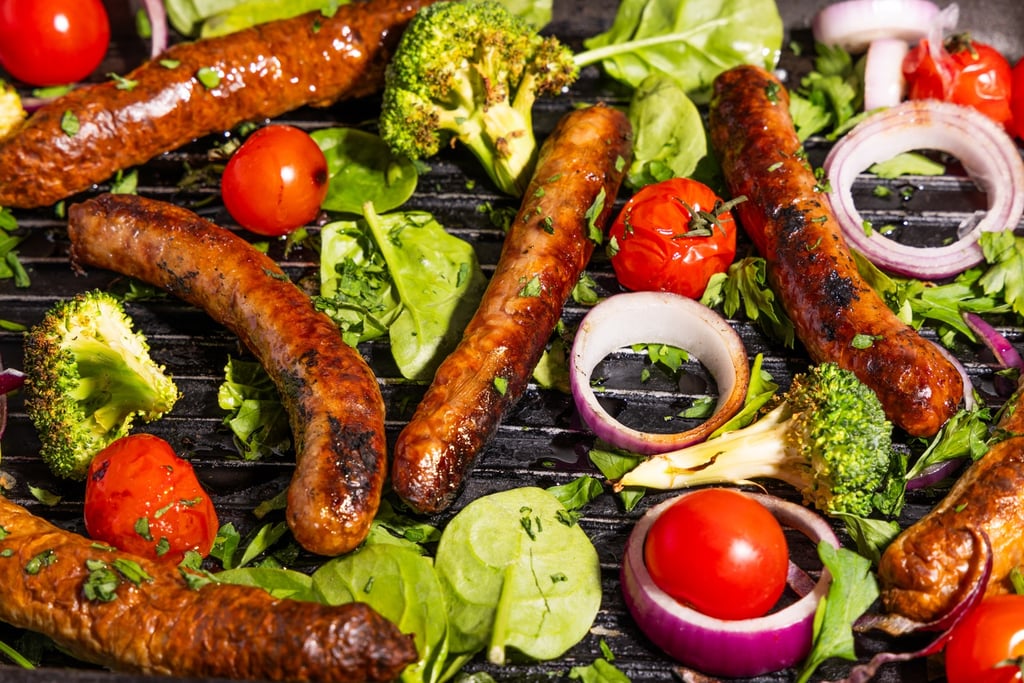





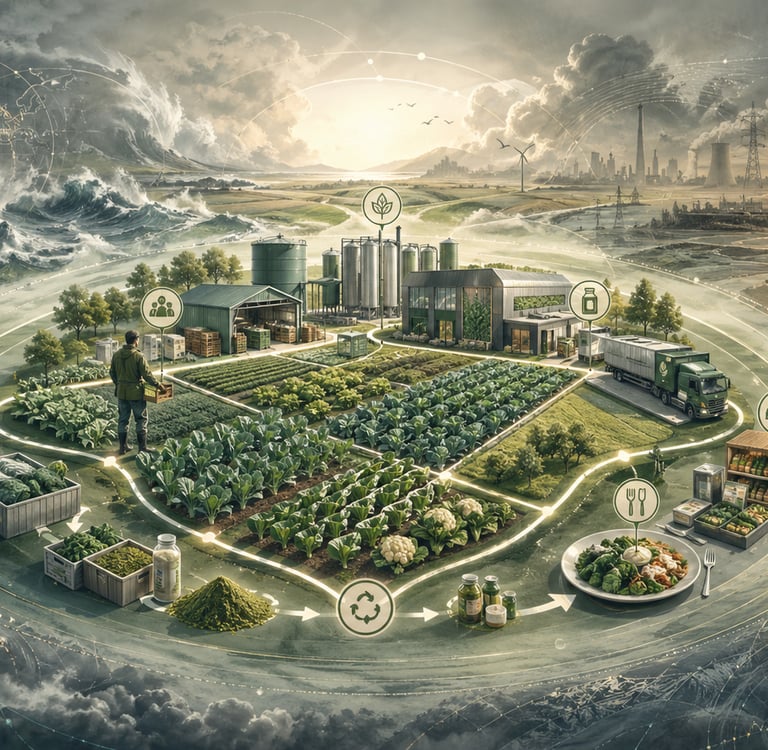
Clean ingredients that sound natural - and why that suddenly matters again
Fork From Farm: Designing Food Around What People Need
Feeding the next phase of food: What GLP-1s reveal about nutrition, not medication
The Fibre Factor: Why “eat more fibre” won’t scale unless we change how food is made
Why low-friction reformulation is now a strategic imperative for food producers
Yuka: The reformulation pressure food producers didn’t vote for (and why UPP is built for it)
The most advanced taste tool we have is still a Chef
If people won’t change their diet to save their lives, why would they change it to save the planet?
A World Without Cows: What happens when we optimise the wrong variable?
Upcycling as Infrastructure: Why UPP Joined the Upcycled Food Association
Ingredient stacking: the fastest route to lower-carbon food that still tastes like food
Europe after peak: why the next era of food is about nutrition density, not volume
The system isn’t broken. It’s optimised.
Sustainability as a by-product of efficiency — and the three places that argument breaks
The healthcare system is paying for poor diet. The food system has to become part of the fix.
The question isn’t whether inulin works. It’s whether it still fits the moment.
Permacrisis is not the problem. Building for it is the answer.
Automate the harvest. Lower the fertiliser. Rebuild the rotation.
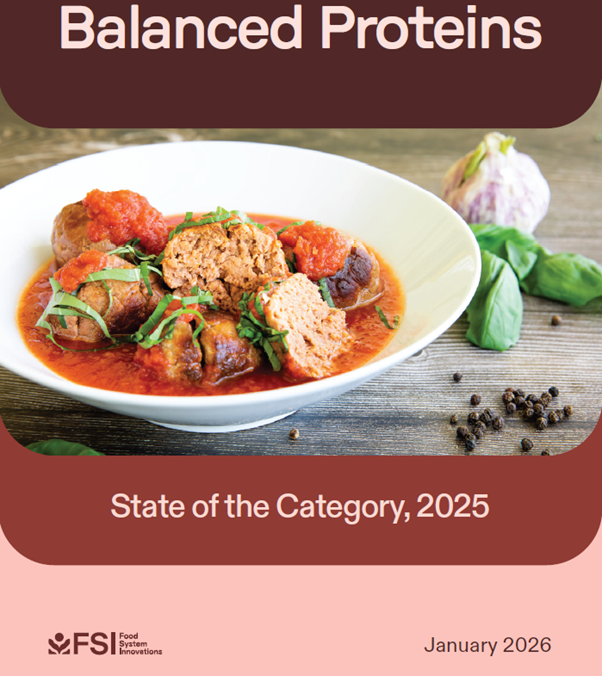
Balanced Proteins: Quiet Scale Beats Loud Disruption
The next era of food. The work happens upstream.
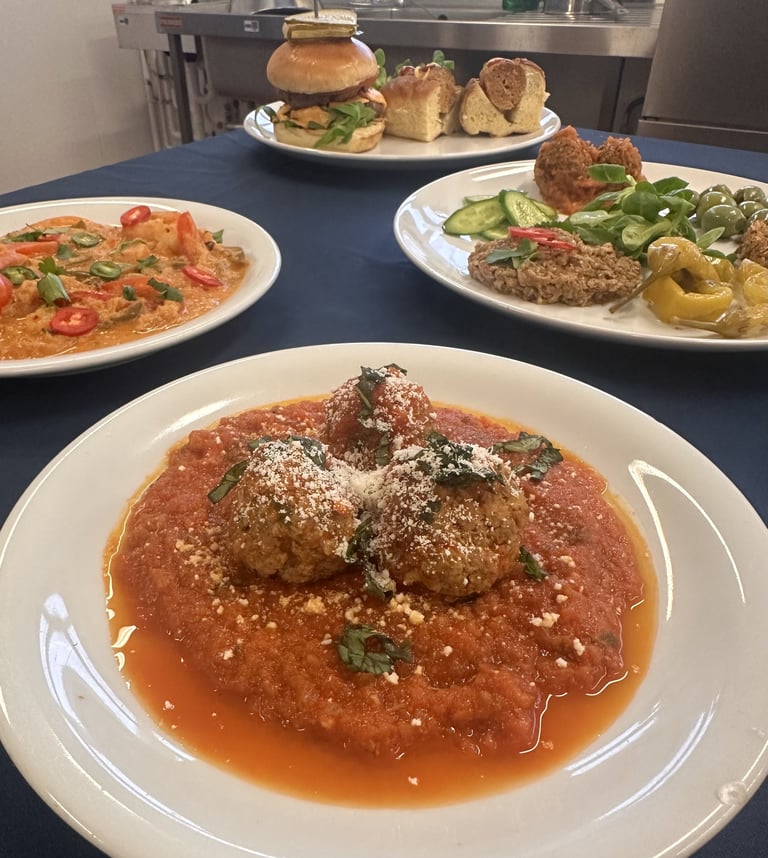
Less than £1 for the food. The school meal is now a system design problem.

What 70 alternative-protein casualties tell us about the next era of food.
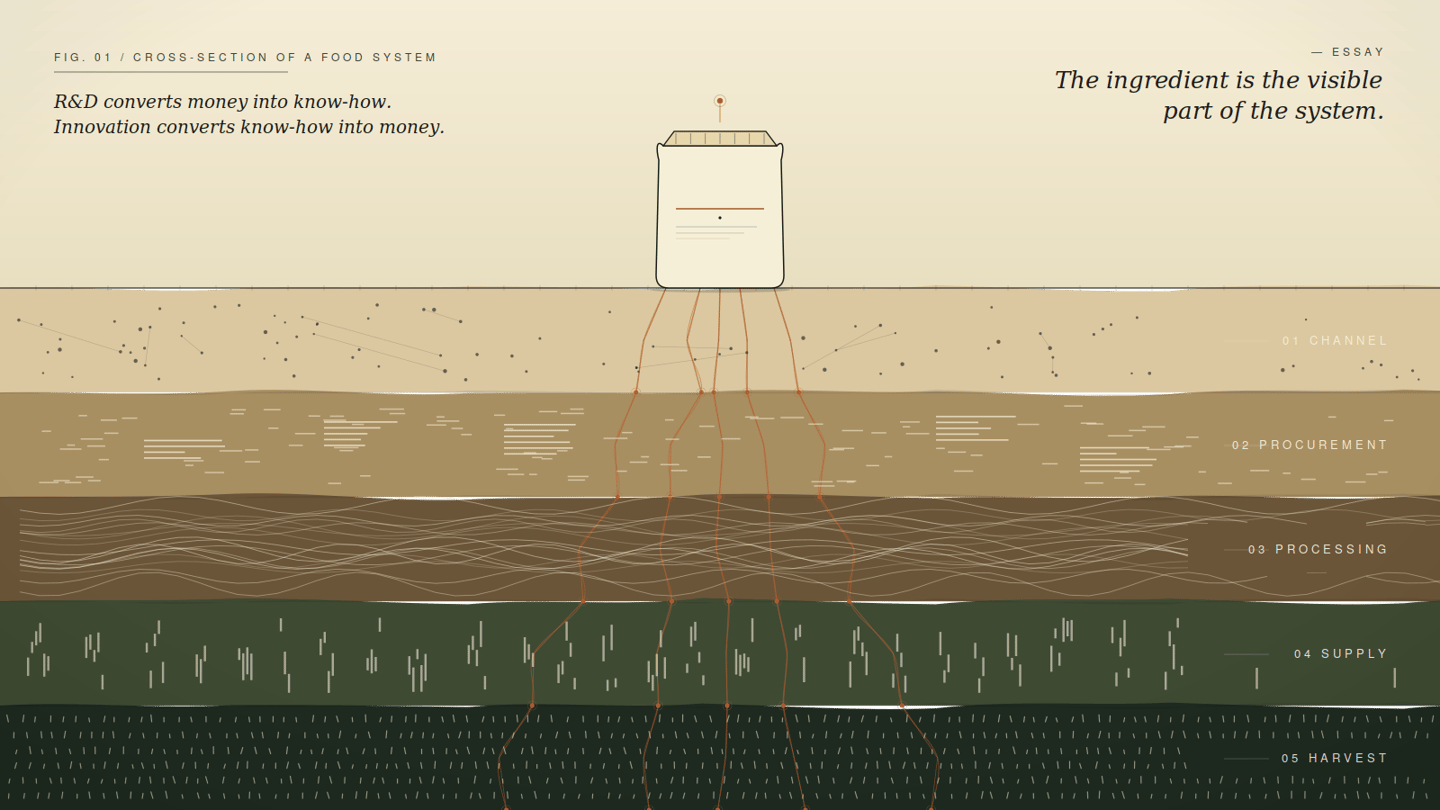
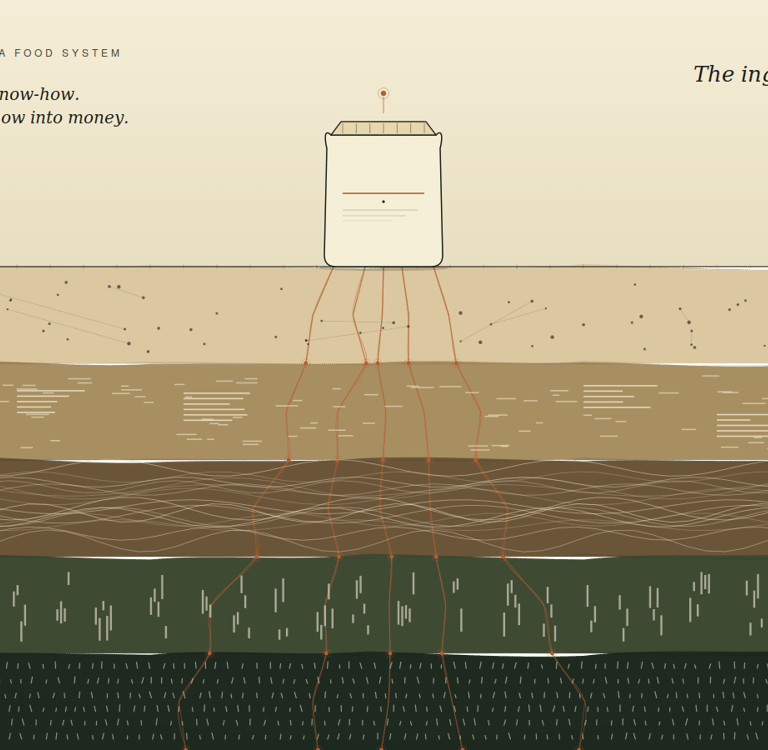
R&D converts money into know-how. Innovation converts know-how into money.
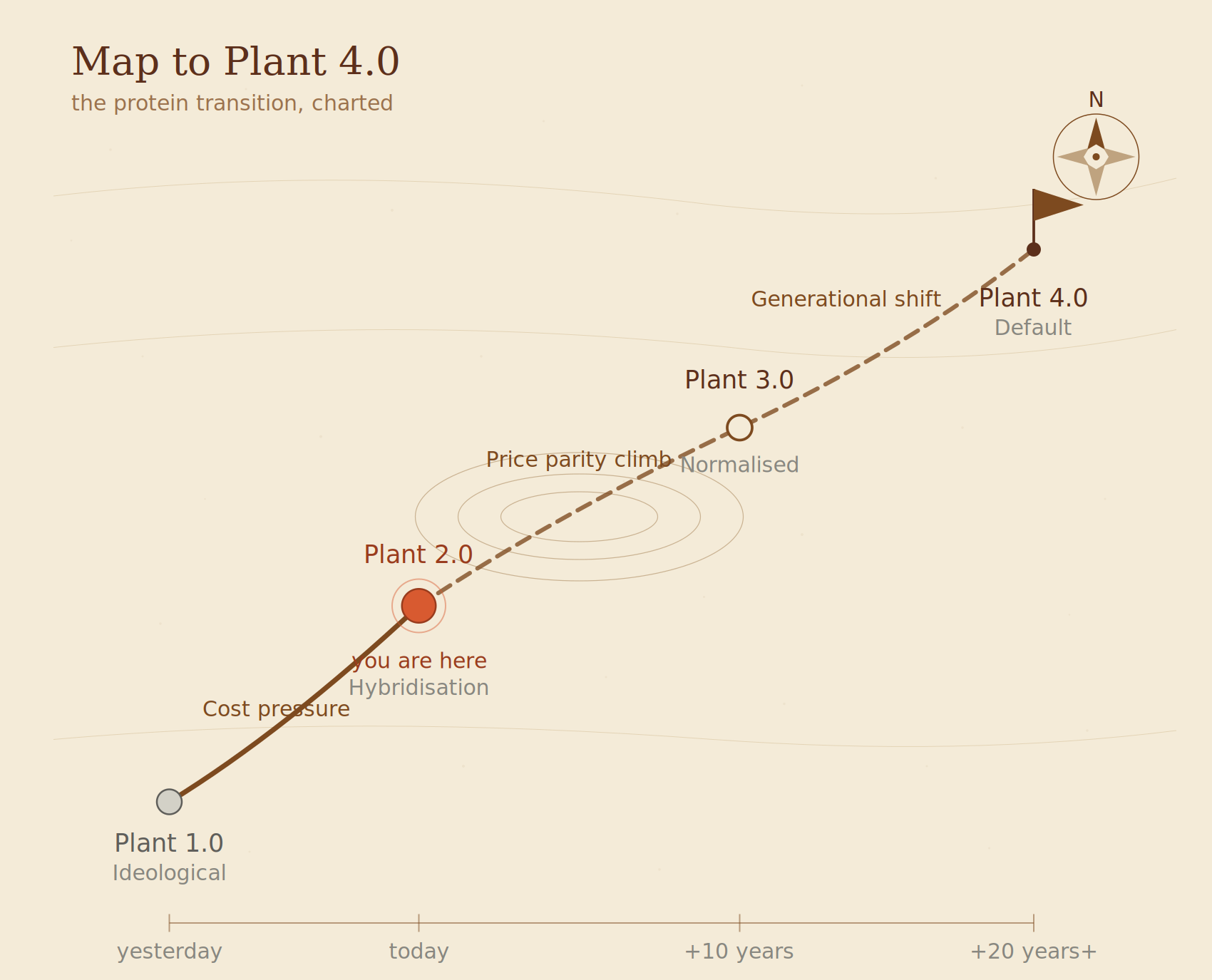
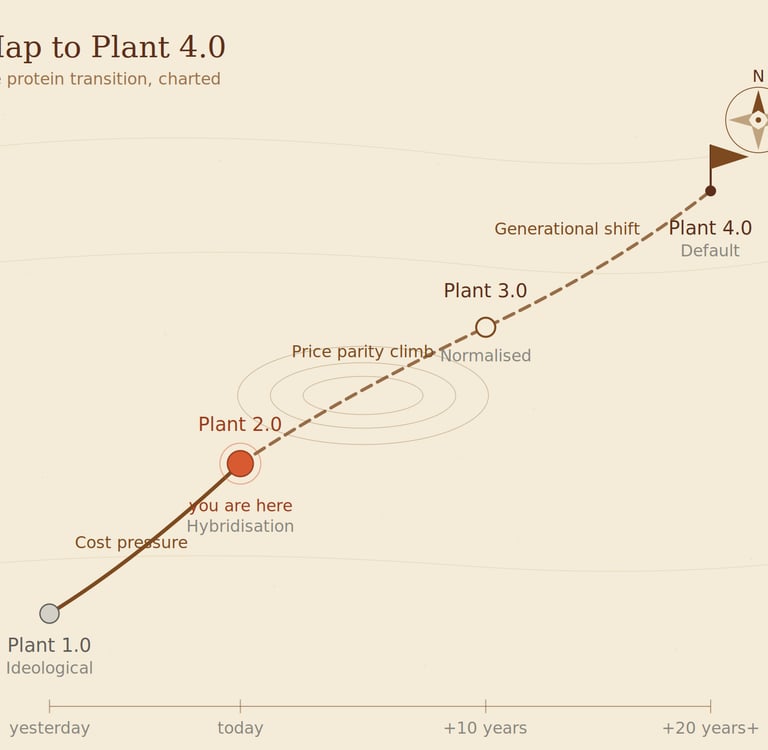
Plant 2.0: Why the Protein Shift Will Arrive in Stages, Not All at Once
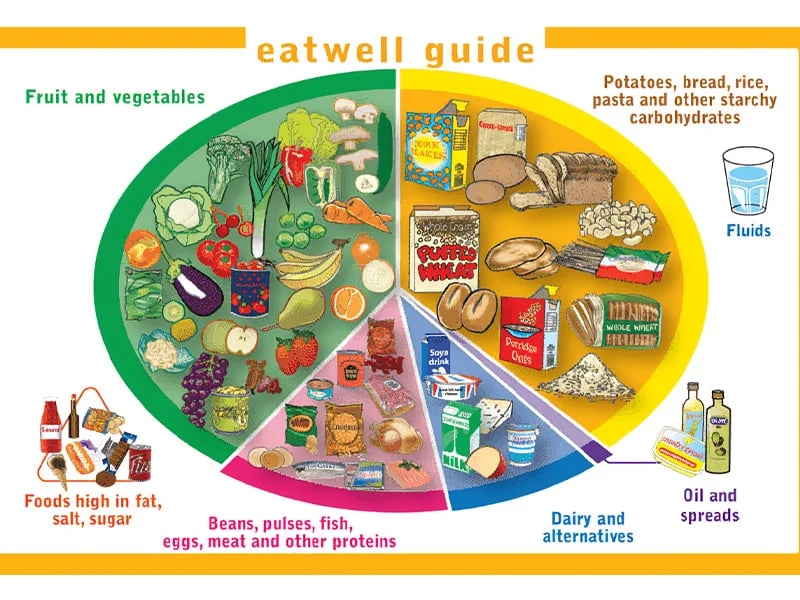
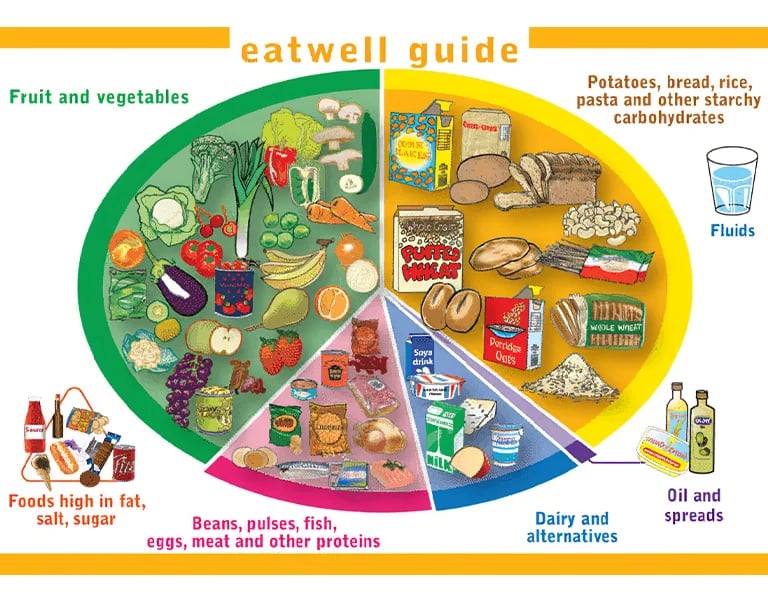
The Eatwell paradox: what happens when a country tries to follow its own advice


The next food-safety problem is the one that builds up slowly

Circularity is at our core: Decarbonising the food system
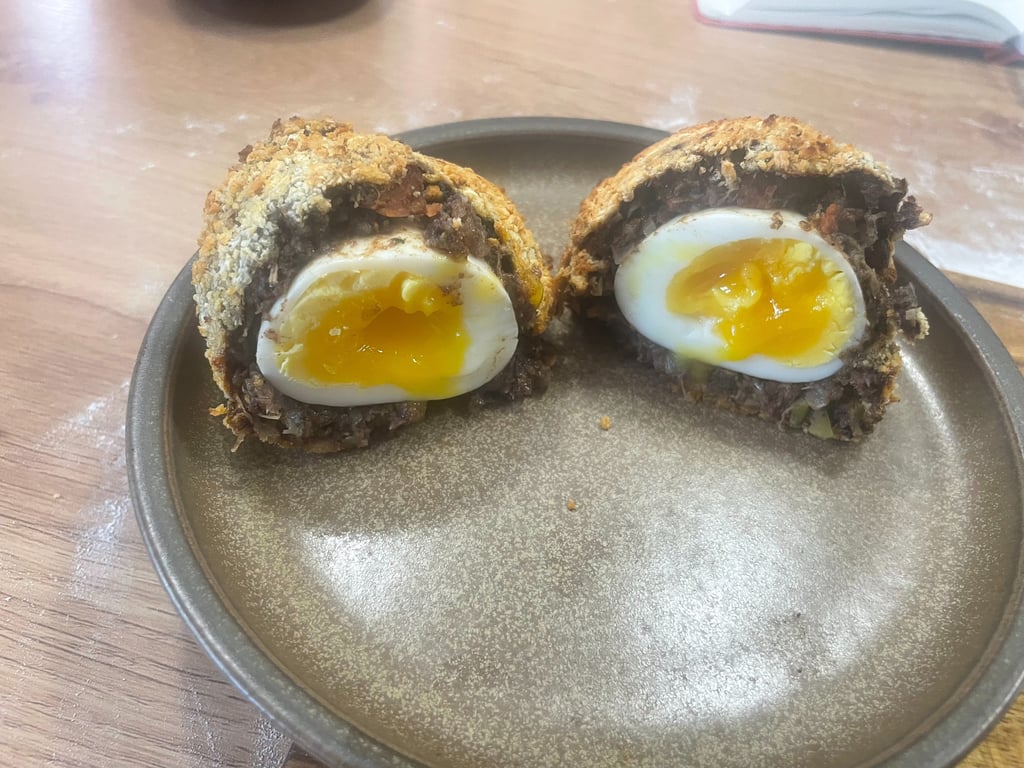
Two flawed rulers. No better one yet. Where that leaves food producers — and us.


The canary on the field: The fields are telling us something - The map of British food is redrawing.


The Fibre Shortcut: from shelf signal to seamless reformulation
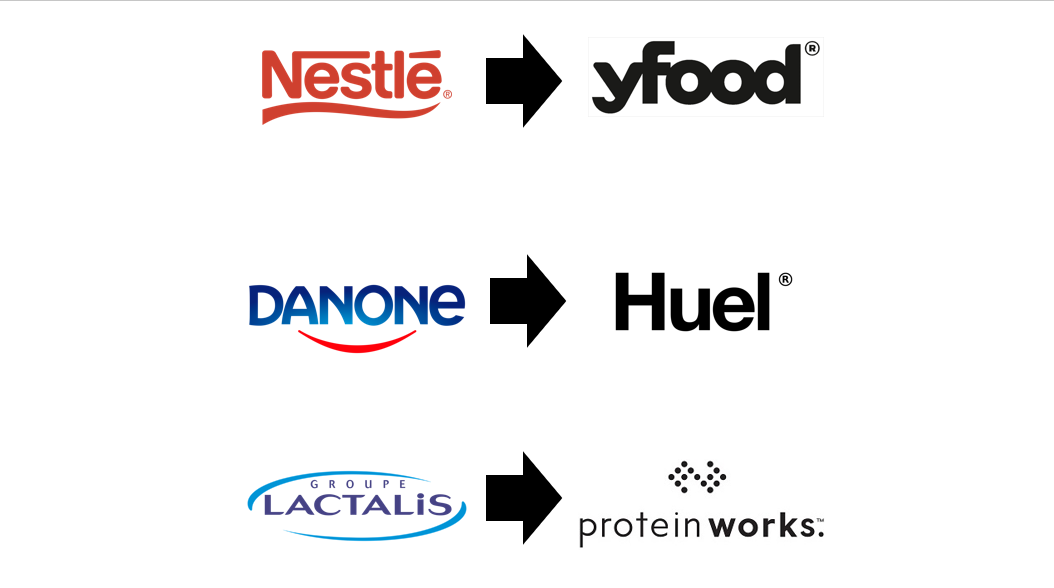
The buyers have spoken. The money moved upstream of the brand.
Two ingredient giants just merged. The deal proves the thesis.


€52 million and six years to a "yes." That's not a milestone — it's the cost of the path.
Sugar reduction has a bulk problem.
Notes from the floor at IFT FIRST: the thesis travels



The Cocopopification of Food (and Why Fighting the Industry Won’t Fix It)
There’s a feeling many consumers share, even if they don’t have the words for it. Food has become… cartoonish. Too sweet. Too smooth. Too engineered. Too loud. Too moreish. Too far from anything you’d recognise in a kitchen.
It’s the "cocopopification" of food: products designed to be hyper-palatable, hyper-convenient, and hyper-repeatable — optimised less for nourishment and more for throughput.
And it’s triggered a backlash.
The book Ultra-Processed People didn’t create the concern — it simply gave it a clear narrative:: "something about the modern diet feels wrong." And people aren’t imagining it.
Should we only eat unprocessed food? No.
That idea sounds clean, but it collapses the moment it meets reality.
Because “only unprocessed” assumes a world where everyone has:
time to cook from scratch every day
stable income and access to fresh ingredients
predictable schedules
equipment, skills, and energy
low stress and high capacity
That is not most people’s life.
It’s not how modern societies work.
Processed food exists for a reason: it made food safer, cheaper, more available, more stable, and more consistent. It reduced hunger. It extended shelf life. It supported working households. It enabled scale.
The mistake isn’t that food is processed.
The mistake is that processing became a proxy for quality.
And then the system got too good at optimising for the wrong thing.
Should we have better food?
Definitely. But “better” doesn’t mean nostalgic.
It means upgraded.
Better food is food that fits modern life and delivers what bodies actually need:
more nutrition density
more fibre
better satiety
fewer empty calories
fewer unnecessary functional crutches
ingredients that behave like food, not chemistry
Better food is not a return to the past.
It’s a redesign of the default.
Can we get there without working with the industry?
Impossible.
Because the industry is the system.
And the system is how food reaches people.
It’s easy to imagine that the solution is to “beat Big Food” — to replace it, shame it, regulate it into submission, or boycott it into collapse.
But that approach misunderstands something important: food at scale doesn’t change through moral pressure alone.
It changes through supply chains, specifications, manufacturing realities, retailer requirements, cost constraints, and consumer repeat purchase.
It changes when the people inside the system have better tools.
And here’s the uncomfortable truth: The people inside the industry eat the same food we do.
They are not a separate species. They are parents buying dinner. They are commuters grabbing lunch. They are shoppers managing budgets. They are humans with the same constraints and cravings.
The idea that the industry is a villain, and consumers are the victims, makes for a satisfying story. But it doesn’t build a better food environment.
The story of modern food is also the story of progress
Look at the UK over the last century.
From 1900 through to around 2011, life expectancy rose markedly — with temporary shocks during wars and pandemics. Multiple forces drove that improvement: public health measures, medical advances, and better living conditions.
But food played a role too.
Improved food security.
More reliable calories.
More consistent nutrition.
Less seasonal hunger.
Safer supply.
The system delivered.
And that matters, because it’s easy to criticise the modern food environment without acknowledging what it replaced.
But now the optimisation target has shifted.
The problem today isn’t scarcity.
It’s abundance — in the wrong direction.
And more recently, rising obesity and chronic disease risk linked to diet and inactivity threaten to slow progress, especially in healthy life expectancy.
So if we want continued gains, something has to change.
Not in theory.
In the everyday food environment people actually live in.
The modern food environment is shaping outcomes by default
Most people don’t fail at nutrition because they lack willpower.
They fail because the environment is doing what it was designed to do:
cheap calories are everywhere
ultra-convenient formats dominate
products are engineered for repeat purchase
the easiest option is rarely the best one
“healthier” often costs more or tastes worse
So the system produces predictable outcomes.
And then we blame individuals for responding normally.
That’s not a health strategy.
That’s a design failure.
The solution isn’t to reject the system. It’s to transform it.
If you want a healthier population, you need healthier defaults.
Not niche alternatives for the already motivated.
That means changing what happens inside the categories people already buy:
ready meals
sauces
bakery
snacks
kids’ food
everyday staples
It means improving the inputs, not just preaching about the outputs. And it means working with manufacturers — because manufacturers control the levers of scale:
formulation
cost-in-use
texture and taste
shelf life
labelling
procurement
production realities
This is not glamorous work. But it’s the only work that scales.
A new goal: keep the convenience, upgrade the nutrition
The future isn’t “everyone eats whole foods all the time.”
The future is that the convenient foods people already rely on become:
more nutritious
less empty
less dependent on ultra-processing tricks
more aligned with long-term health
Not through disruption.
Through upgrade paths.
Small improvements repeated across high-volume products become population-level change.
That’s the game.
What we’re doing at UPP
At UPP, we’re not trying to tear the system down.
We’re trying to make it better at what it already does: feed people at scale.
That means working upstream - turning under-utilised vegetables into functional ingredients that can be used in real manufacturing to improve food from the inside out.
Not as a “health product.”
Not as a premium niche.
As an ingredient-level upgrade that fits the realities of modern food:
affordability
safety
scale
consistency
compatibility
Because beating the industry isn’t the answer.
Helping the system transform is the answer.
And that is what we are doing.
Closing thought
The cocopopification of food didn’t happen by accident.
It happened because the system was optimised for what it was rewarded for.
Now the rewards are changing.
And if we want the next century of progress - not just in life expectancy, but in healthy life expectancy - we need the modern food environment to change too.
Not by wishing processing away.
But by making processed food worthy of the role it plays.
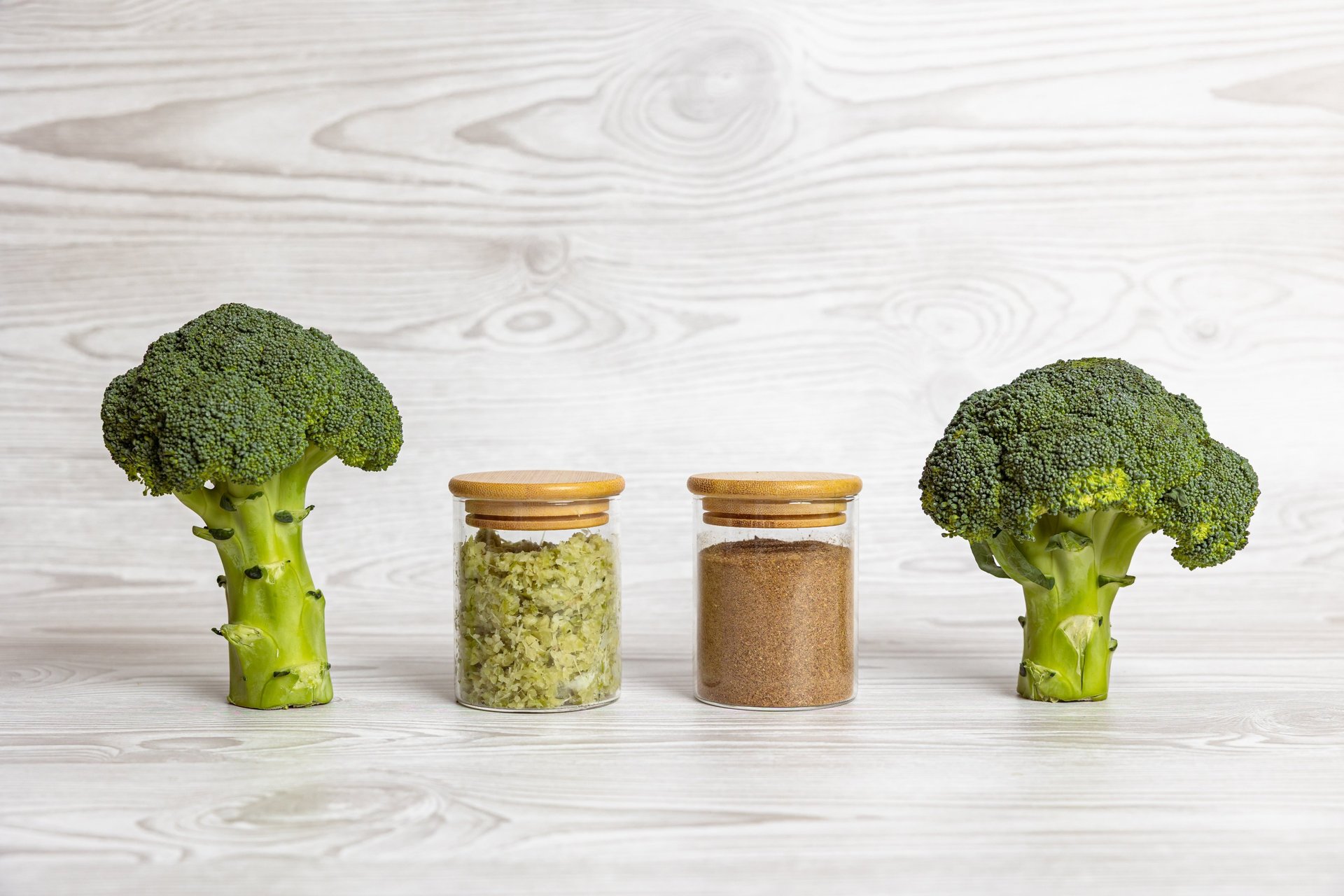
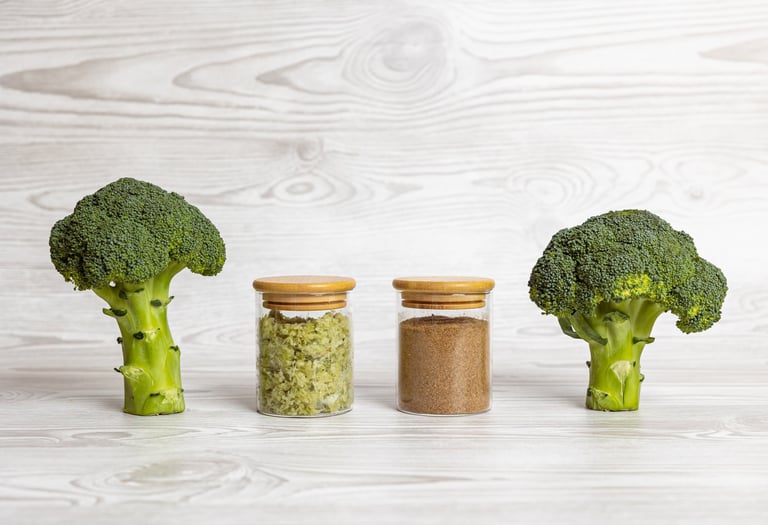
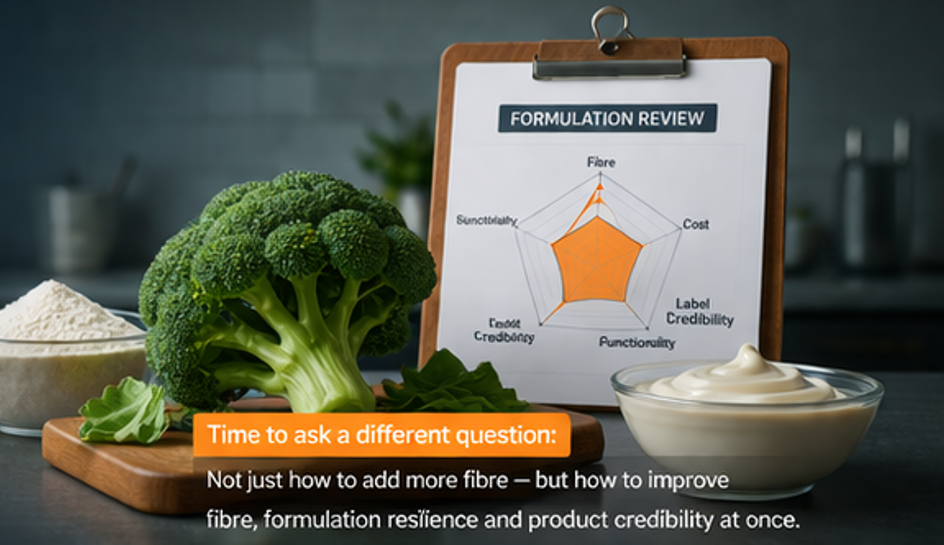
Clean ingredients that sound natural - and why that suddenly matters again
For years, the food industry has treated “clean label” as a marketing problem.
Remove an E-number.
Use "store cupboard ingredients"
Reduce the length of ingredient declarations on back of pack.
What’s changed recently is not the existence of processed food - it’s the level of public scrutiny around how food is processed, why, and whether the trade-offs are still justified. The debate has re-entered the mainstream.
From Joe Wicks: Food for Fitness to the success of Chris van Tulleken’s “Ultra-Processed People”, consumers are being exposed - often for the first time - to the idea that not all processing is equal, and that formulation decisions made far upstream can shape health, trust, and perception downstream.
For food producers, this creates a familiar tension.
The system still needs processed food.
Scale still requires consistency, safety, and shelf life.
Cost pressure has not gone away.
But the tolerance for ingredients that sound synthetic, opaque, or unnecessary is narrowing. And that matters — not because of ideology, but because perception now influences risk.
The quiet return of ingredient scrutiny
What’s striking about the current moment is how little it resembles previous “clean eating” cycles. This is not about superfoods or exclusion diets.
It is about processing logic.
Both the documentary and the book focus less on individual nutrients, and more on the architecture of modern food: fractionation, recombination, texture engineering, and the substitution of whole-food function with isolated additives.
That framing resonates because it aligns with something food manufacturers already know internally: Many formulation decisions were made to solve industrial constraints - not nutritional ones.
Those decisions made sense at the time. But some of their side-effects are now visible to consumers in a way they weren’t before.
Why “natural-sounding” ingredients are not about optics
There’s a temptation to treat this moment as a communications challenge.
Change the language.
Control the narrative.
Re-educate the consumer.
That approach misses the point.
What consumers are responding to is not branding — it’s credibility. Ingredients that sound natural tend to share three characteristics:
They originate from recognisable crops or processes
They perform multiple functions, rather than replacing each one with a separate additive
They can be explained without a chemistry lesson
This is not nostalgia. It’s cognitive load. When ingredient lists become shorter and more intuitive, trust increases - even if the product remains processed.
Processing is not the enemy - fragmentation is
One of the most unhelpful conclusions drawn from the “ultra-processed” debate is that processing itself is the problem. It isn’t.
Processing is what allows food to be safe, affordable, and widely available.
The issue is how fragmented processing has become.
Over time, many foods have been deconstructed into ever more specialised inputs -stabilisers, emulsifiers, texturisers, isolates - each solving a narrow technical problem, often sourced from different global supply chains. The result is food that works industrially, but looks and feels increasingly abstract to the people eating it.
Reversing that trend does not require abandoning processing. It requires re-integrating function.
When one ingredient can do the work of many
From a formulation perspective, the most powerful ingredients today are not the most novel. They are the ones that:
deliver protein, fibre, and functionality together
replace multiple additives with a single crop-derived input
integrate into existing processes without re-engineering lines
arrive with procurement-grade traceability and allergen clarity
This is where “clean” stops being about purity and starts being about efficiency - fewer ingredients, fewer suppliers, fewer explanations.
For manufacturers under pressure to reduce cost, risk, and Scope 3 emissions simultaneously, this matters more than philosophy.
Clean labels as a by-product of better system design
The most scalable changes in food rarely happen because consumers demand them explicitly. They happen because producers redesign systems in ways that quietly remove friction.
When ingredients are:
derived from familiar crops
processed through transparent, auditable systems
supplied regionally rather than globally
used to replace several additives at once
the label improves as a side-effect.
Not because anyone set out to chase a claim — but because the system became simpler.
That distinction is important.
Why this matters now - commercially, not culturally
The current focus on ultra-processing will not last forever. But its effects on risk perception, retailer scrutiny, and regulatory attention already matter. For food producers, the question is not whether to respond – it is how.
High-friction reformulation in response to public pressure often creates more problems than it solves.
Low-friction reformulation - using ingredients that behave like food, sound like food, and come from food - creates optionality.
It allows producers to:
simplify labels without compromising performance
reduce additive dependency without redesigning factories
respond to current media pressure without chasing trends
future-proof portfolios against shifting definitions of “acceptable” processing
That is not a consumer strategy. It is a resilience strategy.
Closing thought: familiarity scales faster than novelty
The food system does not need to swing from hyper-processed to idealised whole foods. It needs better integration between agriculture, processing, and formulation - so that ingredients once again look and feel like they belong in food.
In a world where scrutiny is rising but tolerance for disruption is low, the safest path forward is not to fight processing - but to make it quieter, simpler, and easier to explain.
Clean ingredients that sound natural are not about going backwards. They are about rebuilding trust - one formulation decision at a time.
Read more here.
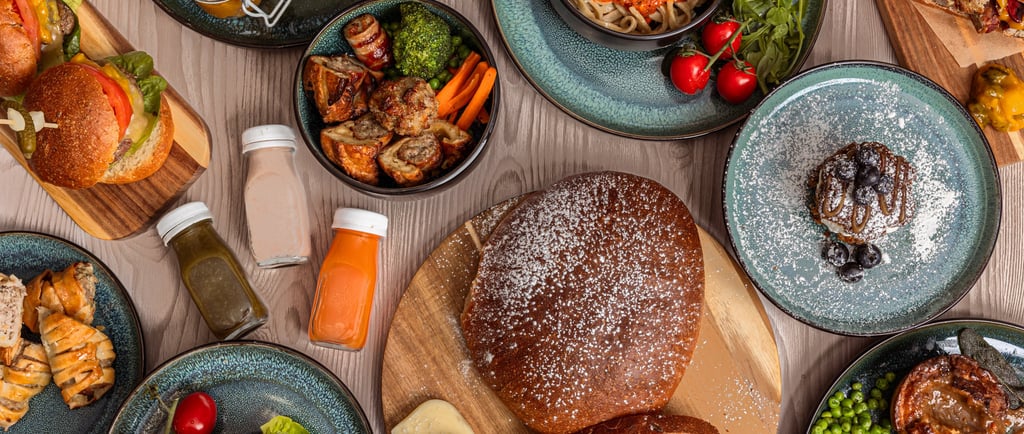
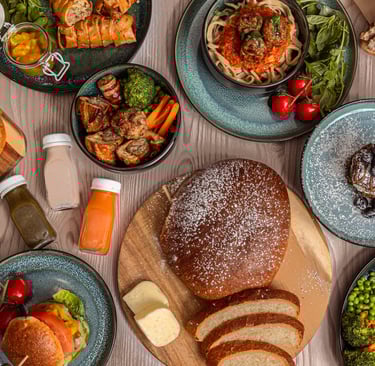
Fork From Farm: Designing Food Around What People Need
Grow it. Process it. Package it. Sell it. Eat it.
It’s a neat story. It sounds logical. It sounds efficient.
But it hides a fundamental flaw:
It starts in the wrong place.
Because the farm doesn’t exist to express its own potential. It exists to feed people. And people don’t buy crops.
They buy outcomes.
They buy dinner.
They buy convenience.
They buy familiarity.
They buy nutrition (even when they don’t call it that).
They buy something that fits their life, their budget, and their taste expectations.
So if we want to build a better food system, we need to invert the logic.
Not farm to fork...Fork from farm.
Start with what people need — then work backwards.
The fork is the specification
In most industries, product design begins with the user.
Food is one of the few sectors where we often pretend the opposite is true.
We treat supply as destiny:
“This is what we grow.”
“This is what we harvest.”
“This is what we can process.”
“So this is what people will eat.”
But consumers don’t eat what exists....They eat what works.
And “works” is a demanding brief:
it has to taste good
it has to feel right
it has to be affordable
it has to fit into habits
it has to be safe
it has to be available consistently
it has to deliver real nutrition in familiar formats
That’s the fork...That’s the spec.
And when you start there, you stop building food systems around what’s easiest to produce — and start building them around what’s actually needed.
The real problem isn’t waste. It’s under-utilisation.
Waste is usually framed as a moral failure.
Something is thrown away. Something is “lost.” Something is “not valued.”
But that framing misses the point.
In modern food systems, waste is often just a symptom of something more structural: We’ve built supply chains that can’t fully use what already exists.
Not because the material isn’t good. But because it doesn’t fit the system:
wrong format
wrong size
wrong spec
wrong shelf-life
wrong processing behaviour
wrong economics
wrong route to market
The issue isn’t that food is wasted....It’s that it’s not engineered into value. And that’s a solvable problem.
At UPP, we focus on a different question: How do we fully utilise what we already grow — and turn more of it into food people actually want to eat?
Not as a side project.
As the core design principle.
Fork from farm changes the optimisation target
Most food systems have been optimised around three things: cost, safety, and scale.
That optimisation delivered real progress.
It made food affordable. It made food safe. It made food reliable.
But now the brief has expanded.
The system is being asked to deliver more:
higher nutrition density
more resilience
more supply security
more efficiency
more stable economics for farmers
and fewer trade-offs
The old approach tries to solve this by adding more complexity.
New ingredients. New supply chains. New consumer behaviours. New formats.
But complexity doesn’t scale cleanly in food.
The better approach is to upgrade the system we already have.
And that starts by rethinking directionality.
What happens when you build backwards from the consumer?
When you design from the fork backwards, three things become possible at once.
1) National food security improves: Food security isn’t just about growing more. It’s about converting more of what we already grow into stable, saleable, nutritious food. If a country can take a higher percentage of its domestic crops and turn them into:
consistent ingredients
predictable inputs for manufacturing
scalable products people actually buy
…then the system becomes less exposed to shocks.
Less dependency.
Less volatility.
More resilience.
Food security is often treated as a geopolitical issue. But a lot of it is simply an engineering issue: How efficiently can you convert what exists into food that fits demand?
2) Consumers get more nutritious food - without needing to change:. There’s a persistent myth in food innovation that better nutrition requires better behaviour. That if we want healthier outcomes, consumers need to:
cook more
read labels
change habits
“make better choices”
Sometimes they will. But at population scale, behaviour change is a weak lever.
The high-impact route is the opposite: Keep the products. Upgrade the inputs.
That means nutrition delivered through the formats people already buy and trust.
More fibre.
More micronutrients.
More functionality from real ingredients.
Not as a new category. As an upgrade path.
That’s how change compounds.
3) Farmers become more financially sustainable. Farm economics don’t collapse because farmers aren’t productive. They collapse because value capture is thin - and too much of what’s grown is trapped in low-value channels. When utilisation is low, margin disappears into:
grading and rejection
price compression
commodity exposure
limited end markets
low flexibility in what can be sold
But when you can convert more of what is grown into ingredients that manufacturers can actually use - at scale - something shifts.
The farmer stops being a price-taker for a narrow output.
And starts being part of a system that creates value from a broader slice of the crop.
That’s not charity.
That’s better system design.
This is what UPP is building: utilisation as a strategy
At UPP, we don’t see ourselves as a “waste solution.”
Waste is the headline.
Utilisation is the mechanism.
We take vegetables that are under-utilised — not because they’re undesirable, but because they’re hard to integrate — and we turn them into ingredients that work inside real manufacturing.
That means designing for:
spec consistency
supply reliability
manufacturability
nutritional value
compatibility with existing formats
and commercial reality
Not reinvention. Upgrade.
Because the system doesn’t need a lecture. It needs tools.
A better question than “what are we wasting?”
The traditional sustainability conversation starts with guilt: “How much are we wasting?”
The better conversation starts with design: "How much of what we already grow can we turn into food that people actually need?"
That shift matters.
Because it doesn’t just reduce waste. It increases:
food security
nutrition access
farm resilience
manufacturing efficiency
and the ability to scale change without breaking the system
That’s fork from farm.
Not a slogan.
A direction of travel that actually works. And that is what we at UPP are delivering.
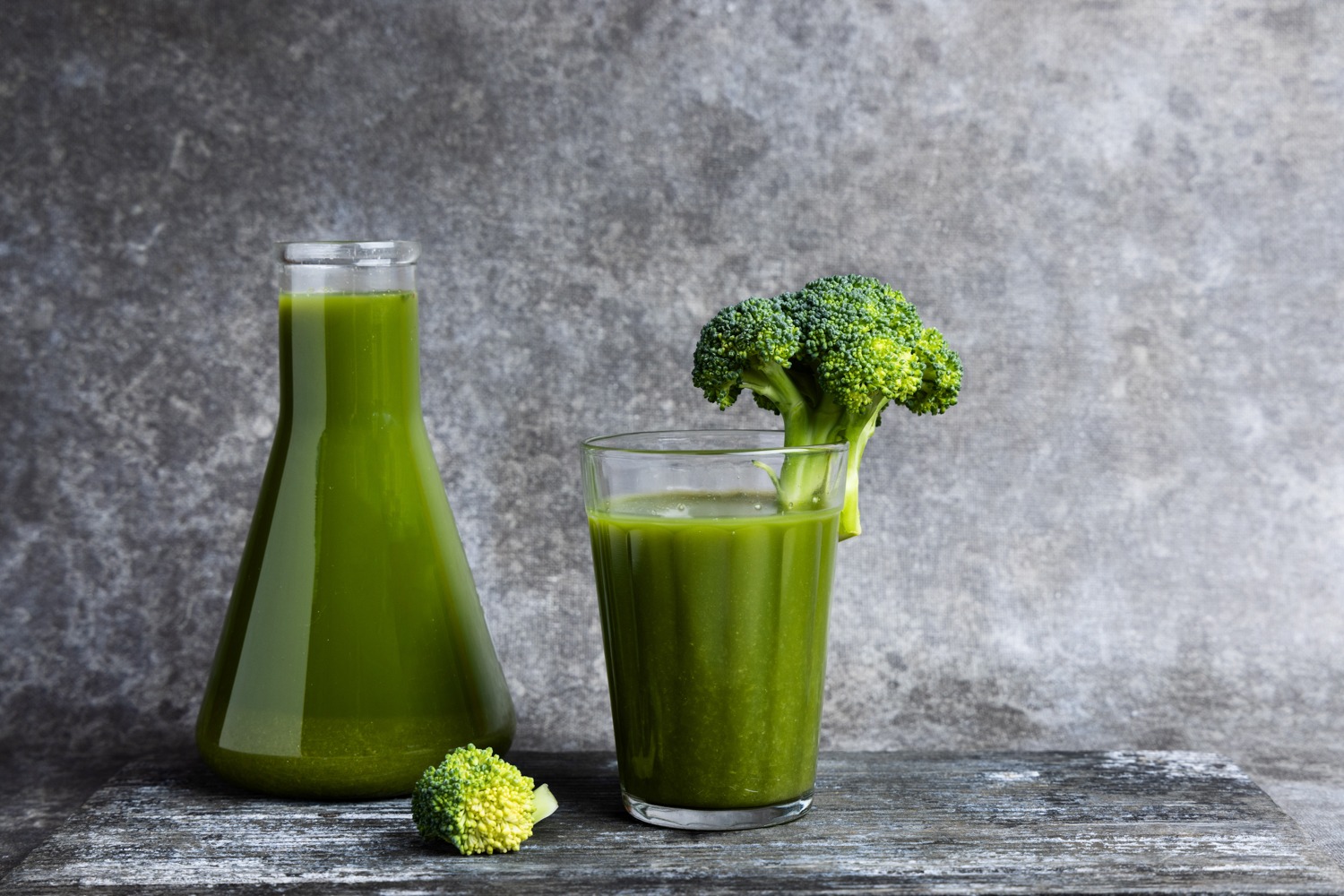
Feeding the next phase of food: What GLP-1s reveal about nutrition, not medication
GLP-1 medications are changing how people eat - whether the food system is ready or not. Drugs like Ozempic and Wegovy are often discussed through the lens of weight loss or healthcare costs. But from a food systems perspective, they reveal something more fundamental: how poorly aligned much of today’s food supply is with the way people actually need to eat.
Reduced appetite.
Smaller portions.
Higher sensitivity to texture and satiety.
When people eat less, what they eat matters more.
This isn’t a niche issue. As GLP-1 use expands - and as many consumers eventually taper or come off medication - the demand for foods that are nutrient-dense, gentle on digestion, and affordable will only grow.
The opportunity is not to medicalise food.
It is to make food do its job better.
Smaller meals expose a big problem
For decades, food formulation has optimised for:
volume
palatability
cost per calorie
That model works when consumption is high. It breaks down when it isn’t.
When people eat smaller portions - whether due to GLP-1s, ageing populations, or shifting health priorities - foods that are:
low in fibre
low in protein
highly fractionated
nutritionally diluted
stop making sense.
The next phase of consumer food is not about eating less food. It is about eating more nutrition per bite.
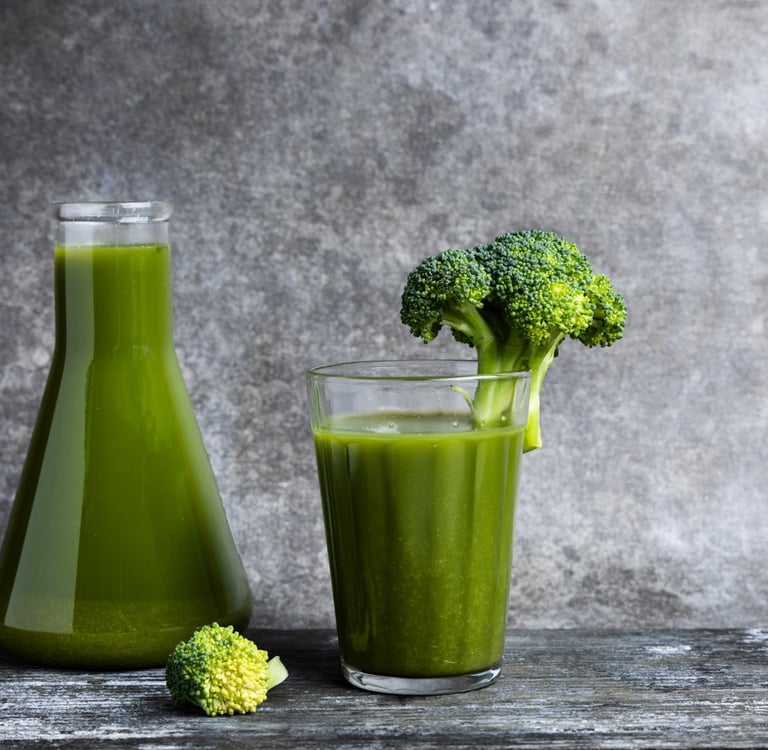
Broccoli is a nutritional outlier - not a trend ingredient
Broccoli is not fashionable.
It is not novel.
It does not need a story.
It is, however, unusually dense in:
fibre
protein (relative to vegetables)
micronutrients
bioactive compounds
And yet, a significant proportion of the broccoli grown in Europe and the UK never enters the food system at all.
Leaves, stems, and surplus florets are routinely left in fields or diverted to low-value pathways - not because they lack nutrition, but because the system is not designed to use them. That is where opportunity lives.
Nutrition density without asking consumers to “try harder”
One of the persistent mistakes in food innovation is assuming that better nutrition requires:
behaviour change
premium pricing
unfamiliar ingredients
In reality, most consumers — including those on or coming off GLP-1 medication — want food that is:
familiar
affordable
easy to tolerate
quietly more nutritious
Broccoli-derived ingredients offer exactly that.
When converted into functional protein and fibre ingredients, they can:
increase satiety in smaller portions
support digestive tolerance
deliver nutrition without heaviness
integrate into existing food formats
No new habits required.
Coming off GLP-1s: where food matters most
Much of the public conversation focuses on starting GLP-1s. Less attention is paid to what happens after.
As people reduce or discontinue medication, food becomes the primary stabilising force:
maintaining satiety
supporting metabolic health
preventing rebound through nutrition, not restriction
This is where nutrient density beats calorie control. Foods that deliver protein and fibre together - in familiar, everyday formats - help bridge the gap between medical intervention and long-term eating patterns.
Not as “diet food”.
As better food.
Why affordability determines whether this scales
Nutrition that only works at a premium price point doesn’t scale.
At UPP, our focus is not on extracting novelty from broccoli - it is on extracting value from what is already grown and wasted.
By using under-utilised broccoli biomass:
farmers gain a new income stream
ingredients are lower cost than many imported alternatives
manufacturers improve margins rather than sacrificing them
consumers access better nutrition without paying more
That matters — because GLP-1 use is not limited to affluent consumers, and neither is the need for nutritious food.
System change, not product theatre
The most important shift here is upstream.
Instead of designing products around consumer willpower, the system can:
reformulate existing foods to be more nutrient-dense
improve satiety without increasing portion size
reduce reliance on globally sourced isolates
quietly align food with emerging consumption patterns
This is low-friction change — the kind that actually reaches scale.
Broccoli as infrastructure, not a hero ingredient
UPP does not position broccoli as a superfood or a solution in isolation. We treat it as infrastructure:
a crop already grown at scale
with nutrition already proven
currently under-utilised due to system inefficiency
By turning wasted broccoli into functional food ingredients, we connect:
agriculture
processing
formulation
and health outcomes
Without asking consumers to think about any of it.
A food system ready for what’s next
GLP-1s didn’t create the need for better food. They exposed it.
As people eat less - by choice, by health, or by circumstance — the food system has to respond with:
higher nutritional yield
better use of what we already grow
and economics that work for everyone involved
Broccoli isn’t the future because it’s new.
It’s the future because it’s already here — and we haven’t been using it properly.
Better for farmers.
Better for producers.
Better for people.
Better for the planet.
That’s not a dietary philosophy.
It’s a systems outcome.
Read more here.

The Fibre Factor: Why “eat more fibre” won’t scale unless we change how food is made
Fibre is having a moment.
Not in the way protein did - with a thousand new SKUs and a marketing arms race — but in a quieter, more structural way. It’s re-entering the mainstream conversation as something we’ve lost, something we need, and something modern diets are failing to deliver.
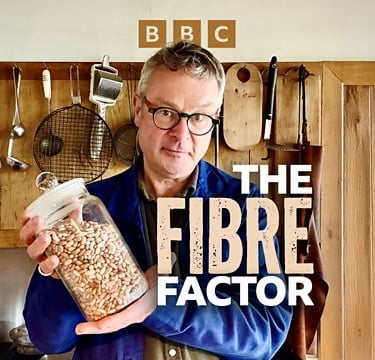
The BBC series The Fibre Factor (BBC Radio 4 - The Fibre Factor), presented by Hugh Fearnley-Whittingstall, captures that shift well. Across five episodes - from Munching Plants to Manufacturing through to fibre fortification, beans, and “fibremaxxing” - it asks a simple question with uncomfortable implications:
If fibre is so foundational to health, why are we eating so little of it?
The answer isn’t ignorance. It’s system design.
We didn’t “forget” fibre. We engineered it out.
The first episode’s historical arc is useful because it reframes fibre not as a new discovery, but as a baseline that modern food quietly moved away from.
For most of human history, diets were structurally fibre-rich because they were built around whole plants: roots, leaves, seeds, legumes. Fibre wasn’t a target. It was a default.
Then industrialisation did what industrialisation always does: it optimised for throughput, shelf life, uniformity and cost. And in the process, fibre became collateral damage.
Refining grains removes bran. Fractionating plants separates function. Ultra-processing turns whole food architecture into inputs and additives.
Nobody set out to create a low-fibre world. It’s simply what happens when you optimise food for industrial efficiency without simultaneously optimising for nutritional outcomes.
“Fibremaxxing” is a signal — but behaviour change is still a weak lever
Episode 2 introduces “fibremaxxing”, the online trend pushing people to deliberately chase fibre targets the way they once chased protein.
That’s interesting - not because trends solve systemic problems, but because they reveal a rising demand for tools people can act on. The public is looking for a new anchor: not restriction, not purity, but something measurable that maps to health.
But even if fibremaxxing is here to stay, it won’t close the gap at population scale.
Most people won’t track fibre long-term. They won’t weigh beans, count grams, or redesign their meals every day. Not because they’re lazy, but because food decisions sit inside real constraints: time, budget, habit, family preferences, and what’s available. This is why behaviour change remains unreliable as a primary strategy.
If we want fibre intake to rise meaningfully, it has to happen upstream — through how everyday food is formulated.
The real question isn’t “can we eat more fibre?” It’s “can we build fibre back into defaults?”
Episode 3 goes directly to the core issue: the foods that dominate modern diets — bread, pasta, rice, packaged meals — are often fibre-poor by design. So the problem isn’t solved by telling people to eat like nutritionists.
It’s solved by improving the foods people already buy.
This is where the industry’s next phase becomes clear:
Can we fortify staples without compromising taste and texture?
Can ultra-processed foods ever become fibre-rich?
Can we do it without raising cost, breaking supply chains, or adding ingredient-list complexity?
These aren’t consumer questions. They’re manufacturing questions.
And they point to the same conclusion we keep coming back to: low-friction reformulation is the only approach that scales.
Because reformulation doesn’t fail due to lack of ambition. It fails due to friction: process disruption, sensory risk, procurement uncertainty, and complexity that slows decision-making.
Beans are the obvious answer — and the hardest one to mainstream
Episode 4 focuses on beans and pulses, and it’s hard to argue with the case: beans are fibre-rich, affordable, nutritionally dense, and comparatively low-impact.
They are also, in the UK at least, under-consumed outside a narrow set of formats (the baked bean exception is telling).
This is a classic example of a food that makes perfect sense on paper but struggles in practice. Not because beans are “bad”, but because the system around them isn’t built to make them effortless.
You can’t scale fibre by asking the whole population to suddenly love lentils.
You scale fibre by embedding it into familiar formats — the foods people already eat — without requiring a cultural conversion.
The future of fibre is not a new diet. It’s better formulation.
By the final episode, the series moves toward solutions: activism, education, cooking, and community-level change.
All of that matters. But the biggest lever still sits upstream.
If the UK is serious about addressing obesity and diet-related disease, fibre has to stop being a personal responsibility and start becoming a system outcome.
That means ingredients and processes that make it easier for manufacturers to:
increase fibre content without wrecking sensory performance
simplify formulations rather than “add another additive”
keep products affordable
work inside existing lines and supply chains
This is exactly why fibre is not just a nutrition story. It’s an ingredient infrastructure story.
At UPP, we think about fibre the same way we think about protein and sustainability: not as a claim, but as a design constraint. The question is never “how do we convince people to eat differently?”
It’s “how do we improve everyday food without asking people to try harder?”
Because when you change what goes into food — quietly, at scale — you change what comes out of the system.
And that’s how fibre stops being a trend, and becomes a default again.


Why low-friction reformulation is now a strategic imperative for food producers
For much of the past decade, reformulation has been framed as a question of innovation.
New ingredients.
New processes.
New claims.
In practice, however, reformulation rarely fails because food producers lack ambition. It fails because it introduces too much friction into systems that are already under pressure.
Today’s manufacturers are balancing cost volatility, labour constraints, Scope 3 emissions targets, retailer scrutiny, and increasingly conservative capital environments - all while maintaining taste, texture, safety, and margin. In that context, the most valuable ingredient innovations are not those that promise transformation, but those that enable change without disruption.
Low-friction reformulation is no longer a “nice to have”. It is becoming a strategic requirement.
The hidden cost of reformulation friction
Every reformulation introduces risk - but not all risks are equal.
High-friction reformulation typically brings some combination of:
changes to existing processing lines
new allergen or regulatory complexity
uncertain supply at scale
unproven sensory performance
additional approval cycles with retailers
Each one compounds internal cost and slows decision-making. Even when the sustainability case is strong, these frictions often stall progress long before products reach shelf.
This is why many reformulation programmes quietly revert to incremental tweaks, rather than the step-changes that sustainability, resilience, and cost pressures increasingly demand.
Why the industry’s constraints have changed
What’s different now is not consumer intent — it’s operating reality.
Food producers are operating in an environment where:
ingredient volatility is structural, not cyclical
labour availability is constraining agricultural and processing inputs
Scope 3 accountability is shifting from aspiration to audit
capital discipline matters more than speed
In this environment, reformulation strategies that rely on novel biology, bespoke infrastructure, or fragile supply chains are harder to justify - even if they are technically impressive. The winning strategies are those that reduce risk while delivering change.
Low-friction reformulation: what it actually means
Low-friction reformulation is not about avoiding innovation. It is about designing innovation around existing food systems, rather than asking food systems to adapt around innovation.
In practical terms, it means ingredients that:
integrate into existing manufacturing processes with minimal modification
behave predictably across standard unit operations (hydration, cooking, freezing, extrusion, etc.)
arrive with procurement-grade documentation: traceability, allergen clarity, country of origin, and certification
are available at meaningful scale from reliable, regionally anchored supply
reduce environmental impact without introducing consumer unfamiliarity
This is not a compromise position. It is a deliberate strategy to unlock adoption at speed.
Why system-level thinking matters more than ingredient novelty
One of the consistent lessons across food innovation is that isolated optimisation creates downstream problems.
A low-carbon ingredient that requires a fragile supply chain creates operational risk.
A cost-effective input that introduces new allergens increases approval friction.
A novel protein that excites R&D but stalls in procurement delivers no impact at scale.
By contrast, system-level approaches - where harvest, processing, supply assurance, and compliance are considered together - reduce friction before it appears.
This is why integration upstream matters. When ingredients are designed from the outset to align with how food is actually grown, processed, audited, and sold, reformulation becomes a commercial decision, not a speculative one.
Reformulation without consumer trade-offs
Crucially, low-friction reformulation also reduces consumer risk.
Many sustainability-led innovations ask consumers to change behaviour: accept unfamiliar ingredients, tolerate different textures, or pay a premium for virtue.
Low-friction approaches avoid that trap.
When reformulation focuses on familiar crops, familiar formats, and behind-the-scenes improvements - such as better utilisation of existing agricultural outputs - the consumer experience remains stable, even as the system improves.
That alignment matters. The fastest-scaling changes in food are rarely the most visible ones.
The strategic upside for food producers
For producers, the benefits of low-friction reformulation compound:
Faster internal alignment between technical, procurement, and commercial teams
Shorter approval cycles with retailers and brand partners
Lower execution risk at scale
Credible Scope 3 reductions tied to operational change, not offsets
Optionality to reformulate further without rebuilding infrastructure
In an environment where resilience is as important as differentiation, these advantages matter.
Closing thought: progress that fits the system
The food system does not need more disruption for its own sake. It needs progress that fits.
Low-friction reformulation recognises a simple truth: the fastest way to change the food system is not to fight its constraints, but to design within them — and quietly remove them over time.
For food producers under pressure to deliver cost control, sustainability, and reliability simultaneously, that approach is not conservative.
It is pragmatic.
It is scalable.
And increasingly, it is the only way change actually happens.
Read more here.


Yuka: The reformulation pressure food producers didn’t vote for (and why UPP is built for it)
Food companies are used to scrutiny. But the source of scrutiny is changing.
For most of the modern food system, legitimacy came from compliance: ingredient declarations, nutrition panels, and the fact a product met regulatory requirements. That framework still matters. But it no longer determines trust.
A growing share of consumers are outsourcing judgement to apps that sit outside the regulatory system entirely. One of the most influential is the French app Yuka.
It’s often described as a “food scanning” app. In practice, it functions more like a parallel credentialing system — one that is increasingly shaping what gets bought, what gets stocked, and what gets reformulated.
And that matters directly to the kind of upstream ingredient work UPP exists to enable.
A small app with outsized reach
Yuka launched in France in 2017. It now has more than 75 million users across 12 countries and 5 languages. In its home market, it’s used by roughly 1 in 3 adults (22 million users). In the US — where it launched in 2022 — it has reached 22–25 million users, and is now its largest and fastest-growing market, adding around 600,000 sign-ups per month.
It has processed more than 8.3 billion product scans to date (including 2.7 billion scans in 2024 alone), and built a database of 5 million product ratings across food and personal care.
The more important point is not the exact numbers. It’s what the numbers represent: Yuka has become a default layer of interpretation between the shelf and the shopper — without relying on traditional marketing or advertising. Growth is largely word-of-mouth.
That’s a sign of structural adoption, not a niche trend.
How Yuka scores food (and why it creates pressure)
Yuka assigns products a score from 0–100. The methodology is transparent in structure but opinionated in weighting:
60% nutritional quality, based on Nutri-Score
30% additives, with “high-risk” additives hard-capping a product at 49/100
10% organic dimension
Users don’t just see a score. They see a simple judgement (“excellent”, “good”, “mediocre”, “poor”) plus suggested alternatives.
This is where the commercial impact compounds. Yuka doesn’t just inform consumers. It redirects demand.
A product can be fully compliant and still become commercially fragile if it is scored poorly by a system consumers increasingly trust more than packaging claims or regulatory thresholds.
The part most manufacturers underestimate: the feedback loop
Yuka’s most consequential feature isn’t the rating.
It’s the mechanism that turns consumer dissatisfaction into direct reformulation pressure.
From inside the app, users can message brands with one click, sharing low product scores and urging reformulation. That turns millions of consumers into a distributed, always-on feedback loop.
Historically, reformulation pressure came from a small number of places:
regulators
retail buyers
internal nutrition targets
NGOs and media cycles
Yuka adds something different: persistent, product-specific scrutiny at the point of purchase, applied at scale, and repeated every day.
For producers, that changes the cost of inaction. It also changes the timeline. This isn’t a once-a-year strategy discussion. It’s a live operational risk.
Why this matters: reformulation is no longer just innovation. It’s defence.
Reformulation is often framed as innovation: new ingredients, new claims, new launches.
In reality, reformulation tends to fail for a more basic reason: it introduces too much friction into systems that are already under pressure.
Food manufacturers are balancing cost volatility, labour constraints, retailer scrutiny, Scope 3 accountability, and increasingly conservative capital environments — while maintaining taste, texture, safety, and margin.
High-friction reformulation introduces compounding risks: changes to processing lines, new allergen or regulatory complexity, uncertain supply at scale, sensory uncertainty, and additional approval cycles with retailers.
This is why many reformulation programmes quietly revert to incremental tweaks, even when bigger changes would be strategically smarter.
Yuka accelerates that reality. It makes the downside of “good enough” more visible.
Why this connects directly to UPP
At UPP, we’ve always assumed the food system won’t change through consumer behaviour alone.
Public health already tells us that behaviour change is unreliable — even when the stakes are personal health. So it’s unrealistic to expect consumers to overhaul their diets to reduce carbon emissions, improve nutrition, or avoid ultra-processing.
That doesn’t make consumers the problem.
It makes system design the problem.
Yuka doesn’t contradict that view. It reinforces it — from the opposite direction.
Consumers aren’t being asked to become perfect. They’re being given a tool that makes certain products feel harder to trust, and nudges them toward “cleaner” formulation logic. Whether or not you agree with Yuka’s weighting, the direction of travel is clear:
shorter ingredient lists
fewer additives that sound synthetic or unnecessary
more nutrition per bite
more explainable inputs
The industry can treat this as a communications challenge, but it’s more accurately a formulation and systems challenge.
And this is where UPP’s model becomes relevant.
UPP works upstream, taking under-utilised vegetables and converting them into food-grade protein and fibre ingredients that integrate into mainstream manufacturing. The goal isn’t to create novelty. It’s to remove friction.
Because the fastest way to improve food isn’t to ask consumers to change what they buy. It’s to improve what goes into the products they already buy — quietly, at scale, without disrupting production reality.
Low-friction reformulation isn’t a “nice to have” anymore. It’s becoming a strategic requirement.
What “Yuka-proofing” actually looks like
For most producers, the practical response to Yuka isn’t to optimise for a perfect score. It’s to reduce the surface area of vulnerability:
simplify ingredient systems where possible
replace fragmented additive stacks with more integrated, crop-derived functionality
increase protein and fibre density without making products heavier or harder to tolerate
improve label familiarity without sacrificing performance
In other words: reformulate in ways that don’t break the system.
This is exactly why familiarity and integration matter. Ingredients that behave predictably in standard manufacturing processes, arrive with procurement-grade documentation, and can replace multiple functions at once are more adoptable than technically impressive solutions that introduce operational risk.
Closing thought: a parallel credentialing system is now in play
Yuka has created a parallel credentialing system that influences consumer choice regardless of what regulators permit.
For food producers, the question isn’t whether Yuka’s scoring is fair.
It’s whether your products can withstand scrutiny from systems you don’t control.
In that environment, the winning strategy isn’t loud disruption. It’s quiet upstream improvement: better nutrition density, fewer unnecessary additives, simpler ingredient logic, and reformulation that fits existing manufacturing constraints.
That is what UPP is built to enable.
Quiet change. Upstream. At scale.


The most advanced taste tool we have is still a Chef
Some universities are trying to build an artificial tongue - a sensor system that can “measure” mouthfeel. And to be fair, the ambition makes sense. Mouthfeel is hard to quantify, and harder still to replicate at scale.
But at UPP, we back the Mark 1 human, or “Joe”.
Because food isn’t for sensors. It’s for people.
And if you want to innovate in food - really innovate, in a way that survives the journey from idea to supermarket shelf - you need to keep people at the heart of the process. That starts with the person who understands the eating experience better than anyone else: the chef.
The chef is the hero - not the lab
There’s a myth that food innovation is mainly about technology: new processing, new ingredients, new data, new optimisation.
In reality, the breakthrough usually comes from a much simpler place:
A chef tasting something and saying, “Not yet.”
That moment matters because it’s where the real standard is set. Not “does it meet the spec?” but:
Does it feel right when you chew it?
Does it eat like food?
Would you actually want a second bite?
A supermarket product doesn’t win because it’s clever. It wins because it’s comfortably familiar - and quietly better.
That’s the chef’s territory.
The creation journey: from idea to shelf
When we build a new meal concept for retail, it starts the same way most great food does: with a simple question.
What are we trying to make people feel when they eat this?
Not nutritionally. Emotionally. Practically. In the real world.
Because the moment it lands in someone’s basket, the rules change. It’s no longer a prototype. It’s dinner on a Tuesday. It has to work when someone is tired, hungry, price-sensitive, and not interested in being educated.
So the chef begins building - testing flavour, texture, aroma, and structure. The goal isn’t novelty. It’s confidence.
And this is where “mouthfeel” stops being a buzzword and becomes a make-or-break reality.
Mouthfeel is where good intentions go to die
You can have the best nutrition profile in the world and still fail on shelf if the eating experience is wrong.
Too dry.
Too grainy.
Too bouncy.
Too “engineered.”
Consumers don’t describe it that way, of course. They just say:
“I didn’t like it.”
Or worse - they don’t say anything at all, and they simply don’t buy it again.
That’s why mouthfeel is one of the highest-leverage parts of product development. It’s also why we don’t believe the solution is to remove humans from the loop.
We don’t want food assessed by something that simulates a tongue.
We want it assessed by the people who actually eat it.
Technology matters - but it plays a supporting role
UPP is technology-enabled, and we’re proud of that. We work upstream, turning under-utilised vegetables into functional ingredients that help food manufacturers improve nutrition, efficiency, and resilience.
But we’re clear-eyed about something: Technology doesn’t make food good. People do.
Our ingredients are designed to integrate into real manufacturing and real products - but they still have to pass the same test every time:
Does it taste good? Does it feel right? Does it work as food?
That’s why chefs are not an optional extra in innovation. They are the decision-makers who protect the eating experience as products scale.
Keeping people at the heart of innovation
The food industry is under pressure from every angle: cost, labour, emissions, reformulation, protein targets, fibre gaps, clean label scrutiny.
In that environment, it’s tempting to treat product development like a maths problem.
But food isn’t just a system of inputs. It’s a human experience.
And the fastest way to build the wrong future is to optimise everything except the thing that matters most: whether people actually enjoy eating it.
That’s why we keep coming back to the same principle:
Food is for people. So people belong at the centre of innovation.
Not as an afterthought. Not as a “consumer test” at the end.
Right at the beginning - with a chef, a spoon, and an uncompromising standard for what belongs on a plate.
Closing thought: trust the classical approach
We’re not against artificial tongues - they may well become useful tools for R&D.
But the best instrument we have for building food that works in the real world is still the simplest: A chef tasting, refining, and insisting that it eats like something you’d actually want to buy again.
The Mark 1 human remains undefeated.
We are not about restricting progress – we are leading the charge on utilisation and hybridisation – it’s about blending emerging technologies with classic approaches. Like everything else in food, it’s all about getting the blend right. And in a world obsessed with engineering the future of food, we think that’s worth remembering.
If people won’t change their diet to save their lives, why would they change it to save the planet?
For years, much of the food sustainability debate has rested on an uncomfortable assumption: that consumers will change first.
Eat differently.
Buy differently.
Pay more.
Care more.
Sometimes they do. Often, they don’t. And that’s not because people are ignorant or indifferent - it’s because food choices are made inside real constraints.
When there is too much month left at the end of the pay cheque, sustainability becomes a luxury. When time, money, and familiarity matter, people default to what works. That reality doesn’t make consumers the problem. It makes the system the problem.
At UPP, we don’t judge consumer behaviour - because judging behaviour doesn’t change outcomes. Designing systems that work within reality does.
Behaviour change is a weak lever - system change is a power enabler.
Public health has already taught us this lesson: If people won’t reliably change their diets to improve their own health, it is unrealistic to expect them to overhaul their food choices to reduce carbon emissions - especially when the alternatives are unfamiliar, more expensive, or harder to trust.
The food system cannot decarbonise by asking millions of households to behave differently every day. It can decarbonise by changing what goes into food: quietly, upstream, and at scale.
That is where leverage actually sits.
Waste is not a moral failure - it’s a design failure
Across UK and European agriculture, vast volumes of nutritious vegetables are grown every year and never enter the food system.
Not because they are unsafe.
Not because they lack nutritional value.
But because harvesting them is labour-intensive, uneconomic, or poorly integrated with downstream demand.
Those crops are left in fields or diverted to low-value uses, while food manufacturers import ingredients from halfway around the world to perform the same functions.
That isn’t a consumer choice problem.
It’s a systems design problem.
UPP exists to fix that. Using what already exists - before growing more. Our approach starts with a simple question: “What if we used the food we already grow — but don’t currently use - to replace ingredients that travel thousands of miles?
UPP works with wasted and under-utilised vegetables: grown in the UK where possible, and in Spain during winter when domestic supply isn’t viable
We don’t compete with fresh markets.
We don’t displace food from plates.
We work with plants that would otherwise be left to rot.
From those crops, we produce protein and fibre ingredients that:
displace globally sourced inputs
deliver lower CO₂ even if grown for purpose
and do so at a cost that works for real food systems
This is not about niche substitution. It’s about mainstream replacement. Sustainability that pays for itself scales faster. One of the reasons sustainability efforts stall is simple: they cost money. UPP’s model flips that logic. Because our ingredients are derived from side-streams and under-utilised crops:
farmers gain a new income stream from material that previously had little or no value
producers gain lower-cost ingredients that integrate into existing processes
retailers gain credible Scope 3 reductions tied to operational change
consumers get nutritious food at lower or equivalent prices
Margins improve instead of eroding. That matters - because the changes that last are the ones that make commercial sense. Technology is the enabler - not the point.
Yes, this is technology-enabled.
Yes, it’s patent-protected.
Yes, it involves automation, processing innovation, and system integration.
But technology is not the goal. We are not developing technology for its own sake. We are developing technology to achieve an outcome. Every decision is anchored to a single question:
Does this make the system work better - economically and environmentally — without asking people to behave differently?
If the answer is no, it doesn’t scale.
Quiet change beats loud disruption
UPP’s ingredients don’t ask consumers to learn new words, adopt new diets, or pay a premium for virtue. They sit behind the scenes - improving food by changing how it is made, not how it is marketed. That is why this approach works:
familiar crops
familiar foods
familiar buying behaviour
But with lower waste, lower emissions, and better economics embedded upstream.
Better for everyone — by design
This is systems-thinking applied to food:
Better for planters (farmers): new revenue, less waste, more resilient economics
Better for producers: lower costs, lower risk, low-friction reformulation
Better for people: nutritious, affordable food without behavioural trade-offs
Better for the planet: emissions reduced at source, not offset after the fact
But
No judgement.
No guilt.
No unrealistic assumptions about how people “should” behave.
Just a better system — designed to work in the real world.
Because the fastest way to change what people buy is not to ask them to change at all - it’s to change the system behind the shelf.
Read more here.
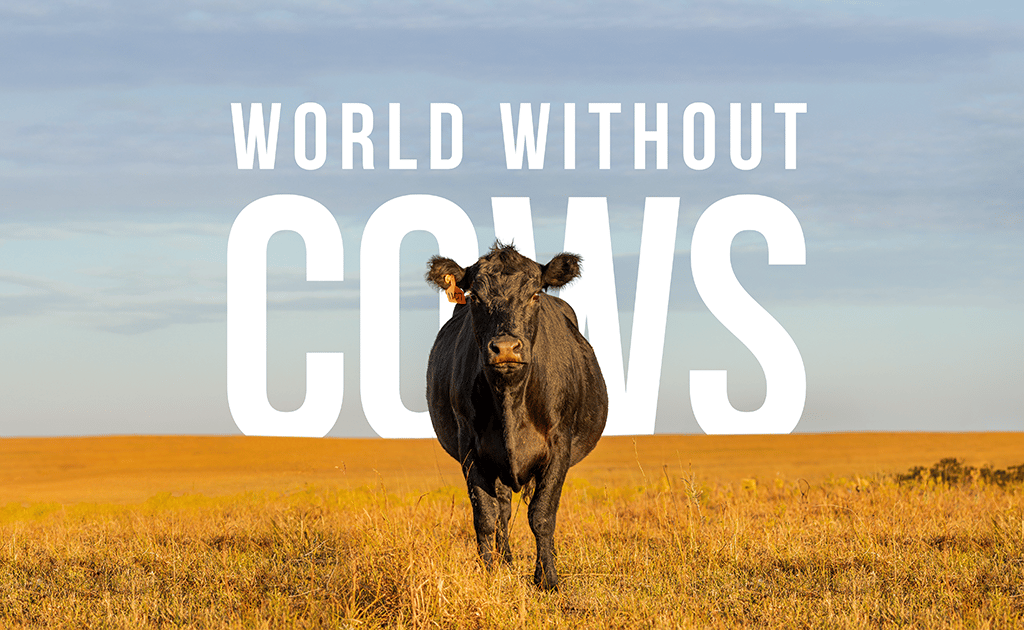

A World Without Cows: What happens when we optimise the wrong variable?
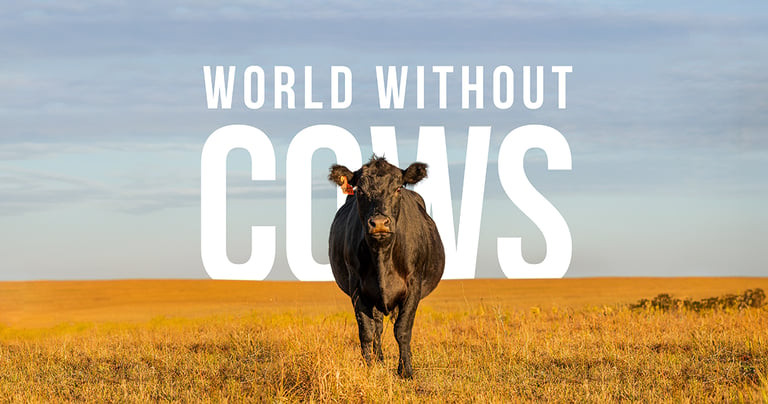
The film World Without Cows (https://worldwithoutcows.com/?) asks a deceptively simple question: “what would the world look like if cows disappeared?” It’s based on a white paper that appeared in Nutrition (https://www.livestockresearch.ca/uploads/cross_sectors/files/A-World-Without-Cows-Imagine-Waking-Up-One-Day-to-7.pdf) – the story is worth reading (https://worldwithoutcows.com/cows-disappeared-scientific-paper-film/)
It’s an emotionally charged premise because cows sit at the intersection of so many modern tensions - climate, land use, food security, rural livelihoods, nutrition, culture, and identity. But what makes the film valuable is not that it defends cattle uncritically, or dismisses the environmental case against them. It highlights something more important: the risk of treating complex food systems as if they have single-variable solutions.
In a moment where “remove the cow” is sometimes presented as a shortcut to sustainability, World Without Cows pushes back with an uncomfortable reminder: systems don’t behave like spreadsheets.
And food systems rarely reward simplification.
The temptation of the clean narrative
Food sustainability debates often gravitate toward clean, binary stories:
cows are bad
plants are good
methane is the problem
replacement is the answer
That narrative is emotionally satisfying because it offers clarity. But it can also become a trap. Because the real question is not whether cows have impact. They do. The question is what happens after we remove them - and whether the “solution” creates second-order consequences that are worse than the original problem.
This is where the film’s premise becomes useful: it forces us to consider the system response, not just the headline metric.
Behaviour change is a weak lever. System design is the power lever.
One of the biggest mistakes in sustainability strategy is assuming consumers will change first.
Eat differently.
Pay more.
Accept unfamiliar textures and ingredients.
Rebuild habits.
But public health already tells us how this goes: if people won’t reliably change their diet to improve their own health, it’s unrealistic to expect them to change it to reduce emissions - especially under cost pressure.
So if the goal is real-world impact at scale, the solution can’t depend on everyone making perfect choices every day.
It has to come from upstream changes that make the default food system work better - without requiring the public to become different people.
That is why we focus on system change, not food ideology.
Replacement strategies often fail because they introduce friction
The film indirectly exposes another commercial reality: even when the sustainability case for “cow-free” food is strong, replacement is hard to execute at scale. Because replacement strategies often come with high friction:
new supply chains
new processing requirements
new sensory compromises
new approval cycles
higher costs
unfamiliar ingredients and consumer scepticism
In practice, reformulation doesn’t fail due to lack of ambition. It fails because it introduces too much disruption into systems already under pressure.
That’s why “low-friction reformulation” matters: ingredients and approaches that reduce emissions, cost, and risk without breaking manufacturing reality.
A world without cows still needs protein, function, and affordability
Remove cows, and you don’t just remove emissions.
You remove a huge amount of:
high-quality protein
functional fat systems
nutrient density
agricultural value creation
rural economic stability
The question then becomes: what fills the gap?
Not in theory - in supermarkets, school meals, hospitals, and mainstream ready meals. At price points that normal households can afford.
And this is where many “cow-free” narratives become fragile: they assume the alternative system is already built, already scalable, already affordable, and already trusted.
It isn’t.
The better question: how do we reduce impact without breaking food?
This is why the most scalable sustainability strategies in food are rarely ideological. They are operational.
They focus on efficiency - using what we already grow more effectively - so that sustainability becomes a by-product of better system design.
At UPP, our work is built around that principle: using under-utilised vegetables and side streams and converting them into functional protein and fibre ingredients that integrate into mainstream manufacturing.
Not because consumers want to “eat side streams”.
But because the system is wasting nutrition at scale - and importing ingredients to replace functions that already exist in-field.
Waste is not a moral failure. It’s a design failure.
Hybridisation beats disruption: the fastest route to real impact
One of the most practical outcomes of the “world without cows” thought experiment is this: you don’t need total elimination to create meaningful change.
You need partial displacement at high volume.
That’s why we believe in ingredient stacking and hybridisation - not as a consumer trend, but as a systems strategy.
For example:
reducing meat inclusion in processed foods while maintaining taste and affordability
increasing nutrition density by adding vegetable-derived protein and fibre
improving texture and yield without additive-heavy formulation
This is not “anti-meat”. It’s pro-efficiency.
It reduces emissions faster because it fits inside existing buying behaviour and existing manufacturing.
Quiet change beats loud disruption.
The film’s real message: beware single-variable optimisation
World Without Cows is ultimately a warning against solving food sustainability by removing one component and assuming the rest of the system will self-correct. The interview with the film makers is worth watching: https://worldwithoutcows.com/the-making-of-world-without-cows
Because the food system is not a single problem.
It’s a network of constraints: nutrition, economics, labour, land, resilience, consumer trust, processing infrastructure, and supply chain risk.
If we optimise only for “remove cows”, we may unintentionally worsen:
nutrition density
affordability
land-use outcomes
reliance on imported, fragmented ingredients
food security and resilience
And we may still fail to deliver the climate gains we expect - because the replacement system carries its own footprint, frictions, and unintended consequences.
Closing thought: don’t aim for a world without cows - aim for a world that works
The most useful takeaway from World Without Cows isn’t that cattle are perfect, or that nothing should change.
It’s that the path to better food systems isn’t purity.
It’s practicality.
The food system will not decarbonise through moral pressure or consumer behaviour change. It will decarbonise when upstream design makes lower-impact food the easiest, cheapest, most reliable option — for producers, retailers, and households.
That is the work:
not removing cows to feel certain,
but redesigning systems to reduce waste, improve nutrition, cut Scope 3 emissions, and keep food affordable - at scale.
Progress that fits the system is the only kind that lasts.

Upcycling as Infrastructure: Why UPP Joined the Upcycled Food Association
For much of UPP’s development, we’ve worked quietly upstream — focused on harvest automation, processing infrastructure, and ingredient integration rather than labels, claims, or categories.
That hasn’t been accidental.
Our view has always been that the fastest way to improve nutrition and reduce environmental cost is not to ask consumers to change what they buy, but to change what goes into food - reliably, at scale, and without adding friction to systems that are already under pressure.
In that context, UPP’s decision to join the Upcycled Food Association is less about affiliation, and more about alignment.
Why “upcycled” fits UPP’s model - without changing it
The term upcycled food is often associated with consumer-facing products and on-pack certification. That’s not where UPP operates.
Our work sits earlier in the system: taking under-utilised crops and side-streams that already exist, and converting them into food-grade protein and fibre ingredients that integrate into mainstream manufacturing.
But at a system level, the logic is the same.
Upcycling is not about novelty. It’s about using what we already grow more effectively - before we grow more, import more, or extract more.
That principle has guided UPP from the start:
working with vegetables that are left in-field or diverted to low-value pathways
converting them into ingredients that displace globally sourced inputs
improving nutrition density while lowering embedded emissions
doing so at costs that work for real food producers
The Upcycled Food Association (https://www.upcycledfood.org/) exists to accelerate exactly that kind of system-level change - not by reinventing the food system, but by reconnecting its broken loops.
From fragmented effort to shared infrastructure
One of the persistent challenges in food sustainability is fragmentation:
Farmers optimise yields.
Manufacturers optimise processes.
Retailers optimise risk.
Consumers optimise price and familiarity.
Waste, emissions, and nutritional dilution tend to sit in the gaps between those objectives.
The Upcycled Food Association plays an important role by creating shared standards, language, and credibility around a simple idea: that waste is not a moral failure, but a design failure - and one that can be fixed.
For UPP, joining the Association is a way of contributing operational proof to that mission.
Not theory.
Not aspiration.
But infrastructure that works under commercial conditions.
Expanding the platform - including into California
While UPP’s current operations are anchored in the UK and Europe, our ambition has always been to build a replicable harvest-to-ingredient platform, not a single geography–bound solution.
California is a natural next step. It is one of the world’s most productive agricultural regions — and also one of the most constrained:
labour availability is structural, not cyclical
water and input efficiency are under scrutiny
food waste volumes are significant
nutrition and sustainability pressures intersect directly
These are exactly the conditions UPP’s system is designed for.
By engaging with the Upcycled Food Association’s network in the US, UPP aims to:
collaborate with growers and processors facing similar structural challenges
adapt our approach to crops and conditions specific to California
contribute to a broader ecosystem focused on nutrition, waste reduction, and commercial viability
ensure that expansion is grounded in existing supply chains, not built in isolation
This is not about exporting a finished solution. It’s about deploying a proven logic into a new context - carefully, collaboratively, and with local relevance
Improving nutrition without asking people to try harder
A consistent thread in UPP’s work - and one shared by the Upcycled Food Association - is realism about behaviour. If people won’t reliably change their diets to improve their own health, it is unrealistic to expect them to overhaul their food choices to save the planet.
That doesn’t make consumers the problem.
It makes system design the problem.
Upcycled ingredients, when done properly, allow nutrition to improve quietly:
more protein and fibre per bite
fewer imported, fractionated inputs
familiar foods made better upstream
No new habits.
No premium positioning.
No behavioural trade-offs.
That is how change actually scales.
Reducing environmental cost where it matters most
From an environmental perspective, the most meaningful reductions rarely come from offsets or end-of-chain claims. They come from using existing land, crops, and inputs more efficiently.
By turning under-utilised vegetables into ingredients that replace conventional alternatives, UPP’s model:
reduces waste at source
lowers the need for additional agricultural production
cuts transport and processing emissions embedded in global supply chains
creates verifiable Scope 3 reductions tied to operational change
The Upcycled Food Association provides a framework for recognising and accelerating these kinds of outcomes — grounded in evidence rather than marketing.
A shared direction, not a new identity
Joining the Upcycled Food Association does not change UPP’s role.
We remain an upstream, B2B ingredient platform.
We remain focused on low-friction reformulation.
We remain committed to designing within real-world constraints.
What it does signal is intent:
to participate in a broader, international effort to redesign food systems around efficiency rather than excess
to contribute practical infrastructure, not just ideas
to expand responsibly - including into California - in partnership with those already doing the work
Progress in food rarely comes from loud disruption. It comes from quiet alignment, repeated at scale.
That’s what upcycling looks like when it’s treated as infrastructure - and why this is a natural next step for UPP.

Ingredient stacking: the fastest route to lower-carbon food that still tastes like food
Most of the food industry’s sustainability debate still gets stuck in the same place: replacement.
Replace meat with plants.
Replace dairy with alternatives.
Replace “bad” ingredients with “better” ones.
The problem is that replacement strategies often come with high friction: new supply chains, new processing behaviour, new allergen complexity, new sensory problems, and – critically - new consumer compromise.
That’s why so many “climate-friendly” products struggle to scale. Not because the science is wrong, but because the system is real.
A more practical approach is emerging—one that fits the way food is actually made, bought, and eaten: ingredient stacking.
Not a new category. Not a new diet.
Just smarter formulation.
Ingredient stacking means combining ingredients so that each one contributes something different - nutrition, function, taste, cost efficiency, and lower embedded emissions - without forcing a total product redesign.
And because it works within existing food formats, it can deliver results faster, with lower risk, and at scale.
That is exactly the kind of low-friction change the food system needs right now.
Why replacement is slow - and stacking is fast
Reformulation rarely fails due to lack of ambition. It fails because it introduces too much disruption into already stressed operations: cost volatility, labour constraints, retailer scrutiny, and Scope 3 accountability all at once.
That’s why the highest-leverage ingredient strategies today aren’t the ones that promise “reinvention.” They’re the ones that deliver measurable change without breaking manufacturing reality.
Ingredient stacking does exactly that.
It doesn’t ask food producers to bet the product on a single hero ingredient.
It spreads performance across multiple familiar inputs - so the final product still behaves like food.
The basic idea: don’t swap one thing for another - combine them
Ingredient stacking is simple:
Example 1: beef + beans + broccoli fibre
Instead of a binary choice—beef burger vs plant burger—stacking gives a third option:
Beef delivers the flavour, texture, and consumer familiarity people already want
Beans contribute protein, fibre, and cost-effective bulk
Broccoli fibre improves nutrition density and can support texture, water-holding, and satiety
This isn’t about taking meat away. It’s about using less of the high-impact ingredient, while improving the overall nutrition and economics.
That matters because behaviour change is a weak lever. System change is the power lever.
Example 2: pea protein + broccoli protein
Plant protein products often struggle because they rely heavily on isolates and functional additives to hit texture and mouthfeel targets.
Stacking helps by combining:
pea protein (familiar, scalable, widely adopted)
broccoli protein (nutrient-dense, crop-derived, and aligned with a “sounds like food” ingredient story)
The result is a protein system that can be more balanced, less additive-dependent, and more explainable to consumers - without needing to invent a new eating behaviour.
Why stacking can cut GHG faster than “perfect” solutions
A lot of climate strategy in food gets stuck chasing the ideal endpoint.
But the atmosphere doesn’t reward idealism. It rewards tonnes of CO₂ removed now.
Ingredient stacking accelerates GHG reduction because it works through:
Partial displacement at high volume
You don’t need 100% replacement to create impact.
If you can reduce meat inclusion by 10–30% across mainstream products - while keeping taste and price stable - you can drive large reductions across a big base.
This is “quiet change beats loud disruption” in practice.
Lower-carbon nutrition density
The next phase of food is moving toward more nutrition per bite, not more calories per pound - especially as GLP-1 use expands and portions shrink.
Stacking protein + fibre (for example broccoli protein + broccoli fibre) helps deliver:
satiety
digestive tolerance
nutrient density
…without forcing consumers into niche diet products.
Better use of what we already grow
The fastest emissions reductions often come from using existing crops more efficiently, not growing new ones. A meaningful share of broccoli biomass never enters the food system - not because it isn’t nutritious, but because it isn’t economically integrated into downstream demand.
Stacking lets manufacturers turn under-utilised vegetable nutrition into functional ingredients that can replace imported, fragmented inputs - reducing emissions where they actually sit: upstream, in Scope 3.
Stacking also improves food - not just carbon
The sustainability conversation often forgets the obvious constraint: food still has to taste good.
Ingredient stacking improves palatability because it avoids forcing any single ingredient to do everything.
Instead, each ingredient plays a role:
animal protein provides flavour authenticity
legumes contribute body and protein
vegetable fibre improves bite, juiciness, and nutrition density
vegetable protein adds complementary amino acids and a cleaner “food-like” ingredient narrative
This matters because consumers aren’t rejecting sustainability - they’re rejecting trade-offs.
Stacking reduces the trade-offs.
Cost and consumer acceptance: where stacking wins
Sustainability that costs more rarely scales. The system is too price-sensitive. Ingredient stacking is commercially powerful because it can:
reduce reliance on volatile commodity inputs
replace expensive isolates or additive systems
improve yield and water-holding in processed foods
simplify formulations (fewer “chemistry-sounding” ingredients)
And crucially, it does this while keeping products familiar.
Familiarity scales faster than novelty.
Why ingredient stacking is “low-friction reformulation” in action
Low-friction reformulation isn’t about avoiding innovation. It’s about designing innovation around existing food systems—so adoption happens quickly, not eventually.
Ingredient stacking fits that logic because it tends to:
integrate into existing processes
reduce sensory risk
reduce the need for new consumer education
deliver measurable Scope 3 reductions through operational change, not offsets
It is pragmatic.
It is scalable.
And it is exactly how mainstream food actually changes.
Closing thought: The fastest decarbonisation strategy is the one that doesn’t feel like one
If the industry waits for consumers to choose radically different foods, progress will be slow.
But if manufacturers quietly improve everyday products -by stacking familiar ingredients in smarter ways - the system can shift quickly:
lower emissions
higher nutrition density
better taste
lower cost
less waste
more resilience
Not through disruption.
Through better design.
That’s ingredient stacking: a faster route to better food, built to scale in the real world.
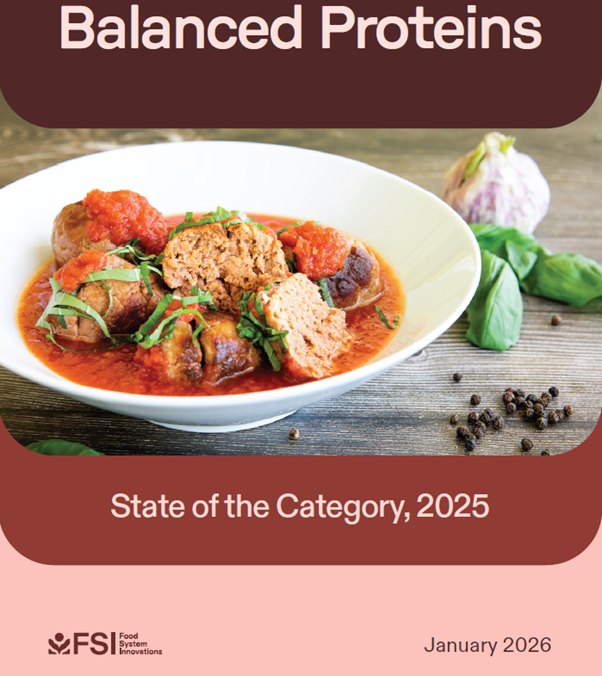

Balanced Proteins: Quiet Scale Beats Loud Disruption
For years, the protein transition has been framed as a battle of replacement.
Replace meat with plants. Replace familiar foods with new formats. Replace existing supply chains with entirely new ones.
The problem is not ambition. It’s friction.
As the Balanced Proteins: State of the Category 2025 report makes clear, the most scalable progress in protein is not coming from asking consumers to change what they eat - but from changing what goes into the foods they already buy.
That distinction matters. Because behaviour change is a weak lever. System change is the power lever.
Balanced Proteins are not a compromise - they are an optimisation
Balanced Proteins sit deliberately in the middle of the protein spectrum. They combine animal protein with plant, fermentation-derived, or cultivated ingredients to reduce cost, emissions, and nutritional gaps - without sacrificing taste, familiarity, or performance.
According to the report, products that replace as little as 30% of animal ingredients already deliver measurable gains across:
Cost stability, as animal protein prices remain structurally volatile
Nutrition density, especially fibre — where 97% of children fall short of recommendations
Emissions, particularly when beef is partially displaced
Operational fit, by integrating into existing manufacturing and foodservice systems
This is not a future-facing hypothesis. It is already happening - quietly, at scale.
The market signal is clear: low friction wins
The strongest adoption signals in the category are not coming from niche retail launches. They are coming from places where performance matters most:
Institutional foodservice converting significant volumes of minced beef to balanced formats
Retailers pricing balanced products below conventional meat to drive trial
Manufacturers using ingredient-based blends to stabilise margins without retooling factories
The report estimates a $5.3bn US serviceable obtainable market today — equivalent to frozen pizza — with a total addressable market aligned to the full $250bn US meat sector.
That gap tells an important story.
This is not a demand problem. It is a deployment problem.
Why balanced proteins succeed where replacements stall
Across multiple chapters, the report returns to the same structural insight: products scale when they work with existing systems, not against them. Balanced Proteins succeed because they:
Preserve familiarity: format, flavour, and cooking behaviour stay the same
Reduce risk: no new allergens, no exotic supply chains, no speculative infrastructure
Improve economic: partial displacement lowers input cost and volatility
Deliver nutrition quietly: fibre, protein, and micronutrients improve without consumer effort
This mirrors a broader lesson we see across reformulation, clean label, and sustainability work:
The fastest-scaling changes in food are rarely the most visible ones.
Partial change, massive impact
One of the most important contributions of the Balanced Proteins framework is reframing impact.
The atmosphere does not care whether a product is 10% better or 100% transformed. It only cares about tonnes of CO₂ avoided.
Balanced Proteins unlock impact through:
Partial substitution at high volume
Use of familiar crops and ingredients
Integration into mainstream foods, not niche categories
Reducing beef content by 20–30% across widely consumed products delivers far more impact than perfect solutions that never scale.
Quiet change beats loud disruption.
Nutrition per bite is becoming the real constraint
The report also lands at the same conclusion emerging elsewhere in the food system:
As portions shrink - due to ageing populations, cost pressure, or GLP‑1 use - nutrition density matters more than ever.
Foods optimised for volume and calories fail when people eat less.
Balanced Proteins respond to that reality by:
Adding fibre where diets are deficient
Maintaining protein quality and quantity
Improving satiety without increasing portion size
Avoiding ultra‑fractionated additive stacks
This is not diet food. It is better everyday food.
From proof‑of‑concept to proof‑of‑category
The final message of the State of the Category report is not technological - it is strategic.
Balanced Proteins do not need reinvention. They need normalisation.
That requires:
Clear category framing
Ingredient platforms that integrate upstream
Co‑manufacturing capacity
Retail and foodservice partners willing to lead
Capital aligned with infrastructure, not hype
In other words: proof‑of‑category, not proof‑of‑concept.
The opportunity ahead
Balanced Proteins are not a trend. They are a correction.
A correction to a food system that over‑optimised for volume. A correction to climate strategies that rely on behaviour change. A correction to innovation models that mistake novelty for impact.
The category’s strength lies precisely in what makes it unglamorous:
Familiar foods
Familiar systems
Familiar buying behaviour
Made better upstream.
That is how change actually scales.


Europe after peak: why the next era of food is about nutrition density, not volume
For most of our lives, the direction of travel has felt obvious.
More people.
More consumption.
More throughput.
Food systems were built in the shadow of expansion - scaling output, optimising for calories, and growing capacity to keep up with demand. The assumption was rarely questioned because the numbers kept rising.
But in Europe, that era is ending. Eurostat projects the EU-27 population will peak in 2026 and then begin a long, gradual decline. Meanwhile, Europe as a whole is already past peak population, with demographic momentum now shifting toward decline and ageing.
That matters because population growth has always been the quiet engine behind food demand. When the number of mouths stops rising, the fundamentals change.
Europe is now moving beyond peak food requirement - not in the sense that food becomes less important, but in the sense that the strategic challenge is no longer “how do we produce more?” It becomes: how do we nourish better, with less waste, less environmental cost, and more resilience?
The end of “more” - and the start of “better”
Peak population doesn’t mean food demand collapses overnight. But it does mean the growth story weakens, and a different set of pressures takes over.
Instead of expansion, Europe is entering a period defined by:
Ageing populations: Older consumers typically need food that supports muscle retention, metabolic health, digestion, and nutrient adequacy — often with smaller appetites.
Rising obesity and diet-related disease: Europe is now grappling with overconsumption and under-nutrition at the same time: too many calories, not enough fibre, protein, and micronutrient density.
Higher scrutiny of how food is made: Consumers and regulators are paying more attention to processing, ingredient lists, and whether modern food is optimised for health or just industrial convenience.
National food security and supply chain risk: The question isn’t just “can we feed everyone?” It’s “can we feed everyone reliably, affordably, and domestically enough to be resilient?”
In short: Europe’s food challenge is shifting from volume to nutritional quality, lower environmental impact, and security of supply.
Why “nutrition per bite” becomes the new metric
When growth was the dominant context, the food system optimised for:
cost per calorie
stable supply at scale
palatability and convenience
maximum yield from industrial processes
That model helped deliver abundance. But abundance has side-effects - and in a post-peak Europe, those side-effects become impossible to ignore.
As appetite declines (through ageing, lifestyle shifts, and even the rise of GLP-1 medications), smaller portions expose a big weakness in the current system: many foods are calorie-dense but nutritionally thin.
So the future isn’t just “less food.”
It’s more nutrition in the food we already eat.
That’s a fundamentally different innovation agenda.
The mistake: assuming consumers will change first
When the food system is under pressure, it’s tempting to put the burden on the public:
Eat differently.
Buy differently.
Pay more.
Learn new ingredients.
But behaviour change is a weak lever.
If people won’t reliably change their diets to improve their own health, it’s unrealistic to expect them to overhaul how they eat to reduce carbon emissions.
Which means the highest-leverage changes are upstream:
reformulating everyday foods
improving nutritional density quietly
reducing reliance on imported and fragmented ingredients
cutting waste and emissions at source
That is where system-level change actually scales
Post-peak Europe needs a different kind of food innovation
In an expanding world, the logic was often: grow more, process more, ship more.
In a post-peak Europe, the logic becomes: use what we already grow better.
That’s where UPP fits.
UPP’s model is built around a simple but powerful shift: capturing under-utilised vegetables and converting them into functional protein and fibre ingredients that integrate into mainstream manufacturing.
This matters because Europe’s future food priorities aren’t abstract. They’re practical:
higher protein and fibre intake without asking consumers to “try harder”
lower embedded emissions through better Scope 3 performance
less waste and better utilisation of domestic crops
reformulation that works inside existing factories, not just in innovation labs
From volume to value: low-friction reformulation
In the next era, the winners won’t be the companies with the most radical ideas.
They’ll be the companies that make change adoptable.
Because reformulation rarely fails due to lack of ambition — it fails due to friction:
manufacturing disruption
procurement risk
allergen and regulatory complexity
uncertain supply at scale
sensory uncertainty
That’s why low-friction reformulation is becoming a strategic requirement, not a nice-to-have. UPP’s approach is designed around that reality: ingredients that work in real processes, at real scale, with real commercial constraints. Sustainability isn’t the goal - it’s the outcome
One of the most important shifts in a post-peak Europe is that sustainability can no longer be treated as a premium add-on.
It has to be built into efficiency.
When you reduce waste, shorten supply chains, simplify ingredient systems, and increase nutrition density, sustainability becomes a by-product of doing things better — not a marketing narrative that depends on consumer sacrifice.
This is what “future-proof” looks like in European food:
less waste
lower carbon
higher nutrition density
more resilient supply
no behavioural trade-offs required
Food security becomes a design constraint, not a political slogan
As Europe moves into demographic decline, it would be easy to assume food security becomes less relevant. In reality, it becomes more relevant - because food security is not only about demand. It’s about fragility. Global supply chains can be efficient, but they can also be brittle. And as volatility becomes structural, Europe will increasingly value:
regionally anchored inputs
predictable supply
traceability and compliance
domestic resilience
UPP’s focus on under-utilised crops and regional supply logic aligns directly with that direction of travel.
The next phase of food in Europe
For decades, the food system has been running an “expansion playbook.”
Europe is now entering a different chapter: one where population growth is no longer the default context, and where the priorities are shaped by ageing, obesity, scrutiny, sustainability, and security.
This is not a crisis. It’s a reset.
And it changes the definition of success.
The future of European food provision won’t be won by producing more volume. It will be won by delivering:
more nutrition per bite
less environmental cost per kilogram
more resilience per supply chain
UPP exists for exactly that future — improving food by changing what goes into it, not by demanding consumers become different people.
Quiet change. Upstream. At scale.
The system isn’t broken. It’s optimised.
There’s a popular narrative in food innovation that today’s food system is “broken” - too processed, too complex, too fragile, too far from nature.
It’s a satisfying story because it creates a clear villain and an easy solution: tear it down and build something new.
But that’s not how food works at scale.
The truth is simpler, and more respectful of reality:
The food system is optimised for affordability, safety, and scale - and those constraints shape ingredient choices.
If you want to change the outcomes, you need to start by understanding the optimisation.
Optimised for affordability
Affordability isn’t a marketing preference. It’s a social requirement.
Most food is purchased under pressure: time pressure, budget pressure, and often energy pressure. The system has been engineered to deliver calories, protein and convenience at a price that works - and that achievement is easy to overlook from the outside.
It’s also why certain ingredients dominate: they’re available, stable, predictable, and competitively priced across huge volumes.
Optimised for safety
Food safety is one of the greatest engineering successes of modern society.
In a world where products travel long distances, sit on shelves, cross borders, and enter millions of homes, safety has to be designed in - not wished for.
That reality shapes everything: manufacturing processes, specifications, microbial targets, packaging formats, shelf-life expectations, and the ingredient toolkits that make those outcomes possible.
Optimised for scale
Scale isn’t a “nice to have”. It’s what turns a good idea into something that actually feeds people.
When a manufacturer makes a product, they’re not making one batch for a launch event. They’re making thousands of tonnes with consistency, week after week, with minimal downtime and minimal variability.
That is why “perfect on paper” ingredients often fail in practice: they can’t handle the manufacturing environment, or they can’t be supplied reliably, or they introduce a new operational risk that no one asked for.
This is the heart of why change is hard - not because manufacturers don’t care, but because the system has been built to prioritise the things that keep food available and safe.
And it works.
The system delivered. Now the optimisation target is shifting.
It’s worth saying clearly: Manufacturers have delivered extraordinary safety, shelf life and affordability at scale.
That’s not the problem.
The problem is that the optimisation target is evolving.
Today, the system is being asked to deliver more, simultaneously:
Nutrition density, without changing formats people already buy
Resilience, in the face of climate and commodity volatility
Sustainability outcomes, without green premiums
Simpler labels, without sacrificing functionality
Stable supply, without adding complexity or risk
And the hardest part is this: the system can’t deliver those upgrades if the only options require a full redesign.
That’s why the next era of food innovation won’t be defined by disruption.
It will be defined by upgrade paths.
Why “disruption” is the wrong tool for food
Disruption works best when you can swap a system quickly.
Food doesn’t swap quickly.
Food has:
qualification cycles
sensory expectations
retailer specifications
regulatory requirements
global supply constraints
production lines designed for specific behaviours
brands built on consistency
So when innovation arrives with a message like “start over,” the response from incumbents isn’t resistance - it’s risk management.
Because in food, risk isn’t abstract. Risk is:
line downtime
product returns
quality escapes
allergen exposure
delistings
margin erosion
supply interruptions
That’s why the most scalable change tends to look “boring” from the outside.
It doesn’t ask the system to become something else.
It helps the system become better at what it already does.
The opportunity: incremental improvement that compounds
The most powerful improvements in food are often small per unit, but massive in aggregate.
A modest change repeated across high-volume products becomes meaningful:
a little more protein here
a little more fibre there
a slightly simpler ingredient list
fewer functional crutches
a more resilient supply input
a lower-footprint component in a familiar format
No single change needs to be perfect.
It needs to be compatible.
Because compatibility is what unlocks scale.
And scale is what unlocks impact.
What collaboration looks like in practice
At UPP, we don’t see ourselves as disruptors of food manufacturing.
We see ourselves as collaborators with it.
That means designing ingredients and supply models around the realities manufacturers face, including:
Compatibility over reinvention
Innovation doesn’t have to mean new product formats.
In many categories, the biggest wins come from improving the ingredients inside the products people already buy — without asking consumers to behave differently.
De-risking over disruption
A great ingredient isn’t just nutritionally interesting. It has to be:
consistent
specifiable
manufacturable
scalable
supported with documentation
resilient in supply
This is the difference between “promising” and “deployable.”
Supporting existing manufacturing
Food factories are highly tuned systems.
When you introduce an ingredient, you’re not just changing a recipe — you’re interacting with:
hydration behaviour
mixing and shear
thermal stability
shelf-life performance
texture development
yield and cook loss
cost-in-use
Real-world reformulation succeeds when it respects those constraints.
That’s why we focus on being a practical upgrade: a way to improve nutrition and resilience without raising complexity.
A better framing for the future: upgrade the system we have
The future of food won’t be won by the loudest manifesto.
It will be built by teams who can deliver change that works in the real world:
in procurement
in QA
in manufacturing
in NPD
in retailer conversations
in consumer repeat purchase
That’s not a compromise.
It’s the only route to scale.
So instead of asking whether the food system is broken, a better question is:
What is it optimised for — and what should it be optimised for next?
Affordability, safety, and scale will always matter.
Now the next layer is clear: nutrition, resilience, and efficiency — delivered through incremental improvements that the existing system can actually adopt.
That’s the upgrade path.
And that’s the work.

Sustainability as a by-product of efficiency — and the three places that argument breaks
We have made the efficiency case repeatedly, and we still believe it. But it is a weaker argument than we have sometimes made it sound, and the honest version is more useful than the confident one.
There is a version of the sustainability argument in food that goes like this. Decarbonisation that depends on someone paying more, or behaving differently, is fragile. Decarbonisation that falls out of doing the job more efficiently — less waste, shorter chains, better use of what already exists — is durable, because it survives budget cycles, elections and procurement reviews. Make sustainability a by-product of efficiency and it stops being a cost line that gets cut when margins tighten.
We believe that. It is the operating logic of this company. But it is also the kind of argument that is very comfortable to make if you happen to sell an efficiency, and comfortable arguments deserve harder scrutiny than we have given this one.
So this piece does two things. It sets out the case properly, with numbers. Then it sets out the three places the case genuinely breaks — including one where our own stated plans are the counter-example.
The case, stated properly
Start with the scale of the inefficiency, because it is the whole basis of the argument.
Food systems account for somewhere between a quarter and a third of global anthropogenic greenhouse gas emissions, depending on where the boundary is drawn — Poore and Nemecek put it at around 26%, Crippa and colleagues at 34% with a range of 25–42%, of which roughly a third is methane. [1][2] Against that, UNEP's Food Waste Index estimated around 1.05 billion tonnes of food wasted at retail, foodservice and household level in 2022 — approximately 19% of food available to consumers — with FAO estimating a further ~13% lost between harvest and retail. [3][4]
Those are enormous numbers, and they describe a system that is not short of food. It is short of the ability to use the food it already produces.
That distinction matters, because it changes what an intervention has to do. If the problem were scarcity, the answer would be to grow more, which means more land, water and nitrogen. If the problem is leakage, the answer is to capture what is already leaking — and the inputs behind that material have already been spent.
Take the crop we know best. DEFRA figures cited in the SusProt consortium announcement put more than 600,000 tonnes of UK broccoli plant mass as unused each year, roughly 70–80% of the harvestable biomass. [5] The land was prepared for it. The water was applied to it. The fertiliser — one of the most energy-intensive inputs in agriculture — was applied to it. Then the head was cut and the rest was left in the field, where much of it rots and releases methane.
Recovering that biomass and converting it into food-grade protein and fibre does not require a new crop to be grown. That is the structural difference between a side-stream ingredient and a dedicated protein crop: pea protein requires a pea crop, soy protein requires a soy crop, and each tonne carries its own fresh load of land, water, nitrogen and transport. An independent interim life cycle analysis by the UK Agri-Tech Centre puts our ingredient below 0.25 kg CO₂e/kg on a cradle-to-gate basis. [6]
The commercial half of the argument follows from the same fact. Because the expensive inputs have already been paid for by the head, the marginal cost of the material is low — which is what allows an ingredient to be cost-neutral or cost-down at 4–30% inclusion rather than carrying a green premium. And a cost-down ingredient does not need a sustainability budget to get adopted. It gets adopted by procurement, for procurement reasons, and the carbon reduction arrives as a consequence.
That is the case. It is a good case. Now the problems with it.
Break one: the rebound effect, and why our own plan is the example
The oldest objection to efficiency-led environmental strategy is Jevons's. In 1865, observing the steam engine, William Stanley Jevons noted that improvements in the efficiency of coal use did not reduce coal consumption — they increased it, because efficiency lowered the effective cost of coal-derived work, and demand expanded to meet the lower price. [7]
The modern literature calls this the rebound effect, and it is real, though the size is contested and estimates vary widely by sector; full backfire, where savings are entirely erased, appears to be the exception rather than the rule. [8] But partial rebound is common enough that any efficiency claim which ignores it is incomplete.
Applied here, the objection is direct: if you make a crop more profitable to grow, more of it gets grown.
And this is not hypothetical for us. We have argued elsewhere, in print, that harvest automation plus side-stream revenue could support a 20–30% expansion in UK broccoli acreage. That is the argument working exactly as intended from a food-security and farm-economics point of view — and it is also, unambiguously, more hectares under cultivation, more seed, more water, more fertiliser and more field operations than would otherwise have happened.
We cannot claim the efficiency dividend and disown the acreage expansion. They are the same mechanism.
The honest position is that the net effect depends on arithmetic we have not yet done properly: whether the emissions avoided per tonne of recovered biomass exceed the emissions added by the marginal hectare, and whether the displaced ingredient was genuinely higher-impact. We think the answer is favourable, for a specific reason — the recovered biomass rides on inputs already committed, while the marginal hectare carries full inputs but also produces a saleable head, so the comparison is not obviously lopsided in either direction. But we think is not we have shown, and the calculation belongs in the next iteration of our LCA rather than in a blog post.
There is a second, subtler version of the same objection that is harder to dismiss. If an ingredient saves a manufacturer money, that money does not vanish. It becomes margin, or a lower shelf price, or investment in something else — and whatever it becomes has its own footprint. Indirect rebound of this kind is routinely ignored in corporate sustainability claims because it is almost impossible to attribute. We ignore it too. We should at least say that we are ignoring it.
Where food is genuinely different — and where it isn't
Having conceded the rebound argument, there is a real counter to it that is specific to food, and it is worth making carefully because it is the most interesting thing in this piece.
Energy rebounds strongly because demand for energy services — light, warmth, mobility, computation — is highly elastic. Make them cheaper and people want more of them, apparently without limit.
Demand for calories is not like that. It is biologically bounded, and in mature markets it is already saturated. Europe is approaching or past peak population, portions are shrinking under demographic ageing and GLP-1 adoption, and the strategic question has shifted from volume to nutrition density. In that context, cheaper food does not straightforwardly produce more eating. It produces cheaper eating, or better eating, or a different mix.
So the classic Jevons dynamic is weaker in a saturated food market than in energy. That is a genuine structural argument, not a convenient one.
But it comes with two qualifications that cut against us.
First, it holds only where demand is saturated. Globally, food demand is not saturated — hundreds of millions of people are undernourished — and there, efficiency gains should rebound into consumption. That is not a failure of the argument. It is the point of the food system. But it does mean the emissions benefit of efficiency is smallest exactly where the human benefit is largest, and anyone claiming both at once should be asked which they are optimising for.
Second, saturation applies to calories, not to categories. Cheaper inputs can shift consumption toward more processed, more energy-dense formats rather than reducing consumption. Efficiency that makes cheap food cheaper is not obviously a health or climate win. Our answer is that we are trying to move nutrition density in the opposite direction inside those same formats — but that is a claim about our specific ingredient, not a defence of efficiency in general.
Break two: efficiency only buys the abatement that happens to be profitable
The second problem is one of coverage, and it is the more serious of the three.
An efficiency-led strategy delivers the emissions reductions that come with a commercial dividend attached. By construction, it does not deliver the ones that don't.
There is a substantial residual in food-system emissions where no efficiency argument exists — enteric methane, certain land-use changes, some refrigeration and logistics, aspects of primary production that are simply carbon-intensive and not obviously wasteful. For those, the abatement costs money that somebody has to pay, through carbon pricing, regulation, subsidy or margin sacrifice.
Efficiency-led strategy is silent on all of it. Worse, it can crowd out the conversation, because it lets an industry point to the profitable abatement it has already done and defer the unprofitable abatement indefinitely.
We should be clear about what that means for us. Our argument is that efficiency is the fastest and most durable route to the emissions that are reachable this way. It is not an argument that this route is sufficient, and it is not an argument against carbon pricing or regulation. A company whose entire model depends on the profitable subset of decarbonisation has an obvious interest in claiming that the profitable subset is the whole job. It isn't.
Break three: "efficiency" is an easy word to launder with
The third problem is about honesty rather than physics.
If sustainability is only ever pursued where it improves the P&L, then a company can claim environmental credit for decisions it would have made regardless. Every cost reduction becomes a climate action. Every yield improvement becomes stewardship. The framing is almost infinitely elastic, and elastic framings get exploited — the same criticism levelled at NOVA as a classification, and for the same reason.
The test we would apply to ourselves, and would invite anyone to apply to us, is simple: is there anything in the model that costs us money and that we do anyway?
There are a few honest answers. Regulatory and certification work has been front-loaded well ahead of the revenue that justifies it. The LCA was commissioned independently and published with its exclusions declared, including the methane-avoidance benefit that would have flattered the number. Our stated intention to site processing near waste heat and run on wind is not the cheapest available site selection.
Those are modest. They are not a moral position. And a reader is entitled to note that all three also serve commercial ends — audit-readiness, procurement credibility, energy-cost control. The overlap is the point of the thesis, but it also means the thesis can never be falsified by our own behaviour, which is a weakness in it.
What we would actually claim
Stripped of the comfortable version, here is the narrow claim we think survives.
For the subset of food-system emissions that sit in unused biomass, fragmented supply chains and inputs already spent, efficiency is the fastest and most durable route to abatement, because it does not depend on anyone agreeing to pay more or behave differently. That subset is large — the waste and loss figures above suggest it is very large — but it is a subset.
Outside it, the emissions are still there, they still need abating, and the mechanism will have to be something other than a better business case. Pretending otherwise is how an industry congratulates itself for a decade while the number moves slowly.
And on our own numbers: the LCA is interim, cradle-to-gate, and excludes both methane avoidance and end-of-life. The acreage-expansion effect described above is not yet in it. The "17 seedlings planted for every 10 heads harvested" figure we have quoted elsewhere is internal and still to be substantiated from primary agronomic data. Any of those could move the answer, and we would rather publish the caveats than have someone else find them.
Closing
The reason to prefer efficiency-led sustainability is not that it is morally superior. It is that it does not require anyone to be good, which is a lower bar and therefore a more reliable one.
But a strategy built on not requiring anyone to be good will only ever reach as far as self-interest reaches. That is further than most people assume, and it is not far enough.
Both of those things are true, and the second one is the one our own arguments have tended to leave out.
A note on sources
Food-system emissions ranges are from Poore & Nemecek (2018) and Crippa et al. (2021) as cited elsewhere in these pages. Food loss and waste figures are drawn from UNEP's Food Waste Index and FAO food-loss estimates; both are periodically revised and the current editions should be checked before the figures are quoted onward. The broccoli biomass figure is DEFRA data as cited in the SusProt consortium announcement. The LCA figure is an independent interim analysis by the UK Agri-Tech Centre, cradle-to-gate, excluding methane avoidance and end-of-life. The Jevons reference is to The Coal Question (1865); characterisations of the modern rebound literature are directional — estimated magnitudes vary substantially by sector and method, and the field is genuinely contested. The acreage-expansion figure is our own published projection, not an observed outcome. The arguments about saturation, indirect rebound and residual abatement are our analysis.
References
[1] Poore, J. & Nemecek, T. Reducing food's environmental impacts through producers and consumers. Science. 2018;360(6392):987–992.
[2] Crippa, M., Solazzo, E., Guizzardi, D. et al. Food systems are responsible for a third of global anthropogenic GHG emissions. Nature Food. 2021;2:198–209. doi:10.1038/s43016-021-00225-9
[3] United Nations Environment Programme. Food Waste Index Report 2024. Approximately 1.05 billion tonnes of food waste in 2022, ~19% of food available at retail, foodservice and household level.
[4] Food and Agriculture Organization of the United Nations. Food Loss Index — estimated ~13% of food lost between post-harvest and retail. [Verify against current edition before republication.]
[5] DEFRA figures cited in the SusProt consortium announcement (UPP, James Hutton Institute, Agri-EPI Centre), June 2023.
[6] Independent interim Life Cycle Analysis, UK Agri-Tech Centre. Functional unit: 1 kg ingredient; boundary: cradle-to-gate; result: <0.25 kg CO₂e/kg; exclusions: methane avoidance and end-of-life.
[7] Jevons, W.S. The Coal Question. London: Macmillan, 1865.
The healthcare system is paying for poor diet. The food system has to become part of the fix.
Better food is no longer just a consumer proposition or a sustainability narrative. It is a healthcare cost issue, a productivity issue and, increasingly, a system design issue.
This is no longer a soft problem.
Poor diet is now one of the leading drivers of death worldwide. The Institute for Health Metrics and Evaluation estimates that dietary risks were the fifth-leading global risk factor for early death in 2023, with 12.2% of all deaths associated with poor diet. The Lancet’s Global Burden of Disease 2017 analysis estimated 11 million deaths globally from dietary risks in 2017. [1][2]
That changes the frame. Diet is not a lifestyle side issue. It is core infrastructure for population health. [1][2]
The bill is already arriving.
In the United States alone, suboptimal diet has been linked to about $50.4 billion a year in direct cardiometabolic healthcare costs, or roughly $301 per person. In the underlying PLOS Medicine model, that equalled 18.2% of spending on heart disease, stroke and type 2 diabetes. [3]
And that is still a narrow estimate. A separate analysis estimated $7.44 billion in five-year direct medical costs for diet-attributable cancers diagnosed in 2015. Diabetes alone cost the U.S. $412.9 billion in 2022, equivalent to roughly $1.1 billion per day, and about one in every four U.S. healthcare dollars is spent on caring for people with diabetes. [4][5]
Obesity adds another nearly $173 billion a year in medical expenditure. At the same time, CMS estimates U.S. health spending reached $5.3 trillion in 2024 and is projected to reach 20.3% of GDP by 2033. The Rockefeller Foundation has argued that once hidden health, environmental and social costs are included, the true annual cost of the U.S. food system rises to at least $3.2 trillion. [6][7][8][9]
Put differently: healthcare systems are increasingly paying the downstream cost of a food environment optimised for convenience, consistency and throughput, but not reliably for metabolic health. [5][6][7][8][9]
The outcomes are becoming hard to ignore.
In the U.S., only 12.2% of adults met a stringent definition of optimal metabolic health in 2009-2016. By 2017-2018, only 6.8% of adults had optimal cardiometabolic health. A 2024 JAMA analysis found that almost 90% of U.S. adults met criteria for cardiovascular-kidney-metabolic syndrome stage 1 or higher. [10][11][12]
Current prevalence data point in the same direction: 40.3% of U.S. adults had obesity in 2021-2023; 115.2 million adults had prediabetes in 2023; and 40.1 million people were living with diabetes. [13][14]
Those categories overlap, so they should not be added together. But the signal is clear. Poor metabolic health is no longer marginal. It is normalised at population scale. [10][11][12][13][14]
This is why food is moving into healthcare.
The evidence base for food-as-medicine is no longer hypothetical. A 2025 American Heart Association systematic review of 14 U.S. randomised controlled trials found consistent improvements in diet quality and food security, while effects on biomarkers such as HbA1c, blood pressure and BMI were mixed but promising. [15]
Produce prescription evidence points the same way. A 2024 systematic review found consistent evidence for improved food security, mixed evidence for higher fruit and vegetable intake, and the clearest biomarker improvements in HbA1c among adults entering programs with elevated blood sugar. [16]
Real-world payment models are now starting to follow the evidence. In Massachusetts, Medicaid nutrition supports were associated with a 23% reduction in hospitalisations and a 13% reduction in emergency department visits. In North Carolina’s Healthy Opportunities Pilots, participation was associated with a decreasing spending trend after enrolment and lower emergency department visit trends. [17][18]
That is why reimbursement is no longer just being considered. Medicare Advantage plans are already allowed to offer food-related special supplemental benefits for eligible chronically ill members, and CMS now requires plans to support those benefits with relevant evidence. [19][20]
Better farming can help. But scale comes from better system design.
There is growing evidence that farming practice can affect food composition. A paired-farm U.S. study found that regenerative systems were associated with healthier soils and differences in nutrient density and phytochemical profiles. A major meta-analysis found that organic crops had, on average, higher antioxidant concentrations, lower cadmium levels and lower incidence of pesticide residues than conventional comparators. [21][22]
But the evidence is not strong enough to claim that regenerative or organic foods have definitively proven superior human health outcomes across the board. A 2019 systematic review concluded that direct clinical evidence remains limited. [23]
That distinction matters. Better production methods may be part of the answer. But population-scale health gains will not come from asking everyone to opt into a niche food ideology. They will come from improving the nutritional performance of the food system people already use. [15][16][21][22][23]
The opportunity is not to replace the system. It is to upgrade it.
This is where UPP’s "fork from farm" logic becomes commercially important.
• Start with what people actually buy: familiar formats, trusted categories, repeatable taste.
• Work backwards to better nutritional outcomes, rather than assuming consumers will adapt to supply.
• Increase the value captured from what farmers already grow by converting more under-used biomass into food-grade ingredients.
• Reduce friction for manufacturers by fitting existing formulations, specifications and supply chains.
• Improve nutrition density without requiring consumers to rebuild their lives around food.
The most scalable nutrition strategy is rarely the one that asks consumers to behave differently. It is the one that quietly improves the default.
That is the opportunity UPP is built around: working with farmers and food producers to turn more of what is already grown into ingredients that can improve nutrition density, functional performance and resource efficiency inside the products people already buy.
Don't replace the food system.
Upgrade it.
References
1. Institute for Health Metrics and Evaluation (IHME). Diet. 2025. Available at: https://www.healthdata.org/research-analysis/health-topics/diet
2. Afshin A, Sur PJ, Fay KA, et al.; GBD 2017 Diet Collaborators. Health effects of dietary risks in 195 countries, 1990-2017: a systematic analysis for the Global Burden of Disease Study 2017. The Lancet. 2019;393(10184):1958-1972. doi:10.1016/S0140-6736(19)30041-8
3. Jardim TV, Mozaffarian D, Abrahams-Gessel S, et al. Cardiometabolic disease costs associated with suboptimal diet in the United States: a cost analysis based on a microsimulation model. PLOS Medicine. 2019;16(12):e1002981. doi:10.1371/journal.pmed.1002981
4. Khushalani JS, Cudhea FP, Ekwueme DU, et al. Estimated economic burden of cancer associated with suboptimal diet in the United States. Cancer Causes & Control. 2022;33(1):73-80. doi:10.1007/s10552-021-01503-4
5. Parker ED, Lin J, Mahoney T, et al. Economic Costs of Diabetes in the U.S. in 2022. Diabetes Care. 2024;47(1):26-43. doi:10.2337/dci23-0085
6. Centers for Disease Control and Prevention. Adult Obesity Facts. Updated May 14, 2024. Available at: https://www.cdc.gov/obesity/adult-obesity-facts/index.html
7. Centers for Medicare & Medicaid Services. NHE Fact Sheet. Updated Jan 14, 2026. Available at: https://www.cms.gov/data-research/statistics-trends-and-reports/national-health-expenditure-data/nhe-fact-sheet
8. Centers for Medicare & Medicaid Services. National Health Expenditure Projections 2024-33: Forecast Summary. 2025. Available at: https://www.cms.gov/files/document/nhe-projections-forecast-summary.pdf
9. The Rockefeller Foundation. True Cost of Food: Measuring What Matters to Transform the U.S. Food System. July 2021. Available at: https://www.rockefellerfoundation.org/reports/true-cost-of-food-measuring-what-matters-to-transform-the-u-s-food-system/
10. Araújo J, Cai J, Stevens J. Prevalence of Optimal Metabolic Health in American Adults: National Health and Nutrition Examination Survey 2009-2016. Metabolic Syndrome and Related Disorders. 2019;17(1):46-52. doi:10.1089/met.2018.0105
11. O'Hearn M, Lauren BN, Wong JB, et al. Trends and Disparities in Cardiometabolic Health Among U.S. Adults, 1999-2018. Journal of the American College of Cardiology. 2022;80(2):138-151. doi:10.1016/j.jacc.2022.04.046
12. Aggarwal R, Vaidya SR, Kondamudi NP, et al. Prevalence of Cardiovascular-Kidney-Metabolic Syndrome Stages in US Adults, 2011-2020. JAMA. 2024;331(18):1574-1576. doi:10.1001/jama.2024.6892
13. Centers for Disease Control and Prevention, National Center for Health Statistics. Obesity and Severe Obesity Prevalence in Adults: United States, August 2021-August 2023. Data Brief No. 508. Sept 2024. Available at: https://www.cdc.gov/nchs/products/databriefs/db508.htm
14. Centers for Disease Control and Prevention. National Diabetes Statistics Report. Updated Jan 21, 2026. Available at: https://www.cdc.gov/diabetes/php/data-research/index.html
15. Seligman HK, Angell SY, Berkowitz SA, et al. A Systematic Review of "Food Is Medicine" Randomized Controlled Trials for Noncommunicable Disease in the United States: A Scientific Statement From the American Heart Association. Circulation. 2025;152(4):e32-e46. doi:10.1161/CIR.0000000000001343
16. Harper Z, Verdezoto Alvarado A, Katz SE, et al. Examining Food Security, Fruit and Vegetable Intake, and Cardiovascular Disease Risk Outcomes of Produce Prescription (PPR) Programs: A Systematic Review. Journal of Nutrition Education and Behavior. 2024. doi:10.1016/j.jneb.2024.06.012
17. Hager K, Sabatino M, Williams J, et al. Medicaid Nutrition Supports Associated With Reductions in Hospitalizations and Emergency Department Visits in Massachusetts, 2020-23. Health Affairs. 2025;44(4):413-421. doi:10.1377/hlthaff.2024.01409
18. Berkowitz SA, Archibald J, Yu Z, et al. Medicaid Spending and Health-Related Social Needs in the North Carolina Healthy Opportunities Pilots Program. JAMA. 2025;333(12):1041-1050. doi:10.1001/jama.2025.1042
19. eCFR. 42 CFR 422.102 - Supplemental benefits. Current through 2026. Available at: https://www.ecfr.gov/current/title-42/chapter-IV/subchapter-B/part-422/subpart-C/section-422.102
20. Centers for Medicare & Medicaid Services. Contract Year 2025 Medicare Advantage and Part D Final Rule (CMS-4205-F). Apr 4, 2024. Available at: https://www.cms.gov/newsroom/fact-sheets/contract-year-2025-medicare-advantage-part-d-final-rule-cms-4205-f
21. Montgomery DR, Biklé A, Archuleta R, Brown P, Jordan J. Soil health and nutrient density: preliminary comparison of regenerative and conventional farming. PeerJ. 2022;10:e12848. doi:10.7717/peerj.12848
22. Barański M, Średnicka-Tober D, Volakakis N, et al. Higher antioxidant and lower cadmium concentrations and lower incidence of pesticide residues in organically grown crops: a systematic literature review and meta-analyses. British Journal of Nutrition. 2014;112(5):794-811. doi:10.1017/S0007114514001366
23. Vigar V, Myers S, Oliver C, Arellano J, Robinson S, Leifert C. A Systematic Review of Organic Versus Conventional Food Consumption: Is There a Measurable Benefit on Human Health? Nutrients. 2019;12(1):7. doi:10.3390/nu12010007
The question isn’t whether inulin works. It’s whether it still fits the moment.
For years, inulin has been an easy answer to a familiar formulation problem.
Need more fibre? Add inulin.
Need a better nutrition story? Add inulin.
Need help with texture, mouthfeel or sugar or fat reduction? Add inulin.
That logic still makes technical sense in many applications. But the environment around formulation has changed faster than the ingredient toolkit.
Recent scrutiny around how “real food” and “wholefood” claims are interpreted has highlighted something important for manufacturers: the issue is no longer only what an ingredient does. It is also how it is made, how easy it is to explain, how it appears on pack, and whether it fits a growing demand for food that feels less fragmented and less engineered.
That does not make this an anti-inulin argument.
Inulin remains a useful ingredient. It can support fibre enrichment, help improve mouthfeel, and play a role in sugar and fat reduction across a range of applications. But useful is not the same as future-proof. Performance is often application-specific, and like many isolated ingredients, inulin now sits inside a wider conversation about processing, simplicity and ingredient credibility.
That is why food manufacturers should start asking a different question: not just how to add more fibre, but how to improve fibre, formulation resilience and product credibility at the same time.
That is where UPP becomes interesting as an alternative.
Not because it is trying to out-inulin inulin.
Because it is solving a different and increasingly more valuable problem.
UPP’s approach is built around upcycled brassica ingredients designed to help manufacturers improve nutrition, support cost stability and strengthen sustainability performance without creating unnecessary label friction. Rather than forcing a disruptive rethink of production, the proposition is intentionally practical: ingredients designed to work with existing manufacturing systems, in formats that fit current operations.
More importantly, the ingredient logic is easier to defend in the current climate.
Where isolated fibres can increasingly attract questions around process and positioning, UPP offers ingredients that are closer to the language and logic of food. That matters. In a market where consumers, retailers and regulators are paying closer attention to how products are made, ingredients that still sound like food and behave like food have an obvious advantage.
There is also a formulation benefit in looking beyond single-function solutions.
One of the weaknesses of the modern ingredient stack is that too many products solve each challenge by adding another isolated fix. Fibre for nutrition. Something else for texture. Something else for binding. Something else again for water management. The result is often a more complex recipe, more pressure on cost, and a pack that feels harder to defend.
UPP offers a different route. Our brassica-based ingredients are not simply a source of fibre, but part of a more functional food matrix, helping manufacturers address multiple formulation needs with fewer compromises. That kind of multifunctionality matters more than ever, especially when technical teams are being asked to improve nutrition while procurement teams are under pressure to manage volatility and brand teams are under pressure to keep ingredient stories simple.
The supply-side story matters too.
UPP’s model is built on upcycling broccoli and brassica side streams that would otherwise be underused, turning them into spec-grade ingredients that support both cost and sustainability goals. For manufacturers looking to reduce waste, improve Scope 3 performance and build more resilient ingredient strategies, that is not a side benefit. It is increasingly part of the commercial case.
And that is the real shift.
The next phase of reformulation will not be won by the ingredient with the longest list of technical applications. It will be won by ingredients that solve several problems at once: improve nutrition, support functionality, fit existing operations, strengthen sustainability outcomes and still make intuitive sense to buyers and consumers.
Inulin still has a place. But the market is becoming less tolerant of ingredients that require a technical explanation to preserve a simple food story.
For manufacturers trying to build products that feel nutritionally stronger, commercially robust and easier to defend, UPP is worth considering not simply as a replacement for inulin, but as a better fit for where formulation is heading.
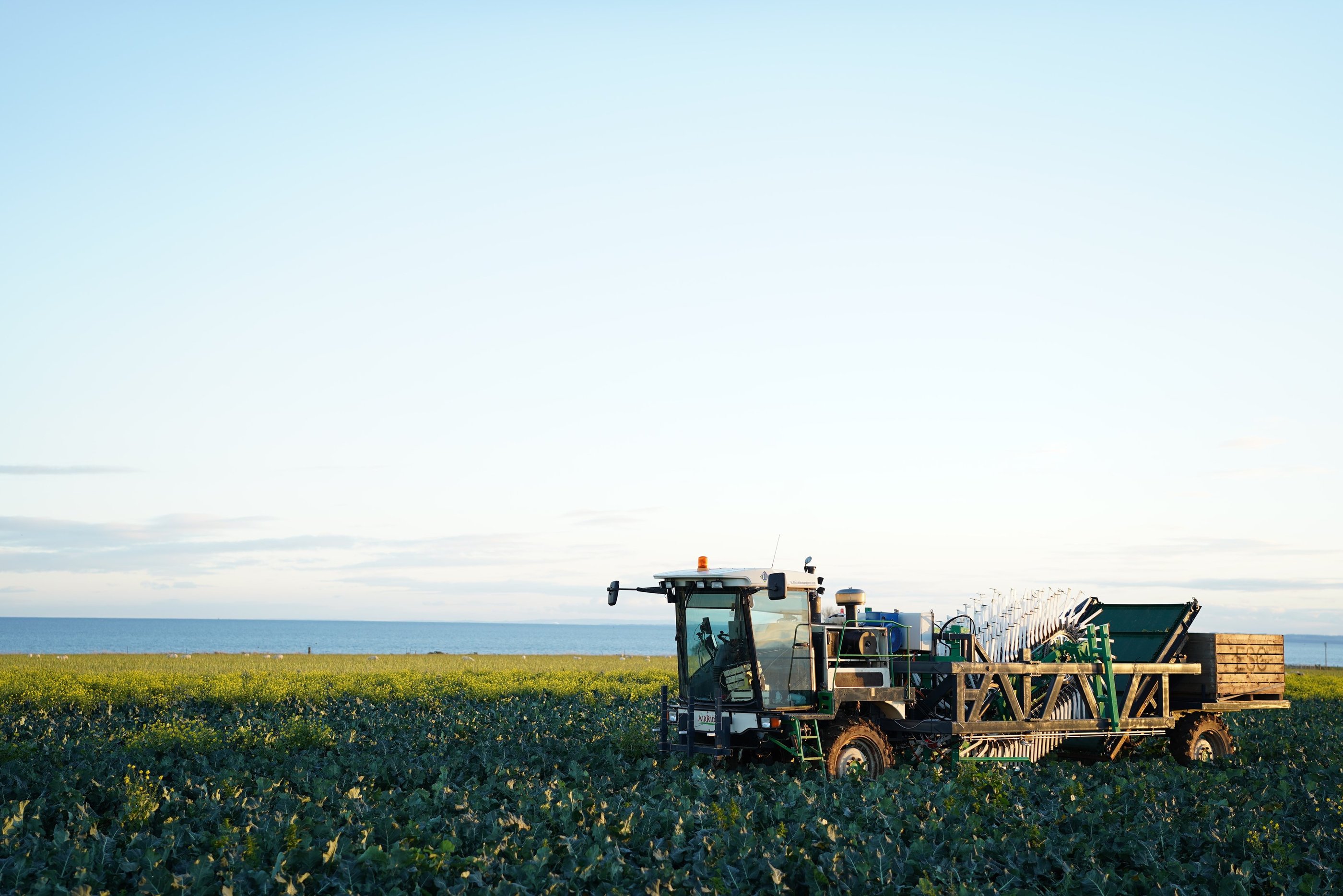
Automate the harvest. Lower the fertiliser. Rebuild the rotation.
Why the real prize from automating broccoli isn't faster picking — it's lower-input farming, better-fed soils, and protein that displaces fertiliser somewhere else entirely.
The real shift is not practical. It is structural.
Harvest automation is usually discussed as a labour story.
Labour is scarce.
Labour is expensive.
Labour is unpredictable.
So we automate.
That framing is true. But it is incomplete. Because when you solve the labour problem in broccoli, the consequences do not stop at the field edge. They move through the rotation, through the ingredient system, and eventually into protein procurement.
And they show up somewhere most people do not expect: fertiliser demand.
That is where harvest automation stops being a farm-efficiency story and starts becoming an upstream lever for lower-input, more resilient food production.
The labour problem is real ... and measurable
The NFU's 2022 horticulture survey found that 40% of UK farms experienced crop waste due to labour shortages, with around £60 million of fruit and vegetables lost in the first half of that year alone. [1] More recent work in the Journal of the Science of Food and Agriculture identifies "labour-intensive crops where adequate automation is currently unavailable" as a leading driver of unharvested produce in field vegetables, with primary-production losses ranging from 10% to 40% across the category. [2]
Broccoli sits squarely in that profile. It is high-value, but it depends on selective, multi-pass manual harvesting. Fields need repeated passes. Cooling and packing windows are tight. When labour availability fails, the crop fails commercially — even when it has not failed agronomically.
That changes grower behaviour.
Acreage becomes cautious. Rotations narrow. Broccoli stays concentrated in specialist regions. A crop that could earn its place in broader rotations becomes a labour-risk crop instead. [1][2]
Mechanical, single-pass harvesting changes that calculation — not only because it lowers harvest cost, but because it makes broccoli easier to plan. Predictable harvest. Lower labour exposure. More usable biomass. A stronger commercial reason to plant the crop in the first place.
Automation changes where broccoli can fit
If broccoli can only be grown where seasonal labour is available, the crop remains geographically constrained. If it can be harvested mechanically, the map changes.
That matters, because broccoli is agronomically more useful than its current narrow deployment suggests. It can fit as a cool-season vegetable crop. It can sit ahead of, or in rotation with, commodity row crops. On the right irrigated fields, near cooling and processing infrastructure, it can give farmers a higher-value rotational option.
Not everywhere. Not every year. Not without infrastructure.
But on the right acres, the crop can do something useful: give growers an alternative to repeating the same commodity sequence year after year because nothing else pays.
That is a regenerative point. Because regenerative agriculture is not only about adding practices. It is about making better rotations economically possible.
The fertiliser case starts in the rotation
Most fertiliser conversations focus on a single crop and a single field. Those questions matter. But they miss the system effect.
If automation lets broccoli enter more rotations, fertiliser use changes across the whole rotation — not only within the broccoli crop.
This is where broccoli's agronomy becomes interesting. Research by University of California Agriculture and Natural Resources in the Salinas Valley, conducted on commercial broccoli fields, found that broccoli roots reach down to 40 inches by the end of the crop cycle, and that in 9 of 10 sites studied, broccoli took up more nitrogen than was applied as fertiliser — scavenging residual soil nitrate that would otherwise have been at risk of leaching. [3]
That does not make broccoli magic. It does not turn it into a nitrogen-free crop — recommended seasonal N rates for broccoli still run between roughly 150 and 240 lbs/acre in California fertilisation guidelines. [4] But it does mean broccoli can capture residual nitrate from deeper in the soil profile than shallower-rooted crops like lettuce or spinach, putting nitrogen back into productive use rather than letting it leach. [3]
That is a fertiliser story. It is also a water story, a soil story, and a rotation story.
The rest of the plant makes the economics work
Agronomic value alone is rarely enough. Farmers do not plant theory. They plant crops that pay.
That is why automation and side-stream utilisation matter together.
A broccoli head represents a small fraction of the plant. Stems, stalks and leaves contain protein, fibre and structure. DEFRA figures, cited in the SusProt project announcement, estimate that more than 600,000 tonnes of broccoli plant mass goes unused in the UK each year — roughly 70–80% of the harvestable biomass, depending on the cut. [5]
Hand-harvesting cannot economically separate and recover that biomass at the cost, scale, and consistency food manufacturing requires. Automation can.
Once that happens, broccoli changes commercially. The head remains the primary vegetable product. The stem and stalk become contracted feedstock. The grower gains a second revenue stream. The processor gains a domestic ingredient source. And the crop becomes easier to justify inside a rotation.
Side-stream value does not just reduce waste. It improves the economics that allow broccoli to be planted more widely.
The fertiliser has already done its job
There is one more layer.
The biomass used for protein and fibre has already been grown. The land has already been used. The water has already been used. The fertiliser has already been applied — for the heads.
That makes broccoli-derived ingredients structurally different from ingredients grown as dedicated protein crops. Pea protein requires pea production. Soy protein requires soy production. Each tonne carries its own input history.
Broccoli-derived protein and fibre start from biomass that exists only because broccoli heads were being grown anyway. That does not make the ingredient input-free — extraction and processing have their own footprint — but it does mean no additional dedicated crop has to be grown to create the protein and fibre stream.
Life-cycle analysis carried out within the SusProt consortium estimates broccoli-derived protein at around four times less carbon-intensive than pea protein. [6] Carbon intensity is not the same metric as fertiliser intensity, but the two move together: synthetic nitrogen production is one of the most energy-intensive parts of agriculture.
When broccoli-derived ingredients displace higher-input alternatives elsewhere in the food system, some of the fertiliser demand associated with those alternatives is avoided. [5][6]
That is system-level fertiliser displacement. It does not happen through a single field-level calculation. It happens because one crop starts doing more work.
Regenerative agriculture needs commercial machinery
There is a tendency to talk about regenerative agriculture as if it is mostly a philosophy.
It is not.
It is also logistics. Timing. Markets. Machinery. And whether the grower can make money.
A more diverse rotation is only useful if the crop can be harvested. A break crop only works if someone wants to buy it. A lower-input plan is only credible when data shows where inputs can actually be reduced.
This is why harvest automation matters. It removes one of the largest commercial frictions preventing broccoli from being used more widely. Side-stream ingredient recovery removes another. Field-level data removes a third.
Together, they begin to turn broccoli from a specialist vegetable crop into a crop-system platform.
Data turns lower NPK from ambition into management
Reduced NPK use cannot be built on slogans. It needs measurement.
Automated harvesting creates a new layer of plant-level and field-level data. Combined over time with information from planters, weeders, weather, soil, varieties and geography, that data can support better variety placement, better yield prediction, better understanding of crop establishment, and better decisions about where fertiliser is actually needed and where it is not.
Lower input use is not about simply applying less. It is about applying better.
That is how automation moves from labour substitution to farm-system intelligence — and how lower NPK use becomes practical without asking growers to take on more risk.
Why this matters commercially
For food producers, the embedded fertiliser footprint of ingredients is becoming more visible. Scope 3 scrutiny is rising. Retailers are asking harder questions. Input volatility is no longer background noise — fertiliser markets are exposed to energy prices and geopolitics in ways they were not five years ago.
In that context, a domestic protein and fibre source recovered from an already-grown crop is not a niche sustainability claim. It is a structural advantage.
For growers, the argument is more direct. Automation can make broccoli easier to harvest. Side-stream utilisation can make it more profitable. Contracted demand can make it less risky. Rotation value can make it agronomically useful. Data can make it easier to manage.
That combination is what supports wider adoption.
Not automation alone. A stack.
What this means for UPP
Harvest automation is the foundation of UPP's model. But the reason it matters is bigger than labour.
It unlocks a different relationship between crop, rotation, ingredient and input use.
Better for growers, because broccoli can become a more predictable, higher-value rotational option. Better for farming systems, because more diverse rotations can support soil health, nutrient capture and lower pressure on NPK inputs. Better for manufacturers, because protein and fibre can come from biomass already grown for another purpose. Better for retailers and brands, because Scope 3 reduction becomes part of ingredient design rather than a separate offsetting exercise.
Better for the system, because the avoided fertiliser demand is not theoretical. It comes from using more of the crop — and from making better rotations commercially possible.
Closing thought
The labour case for harvest automation is easy to understand.
The fertiliser case is quieter.
The rotation case is bigger.
Once broccoli is no longer constrained by manual harvest economics, it can play a different role in farming systems. It can move beyond specialist production. It can enter selected rotations. It can support cover-crop-based and soil-health strategies. It can scavenge residual nitrogen. It can create more value from the same acre.
And when the whole plant is recovered, processed and used as protein and fibre, the fertiliser already invested in that crop does more work.
Not just less waste.
More function.
Not just harvest automation.
Rotation enablement.
Not just a better broccoli business.
A better crop system — with lower embedded inputs, stronger farm economics, and a clearer path to regenerative agriculture at commercial scale.
References
National Farmers' Union. NFU Horticulture mid-season labour survey results. August 2022. Available at: https://www.nfuonline.com/updates-and-information/nfu-horticulture-mid-season-labour-survey-results/
Gage RA, Terry LA, Falagán N, et al. Biological factors and production challenges drive significant UK fruit and vegetable loss. Journal of the Science of Food and Agriculture. 2025. doi:10.1002/jsfa.13830
Smith R, Cahn M, Hartz T, et al. Using rotations to improve nitrogen use efficiency of cool season vegetable production systems. University of California Agriculture and Natural Resources, Salinas Valley Agriculture Blog. 2018. See https://ucanr.edu/blog/salinas-valley-agriculture/article/using-rotations-improve-nitrogen-use-efficiency-cool-season-vegetable also Abstract: Broccoli Rotations Role in Reducing Nitrate Leaching in Vegetable Production Systems. (ASA, CSSA and SSSA International Annual Meetings)
Geisseler D, Horwath WR. Broccoli — Production and fertilisation guidelines. California Department of Food and Agriculture, Fertilizer Research and Education Program. UC Davis. Available at: http://geisseler.ucdavis.edu/Guidelines/Broccoli.html
UPP, James Hutton Institute, Agri-EPI Centre. SusProt: Sustainable Plant Protein from Vegetable Crop Sidestreams — Consortium announcement and DEFRA / UKRI grant. June 2023. Available at: https://www.proteinproductiontechnology.com/post/upp-leads-consortium-to-unlock-a-healthy-sustainable-plant-protein-source-from-the-broccoli-we-already-grow
UK Agri-Tech Centre. Automated broccoli harvester could help farmers with labour shortages — SusProt project life-cycle and environmental findings. February 2025. Available at: https://ukagritechcentre.com/news/automated-broccoli-harvester-help-farmers-labour-shortages/
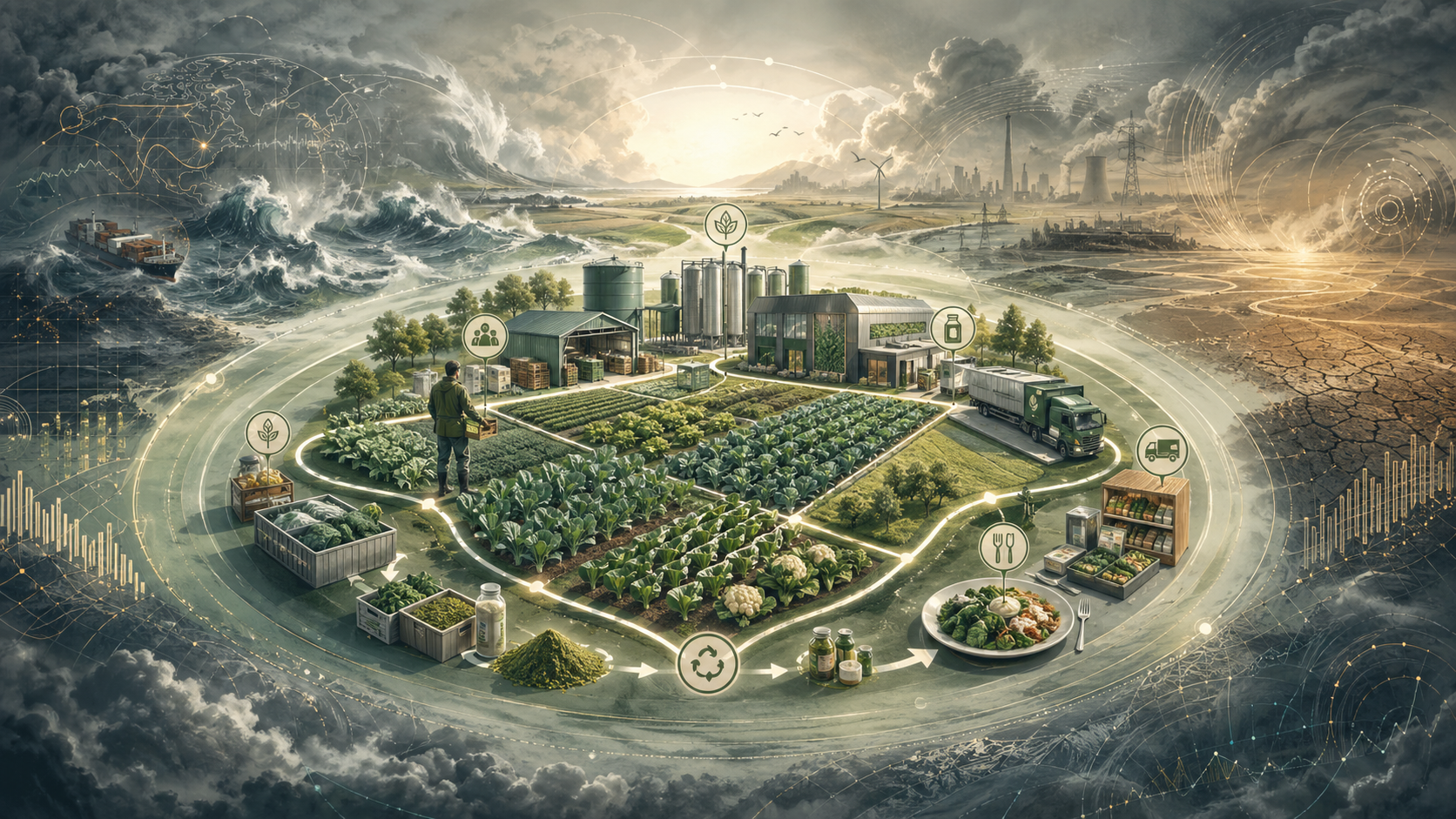
Permacrisis is not the problem. Building for it is the answer.
People have stopped saying "when things get back to normal." The 2020s are the decade of omnicrisis, and the food system is where that decade lands hardest.
Brexit and the regulatory divergence of devolved nations. De-globalisation. Covid. Ukraine — first the energy shock, then the commodity shock. The Middle East — first the energy shock, soon the commodity shock. None of these are over. None of them happened in isolation. And none of them are the last shock the food system will absorb in this decade.
Layered on top: tax and administrative burden rising, customer expectations of immediacy and personalisation rising, retailer cost pressure rising, supply-chain reporting requirements rising, climate-related disruption rising, water and labour availability falling. The system is getting exponentially more complex while the people who run it are getting exhausted.
The biggest loss isn't margin. It's confidence.
Where confidence has gone first
The loss is most visible in the farming sector, and that's not an accident. Farming carries a temporal mismatch that concentrates risk in a way no other part of the food system has to bear: input decisions made twelve to eighteen months before output prices are known, weather risk borne entirely upstream, labour cost inflation outrunning farmgate price increases, and increasingly volatile demand signals from supermarkets that pass volatility downward without absorbing it.
This produces a perverse incentive. Farmers diversify away from food production at exactly the moment the system most needs domestic food production. Land use shifts toward solar, toward stewardship schemes, toward anything that pays predictably. Food production becomes the residual activity rather than the primary one.
Meanwhile the delivery system is fragmented. Growers, processors, manufacturers, retailers, foodservice operators all optimise for their own slice. There is no architect for the whole. Coordination, when it happens, happens informally between people who have known each other for twenty years — which works, until the people retire and the relationships don't transfer.
Why "cost vs resilience" is the wrong frame
The conventional response is to call this a trade-off. Resilience costs more than cost-optimisation. So either you pay for resilience and lose on price, or you optimise for price and accept fragility.
This framing is wrong, and it's wrong in a way that matters. The trade-off only exists if you accept the existing supply chain architecture as fixed. If you treat the architecture itself as the variable, cost and resilience can converge rather than diverge. Three observations explain why.
Cost is well-defined; resilience is not. Everyone in the supply chain can calculate cost down to the penny per kilogram. Almost nobody can calculate resilience with the same precision. We measure what we can quantify, and we systematically under-invest in what we struggle to. The first task isn't to choose between cost and resilience — it's to make resilience measurable enough that it appears on the same balance sheet as cost.
The cheapest meat is no meat. When food production fails, the cost is not the price differential between domestic and imported supply. It's the absence of supply at any price. The pandemic taught this lesson, briefly, before the system reverted to pre-pandemic optimisation patterns. The next shock will teach it again.
Resilience is a system property, not a company property. No individual business can be resilient inside a fragile system. Resilience is what the system delivers when its components are aligned. That means resilience can only be improved by changing the relationships between participants — not by any individual company spending more on contingency.
The "we are the system" argument
It's easy to blame structural forces. Brexit, geopolitics, climate, regulation. These forces are real, and they are not under any individual actor's control.
But the supply chain architecture that determines how those forces get absorbed is something the participants chose, and continue to choose, every day. We are the system. The system is what we permit. And the system is what we tolerate.
This matters because it puts the response back in our hands. If the system is something we are — rather than something that happens to us — then the response is not to wait for shocks to stop, but to redesign for them.
What redesigning for permacrisis actually means
Three things, in our experience.
First, defining the strategic advantages that are genuinely yours and leveraging them ruthlessly. Most food businesses try to compete across too many dimensions. The successful ones identify two or three structural advantages — geographic, technical, relational, financial — and build the entire commercial proposition around them. For everyone else in the supply chain, those advantages translate into reliability, which is the currency resilience trades in.
Second, focus on the outcome rather than the activity. Most operational planning works backwards from process: how do we run the existing system more efficiently. Resilient planning works backwards from outcome: what does the food on the plate need to be, and what's the simplest supply chain that delivers it consistently. The first question optimises for the past. The second one designs for the future.
Third, long-term relationships have to be part of the answer. The transactional contract — lowest price, swappable supplier, six-month renewal — is the mechanism by which volatility gets pushed down the chain to the most exposed actor. It's economically rational for the buyer in any given quarter, and structurally destructive over a decade. The systems that survive permacrisis well are the ones that have replaced transactional sourcing with multi-year commercial relationships where both parties bear some of the volatility and both parties share some of the upside.
Collaboration as architecture, not slogan
Collaboration is the most overused word in food systems writing. It mostly means nothing. People say it when they mean "I want you to help me with my problem."
Real collaboration in supply chains has three observable features. The participants align their incentives in writing rather than verbally. They build trust through small commercial commitments before making large ones. And the perception of fairness — not just the substance of fairness — is treated as a first-order design criterion. People do not stay in commercial relationships that feel unfair to them, even if those relationships are technically equitable on a spreadsheet.
This last point is under-appreciated. Fairness is a perception variable, not a financial variable, and most supply chain redesigns ignore it. Treating fairness as architecture rather than as garnish is what separates supply chain partnerships that survive a decade from the ones that fall apart in eighteen months.
We are, after all, all on the same island. All in the same boat. The decisions a food manufacturer makes about how to source ingredients shape what farming looks like on the same land where that manufacturer's workers live. The decisions a retailer makes about how to price ready meals shape whether the next generation chooses agriculture or chooses leaving. The system is reciprocal whether or not the participants behave as if it is.
The "big food" / "small food" balance
Markets require management. The bigger the business, the stronger the guardrails need to be. This is not anti-corporate — it's pro-functional-market. Concentration of market power creates fragility precisely when stability requires distributed capability. A food system with three buyers and a million sellers fails differently from a food system with three thousand buyers and a million sellers. The second one absorbs shocks; the first one transmits them.
The right answer isn't to dismantle "big food." It's to ensure "small food" has enough scale and protection to remain commercially viable alongside it. Diversity of business model — large industrial alongside regional artisan, vertically-integrated alongside networked, branded alongside private-label — is itself a form of system resilience. Monocultures fail catastrophically; diverse systems fail gracefully.
This is true in the field and true in the supply chain.
A note on data husbandry
There is a particular concern emerging that deserves direct attention. The food system is rapidly becoming a data system, and the lessons from other industries about what happens when data concentrates need to be heard before the same patterns establish themselves here.
Farmers will already be aware of the Uber pattern. A platform aggregates supply and demand. Initially both sides benefit because the platform reduces friction. Over time, the platform accumulates enough information about both sides of the market that it can use that information to extract a maximum economic tariff — pushing both producers and consumers to accept the minimum acceptable price at any given moment, while the platform captures the difference.
This pattern is not theoretical in food. It is already visible in some categories. Real-time pricing, dynamic procurement contracts, AI-driven yield prediction tied to forward purchasing — each of these technologies, deployed without governance, accelerates the concentration of information and the extraction of margin.
Data husbandry — meaning, who owns the data, who controls the analysis, who benefits from the insight — is the single most important governance question the food system needs to answer in the next five years. It needs to be answered by the participants, not for them by intermediaries.
What we are trying to do
At UPP we believe the response to permacrisis is to build infrastructure that makes the food system simpler, more reliable, and more locally-grounded — not more complex. Our specific contribution is small: we convert underused brassica biomass into specification-grade plant protein and fibre ingredients that allow major food manufacturers to reformulate existing products at lower cost, with reduced allergen complexity, with shorter supply chains, and with measurable Scope 3 reduction.
But the wider thesis is bigger than our specific products. It's that the way to navigate permacrisis is not to wait for stability to return. It's to build operations, relationships, and supply chains that work because of complexity rather than despite it.
Shocks have come. More are coming. The question is whether we have built businesses that absorb them, or businesses that transmit them.
Are we prepared?
How will we respond?
The choice is to struggle on, or to embrace the opportunity. The first response treats permacrisis as something happening to us. The second one treats it as something we are designing for. Only the second one is durable.
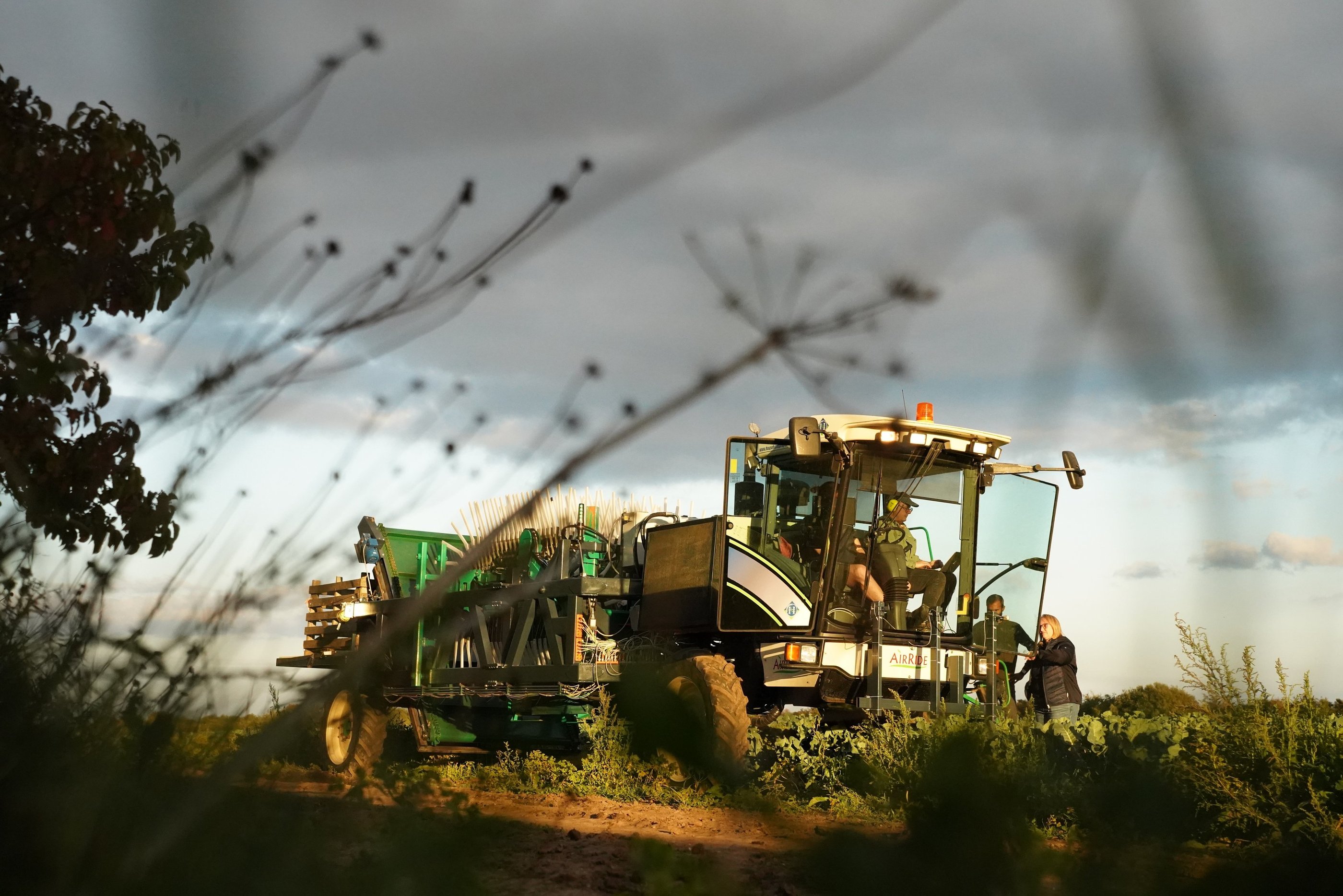
The next era of food. The work happens upstream.
There is a temptation to read each new retailer announcement as an isolated update. More value. More innovation. More personalisation. More sustainability.That misses the point.
What the major UK and European retailers are actually describing — across multiple updates over the past two years — is a shift in the operating model of food. The next phase of retail will not be won by suppliers offering cheaper ingredients, stronger claims, or another layer of complexity. It will be won by suppliers who can help the system move faster without making the customer experience worse.
That distinction matters, because the food system is now under pressure from every direction at once: cost-conscious customers, availability targets, manufacturer margin, rising health expectations, Scope 3 audit, and supply chains tested by climate, labour, geopolitics and volatility. And now GLP-1s are changing how people eat — not in theory, but in baskets, in portions, in protein choices, in fibre demand, in the basic question of what food has to do for people.
The market is in a holding pattern
Consumers haven't abandoned value, convenience, or familiar formats. But they are reassessing what food needs to deliver.
That's the tension. People want food that is affordable, familiar and easy. They also want food that supports better health, feels more credible, and doesn't ask them to compromise on taste, texture or availability.
For retailers, that creates a difficult equation. Better food cannot become a premium niche. Health cannot become a separate aisle. Sustainability cannot rely on customer sacrifice. And reformulation cannot break the product.
So the real question becomes: how do you upgrade the food system without asking shoppers to experience the disruption?
The answer sits upstream
This is where suppliers matter more than ever.
Retailers cannot solve Scope 3 from the shop floor. They cannot reformulate every product from the shelf edge. They cannot deliver healthier defaults if the ingredients going into food are still optimised only for cost, bulk, shelf life and repeat purchase.
The work has to happen earlier — in crops, in specifications, in ingredient systems, in processing, in how side streams are valued, in how manufacturers reduce additives, increase nutrition, protect quality and maintain affordability at the same time.
That is not a communications challenge. It is an infrastructure challenge.
Protein and fibre are not trends. They are signals.
The recurring retailer focus on protein and fibre matters — not because either is new, but because both reveal what the next phase of food is really about: nutrition density.
GLP-1s didn't create that need. They exposed it. An ageing population needs better protein. A fibre-deficient population needs more fibre in everyday foods. Health-conscious shoppers need products that deliver more per calorie. Manufacturers need ingredients that improve the nutritional profile of existing categories without turning every reformulation into a technical project.
That is why protein and fibre are becoming system levers. Not just claims. Not just front-of-pack language. Functional inputs. Quiet upgrades. Better defaults.
Reformulation has to become lower friction
Food businesses do not need more theoretical innovation. They need innovation that survives procurement, QA, factory trials, retailer approval, sensory testing, cost pressure and repeat purchase.
That is the real filter. Can it work in existing processes? Can it reduce complexity rather than add it? Can it support cleaner labels without creating allergen issues? Can it improve nutrition without changing the eating experience? Can it help with carbon without relying on offsets? Can it scale?
This is where many good ideas fail. Not because they are wrong, but because they ask too much of the system too soon.
The retail direction now points to a different kind of supplier value: ingredients and partnerships that make change easier to adopt. Not louder. Easier.
Sustainability is becoming a supplier action, not a retailer slogan
For years, sustainability sat comfortably in brand language. Targets. Pledges. Reports. Commitments.
That era is ending. Scope 3 moves the pressure into the supply chain — and that means retailers need suppliers who can do more than talk about impact. They need suppliers who can evidence it, measure it, reduce it, and build it into the ingredient itself.
That is where Life Cycle Analysis stops being a sustainability document and becomes a commercial tool. Because if a supplier can show lower impact, secure supply, credible traceability and practical reformulation value, they are not just helping a retailer meet a target — they are reducing system risk.
Circularity is moving from nice idea to competitive advantage
Circularity is often treated as a sustainability concept. Use more of the crop. Waste less. Close loops. Do the right thing.
But in a more volatile food system, circularity is also a resilience strategy. If more of the crop becomes useful food-grade input, supply improves. If side streams become functional ingredients, waste becomes value. If ingredients can come from existing agricultural outputs, the system gets more efficient without needing a new food universe.
The principle is straightforward. Take broccoli as an example: using the whole crop across fresh, frozen and ingredient supply is not a marginal idea — it is exactly the kind of systems thinking food retail now needs. The crop does not stop being valuable when it falls outside one specification. The question is whether the supply chain is intelligent enough to use it.
Waste is not a moral failure. It's a design failure. And it is solvable.
The future supplier is a systems partner
Retailers increasingly say they want to be more strategic partners for their suppliers. The reciprocal is just as important. Suppliers now need to become more strategic partners for retailers.
That means recognising each step in the chain — farm, harvest, processing, ingredient functionality, manufacturing, retail execution, customer experience, carbon, nutrition, cost, availability — not as separate problems, but as one connected system.
The suppliers who win will be those who can help retailers deliver better food with less friction. Healthier products without compromise. Lower carbon without fragility. Cleaner labels without technical risk. Innovation without disruption. Resilience without extra cost.
Why this is exactly what UPP is built for
UPP is not trying to invent demand for something the food system does not need. We are responding to what the system is already asking for.
We work upstream — turning under-utilised brassica biomass that would otherwise be left in fields or diverted to low-value pathways into food-grade protein and fibre ingredients that integrate into mainstream manufacturing. The crop is already grown. The nutrition is already there. What's been missing is the infrastructure to convert it into something manufacturers can actually use, at scale, with procurement-grade documentation, allergen clarity, and traceability.
That is the same whole-crop logic the most forward retailers are now describing — applied at the ingredient layer. More protein. More fibre. Cleaner functionality. Lower-carbon inputs. Better use of crops. More resilient supply. Reformulation that works inside real manufacturing constraints. And food that improves without asking the customer to notice the machinery behind it.
Closing thought
The message coming from retail to suppliers is not complicated: help us make food better, but do it without breaking what customers already rely on.
Better health without higher friction. Sustainability without weaker availability. Innovation without losing value. Reformulation without compromising taste. Circularity without complexity.
The food system does not need more pressure. It needs better tools.
The suppliers who provide them will not just support the next phase of retail. They will help define it.
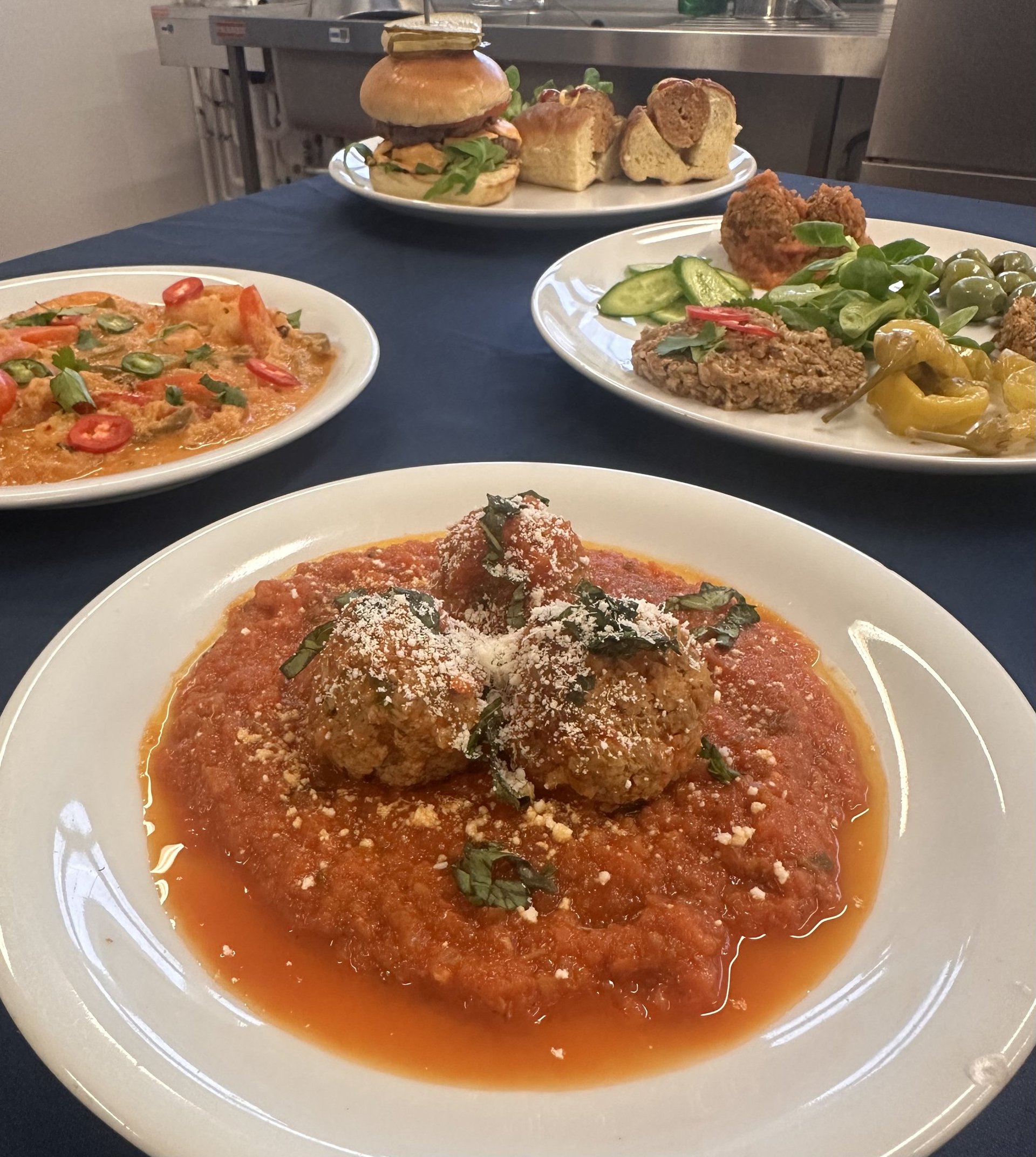
Less than £1 for the food. The school meal is now a system design problem.
Funding has not kept up with what schools are being asked to deliver — and the gap is no longer something operators can close on their own.
England's school meal funding is now £2.61 per child. The real cost of delivering a quality two-course meal sits closer to £3.45. Wales pays 79p more, Scotland 69p more, Northern Ireland 49p more.
Roughly half of the £2.61 is consumed by staffing and overheads. That leaves under a pound for the actual food on the plate — at a moment when food inflation, wage increases, National Insurance rises, energy costs and the expanded Free School Meals roll-out are all moving in the wrong direction at once.
The conversation is starting to shift toward where it should have been all along: indexed funding, universal primary free school meals, and a coordinated industry voice. Those are the right reforms. But while the policy debate plays out, schools and caterers are having to subsidise meals from budgets meant for building repairs, IT and pastoral support. That is not a sustainable position. And the operational efficiencies that have absorbed cost pressure for the last decade are now exhausted.
The shelf-edge response is running out of room
For most of the last ten years, the cost-pressure response in school catering has been the same response it has been across the wider food system: smaller portions, cheaper inputs, longer shelf life, more bulk fillers, more processed components. That arithmetic worked for a while. It is not working any more — and the food children are eating is increasingly the variable that gets cut.
That is not a moral failure on the part of school caterers or operators. It is the predictable outcome of asking the same operating model to absorb compounding cost pressure year after year without changing how the food is delivered.
The work has to move upstream
Cost cannot be solved at the serving counter. Nutrition cannot be solved at the till. The shelf-edge response in school catering is now identical in structure to the shelf-edge response in retail: there is no margin left in operations to cut, and the only honest answer is to change how the ingredients themselves are sourced and used.
That is an upstream problem.
It means rethinking how crops, side-streams and existing agricultural outputs are converted into the ingredients that go into school food. It means asking what proportion of the food currently on the plate could be replaced — invisibly, without changing taste or texture — with ingredients that deliver more nutrition per pound, lower carbon, fewer additives, and supply-chain resilience. It means treating school food as an ingredient infrastructure problem rather than a kitchen-discipline problem.
More nutrition per pound is not a slogan — it's the only honest answer
The shift the wider food industry is making — toward nutrition density rather than calorie density — applies more sharply to school food than anywhere else. Children need protein and fibre. They need ingredients that carry the nutritional load without carrying additives and allergens that increase compliance complexity for kitchens already running under pressure. They need food that tastes good enough to be eaten rather than thrown.
The same low-friction reformulation principles that apply in mainstream retail apply in school catering, with one important difference: the budget per portion is far tighter and the consequences of getting it wrong are felt by children whose nutrition matters most. That makes the case for upstream reform stronger, not weaker.
The whole-crop opportunity
A meaningful share of the broccoli, cauliflower and brassica crop grown in the UK never enters the food system — not because it isn't nutritious, but because it isn't economically integrated into downstream demand. The same is true of many other crops grown for retail specification.
Converting that under-utilised material into food-grade protein and fibre ingredients does three things at once: it lowers the cost of the nutritional load; it reduces Scope 3 emissions associated with the meal; and it improves the resilience of the supply chain feeding institutional catering at a moment when that supply chain is under structural strain.
This is not a future option. It is one of the few levers left that can move the underlying economics of a school meal in the right direction without asking the policy environment to fix everything first.
Where UPP fits
UPP is built around exactly this principle. We work upstream, turning under-utilised UK and Spanish brassica side-streams into non-allergenic, non-novel protein and fibre ingredients (Prota, Fiba, Bynda) that integrate into mainstream manufacturing — the manufacturing layer that feeds school catering as much as it feeds supermarket shelves. The crop is already grown. The nutrition is already there. The infrastructure to convert it is what we have built.
We are not the answer to the funding gap. The funding gap needs the policy reforms that Kanpla and others are rightly calling for. But while that conversation plays out, manufacturers and caterers feeding institutional food systems do have a lever to pull — and that lever sits in the ingredients, not at the serving counter.
Closing thought
A £2.61 school meal does not need another efficiency drive. The kitchen has run out of room. What it needs is better ingredients arriving at the kitchen door, wherever possible from British Farms — ingredients designed from the outset to deliver more nutrition per pound, with the documentation, allergen clarity, and sensory performance that institutional catering actually requires. Fork from Farm.
The policy reform conversation matters. But it is not the only conversation. The other conversation — the one happening upstream in crops, side-streams and ingredient systems — is where some of the cost pressure can be relieved without waiting for Westminster to act.
It is pragmatic. It is operational. And increasingly, it is the only honest response to the room that has run out.
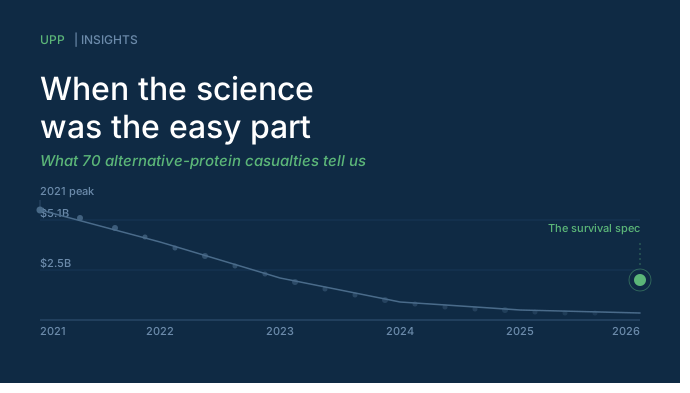
What 70 alternative-protein casualties tell us about the next era of food.
Between September 2024 and April 2026, the alternative-protein sector lived through its first real shake-out. Green Queen's running register documented 40+ closures, bankruptcies, liquidations and distressed M&A events between September 2024 and August 2025. By February 2026, GFI's analysts were citing 60+. Add in Believer Meats, Meatable, Yves Veggie Cuisine, Allplants, Wild Earth and the others that have closed or been wound down since, and the count is approaching 70.
The temptation is to read this as a sector failing. We don't think it is. We think it's a sector being re-priced. And the re-pricing has something specific to teach about how the next era of food will actually be built.
Three risks underwritten as one bet
Capital markets supported the alternative-protein category in 2020–22 by underwriting three independent risks as if they were a single thesis.
Process-biology risk. Sterility, contamination, titer, yield, downstream processing. Whether the biology would actually work consistently at industrial scale.
Plant-based meat-analogue category-demand risk. Whether consumers would adopt the meat-replacement category at the scale and speed the funding rounds had assumed. US plant-based meat retail sales fell 7% in 2024 and unit volume fell 11%. European numbers tracked. The downstream channel that most fermentation start-ups were ultimately selling into compressed.
Capex-to-cash-flow conversion risk. Whether the bioreactor builds and pilot facilities would convert into operating cash before follow-on capital was needed. In a 2021 funding environment, follow-on was abundant. By 2024 it wasn't.
A company built around any one of these risks could survive. A company built around all three simultaneously — which describes most fermentation-route alt-protein businesses — could not survive a contracted funding environment. The casualty register is not a list of companies that executed badly. It's a list of companies whose underwriting model didn't hold once capital markets started pricing the risks separately.
The five canonical cases
Five collapses are doing most of the explanatory work in industry conversations, and they're worth understanding because each names a slightly different failure mode.
Mycorena (Sweden, biomass mycoprotein). ~€35M raised. Discontinued large-scale factory project June 2024 after Series B failed to close. Acquired by VEOS-subsidiary Naplasol the next month. Founder Ram Nair's diagnosis to the trade press was the canonical chicken-and-egg trap of capex-stage fermentation: investors will not back the factory without binding offtake; partners will not sign offtake without proven production. Stuck companies fail there.
Motif FoodWorks (USA, precision fermentation). $345M raised. IP litigation with Impossible Foods over heme-protein patents. Settled September 2024 with each side bearing its own costs. Wind-down notice within days. The deeper question, framed by industry sources at the time, was whether precision fermentation can move from creating a strain to commercialising it at the right titer, the right yield, and the right application — and whether there is an actual customer at the end of that journey.
Planetarians (USA, solid-state fermentation upcycler). $6M+ raised. Schools and foodservice channel, claimed 72% acceptance, repeat purchases. Could not bridge from foodservice unit economics to retail margins. IP and assets auctioned August 2025.
Arkeon (Austria, gas fermentation). $13M raised. Filed for insolvency June 2025. CEO Gregor Tegl's own postmortem to AgFunderNews — unusually candid — identified five compounding factors. The line worth keeping: the sector got hooked on technologies that produced new things, and forgot the customer.
Meati Foods (USA, biomass mycoprotein). $365M–$450M raised. 7,000-store distribution. 130% YoY distribution expansion in 2024. It breached a financial covenant in February 2025 and assets sold for ~$4M in May 2025. A 99%+ wipe-out for late-stage equity.
The composite reads cleanly. Process biology is hard. Capex scale-up requires offtake. The downstream meat-analogue category contracted. Litigation tax. Debt-covenant fragility. All of it true. None of it surprising once you see it laid out.
What's underneath the casualty list
It's possible to read the register as a story about bad luck, bad timing, or bad markets. We don't think that's quite right either.
Read together, the cases describe a category that bet on consumers changing — and on capital staying patient while consumers changed. Both bets were structural mistakes.
Beyond Meat's CEO Ethan Brown, announcing the rebrand to “Beyond” in March 2026, told Fortune the moment for plant-based meat had passed. That's the mature version of the bet that didn't pay. Quorn's revenue down £186.7m in 2024. Yves discontinued. Hooray Foods, Nowadays, Sunfed, Allplants, Plant & Bean, Meatless Farm — the meat-analogue retail and DTC layer has been compressing since 2023, and the compression isn't a blip. It's a structural reset of consumer adoption against pre-2022 forecast.
Cultivated meat has it worse. Funding peaked at $989M in 2021. 2024: ~$55M. 2025: ~$65M. Believer Meats had FDA approval, USDA approval and a 200,000 sq ft North Carolina plant cleared for commercial sale. They never entered commercial production. They filed for bankruptcy in December 2025 with $225M in debt. Industry observers reading the news called out the bitter irony: every regulatory and infrastructure box ticked, and still no commercial future. The trifecta wasn't enough.
The pattern that matters isn't that these companies failed. It's that the surviving cohort — Planetary in Switzerland raising CHF 22M in early 2026 on an explicit “control the full value chain” thesis; the strategic acquirers who are buying the wreckage at 1–2% of capital raised — are operating from a different model. Vertical control. Lower capex per unit of output. Non-novel regulatory paths. Functional ingredient channels rather than category-creation channels. Customer-pull rather than capital-runway as the primary risk-management mechanism.
Where the consolidation is actually going
The acquirer base for distressed alt-protein platforms in 2025–26 tells you something the funding numbers don't.
Vegetarian Butcher: Unilever to JBS-Vivera. Loma Linda: Atlantic Natural Foods to Century Pacific. Kate Farms: to Danone. Raisio's plant-protein business: to Valio. Mycorena: to Naplasol, a subsidiary of Belgian animal-protein producer VEOS. The buyers of distressed alt-protein platforms are now mainstream meat, dairy and food incumbents — not other VC-backed players. This is mature-category consolidation, and the multiples reflect it.
For founders and operators in the space, that's a meaningful signal about what the next wave of value creation is going to reward. Companies positioned as inputs to incumbent food production, on incumbent margin and quality structures, are being underwritten by the buyers who matter. Companies positioned as alternatives to incumbent food production are being repriced as distressed assets.
What we believe — and what the casualties evidence
This isn't an article we'd be writing if we didn't have a structural view about what the next era of food looks like.
We believe the food system isn't broken. It's optimised. Optimised for cost, convenience and throughput, not for nourishment. The casualties above don't change that thesis — they confirm it. Every one of those companies was trying to add a new optimisation target (alternative-protein sustainability, novel functional ingredients, consumer-facing meat replacement) on top of an industrial system that was already optimised for something else, and trying to do it with new biology, new regulatory exposure, new consumer behaviour, and new capital structures all at once. The system absorbed the cash and gave most of it back as distressed assets.
We believe consumers shouldn't have to change. The system should. The plant-based meat-analogue category compression is the cleanest evidence in the register that consumer-behaviour-change theses don't scale at the price points that were assumed. Beyond Meat's 95% market-value decline, plant-based unit volume falling 11% in 2024, the long list of meat-analogue closures from Yves to Hooray to Allplants — these are not failures of execution. They are evidence that the bet on changing what consumers ask for at the till has a low ceiling.
We believe the next era of food will be built upstream. Not with new diets, but with new inputs. The companies in the casualty register that came closest to a survivable model — Planetarians on schools-and-foodservice, Mycorena on partner offtake, Motif on functional ingredients to existing manufacturers — were all attempting an upstream-input strategy, but trying to do it on top of fermentation biology and novel-food regulation. The strategy was right. The biology and the regulatory tail were the problems.
We believe upcycling is infrastructure. When you control feedstock, processing and agronomy, you control the future. The Planetarians lesson is the most direct: upcycling spent yeast or seed cake from someone else's process is a powerful product story but a fragile commercial one. You cannot control feedstock continuity, you cannot fix the price, you cannot expand. The companies emerging from the wreckage in 2026 are the ones that own the field-to-ingredient vertical.
We believe the future of food is built on better ingredients, not better intentions. The alt-protein category that's now being repriced was sold partly on intention — consumer intention to eat sustainably, investor intention to back transformative biology, founder intention to displace meat. Intention is not infrastructure. The companies surviving the shake-out are the ones whose ingredients improve foods that consumers already buy, on margins that manufacturers already operate, on regulatory pathways that already exist. That's not a less ambitious thesis. It's a more deliverable one.
The honest read
We don't write this from a comfortable position. Every operator in adjacent ingredient categories is under-resourced relative to the size of the change they're trying to make. The companies in the casualty register were, in many cases, run by serious people doing serious work. Their failure is not their incompetence — it's their position relative to a category-wide repricing.
But the repricing is real, and the lessons are specific. The next decade in food will be built by companies that:
operate inside today's regulatory framework rather than racing approval clocks,
supply functional ingredients to existing manufacturer channels rather than creating new consumer categories,
own enough of the upstream — feedstock, harvest, processing — to fix continuity and cost,
match capex to demonstrated commercial pull rather than to capital-runway optimism,
and treat capital structure as part of the risk model rather than a financing afterthought.
Some of this is hindsight talking. Most of it isn't. The five composite failure modes — capex-without-offtake, novel-food regulatory tail, meat-analogue downstream contraction, debt-covenant fragility, IP litigation drag — were all visible to anyone reading the right reports in 2022. They were just not the lens through which the 2021 funding rounds were being underwritten.
For UPP, the casualty register is not a story about competitors. It's evidence that the structural choices we made — non-novel ingredient base, mechanical extraction not fermentation, integrated harvest-to-processing vertical, drop-in functional inclusion at 4–30% rather than category-creation, modular replication rather than monolithic capex — are choices that read differently in 2026 than they did in 2022.
In 2022 they would have looked unambitious. In 2026 they are the structural specification of what survives.
What this isn't
A few things this article deliberately is not.
It isn't a victory lap. The companies in the register were doing real work, their failure was painful for the people who built them, and their pain is not our credibility. The right way to read these closures is as expensive industry learning — paid for, in many cases, by people who lost their savings, their jobs, or their belief in their own thesis. We've taken the lessons from them. We owe them a clear-eyed reading, not a self-congratulatory one.
It isn't an argument that fermentation, mycoprotein or cultivated meat won't matter. They will. The biology is real. The use cases are real. The companies that emerge from this winter — Planetary, Better Meat Co, ENOUGH if it survives the going-concern qualification, Nosh.bio, ProteinDistillery, the survivors of the cultivated cohort once the capital winter ends — will likely build durable businesses on the back of disciplined post-mortems of the casualty register. The category isn't over. It has been re-shaped.
It isn't a claim that UPP has all the answers. We have a thesis and we have an operating model. We have BRCGS Grade A on first audit, ISO 9001:2025, an LCA below 0.25 kg CO₂e/kg, an institutional partner network and a commercial pipeline that's converting. Those are facts. The thesis is still being tested in market. The 70 casualties of 2025-2026 are evidence that even the strongest-funded players in this space can fail in ways that look obvious only in retrospect. We hold our position with humility about the difficulty of doing any of this well.
What the casualty register has clarified is that some structural choices age better than others, and that the alt-protein shake-out has surfaced which choices those are. The article you're reading is our attempt to set down what we think the lessons are, in a register that respects the people who paid for them.
The future of food is built upstream. With non-novel ingredients. On existing channels. By companies that control their own feedstock, run on disciplined capital, and improve foods consumers already buy.
Not better intentions. Better ingredients.
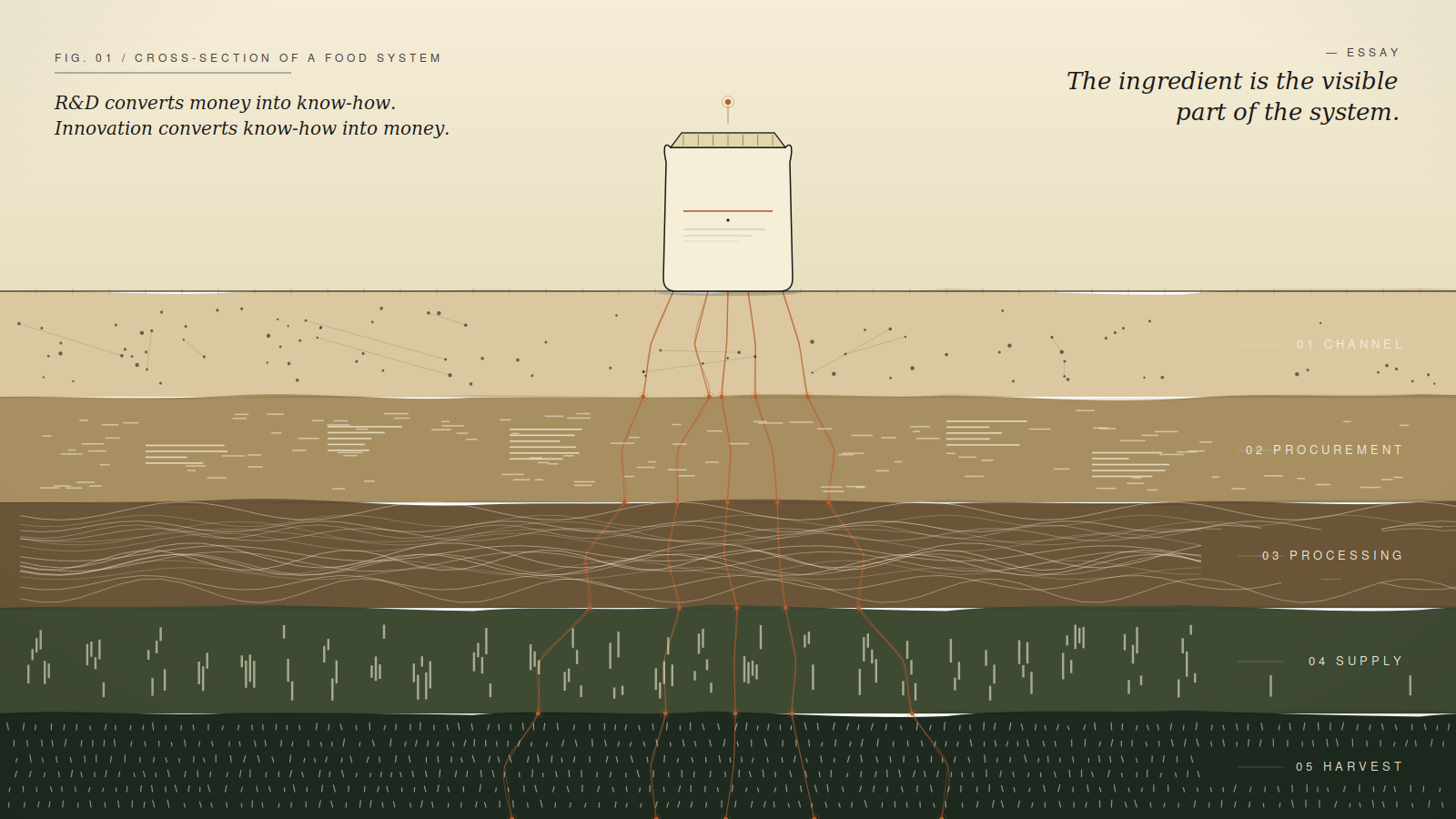
R&D converts money into know-how. Innovation converts know-how into money.
Why most food innovation fails at the second step — and what Danone's €1bn bet on Huel tells us about where it doesn't.
Most food innovation failure is misdiagnosed: When a new product, ingredient or business model fails to scale, the post-mortem usually lands on familiar ground: consumers weren't ready, the brief was wrong, R&D missed the mark, the marketing didn't land.
These explanations are comfortable because they're solvable with the next launch.
They're also, mostly, wrong.
Across the trials, conversations and procurement processes we see, the real killer is rarely the idea itself. It is the ratio of switching cost and risk to time-to-market and economic upside. Almost nobody is designing for that ratio — and so almost everything stalls.
The reasons innovation fails to scale are operational, not creative: reformulation risk inside an existing line; switching cost in factories, specifications and procurement systems; supply that cannot commit to a 36-month volume curve; certification and audit overhead; consumer perceptive barriers on pack; regulatory delay that stretches payback periods beyond the patience of most boards; and procurement teams (rightly) being risk-averse, because their job is to keep the line running, not to take a punt. None of this is glamorous. None of it appears on innovation award shortlists. All of it decides which ideas survive contact with a Tier 1 manufacturer.
R&D is not innovation.
It helps to be precise about the words. R&D is the process of converting money into know-how. Innovation is the process of converting know-how into money. They are different disciplines, with different success criteria, and they fail for different reasons. Conflating them is one of the reasons good ideas die.
R&D rewards depth in a single domain — formulation, processing, microbiology, agronomy. Innovation rewards breadth across a system: what the procurement team can sign off, what the regulatory framework permits, what the consumer recognises on pack, what the factory can run without re-tooling, what the channel can sell, what the unit economics can absorb. A company can be world-class at the first and still fail at the second. Most do.
That is why a system-level view is necessary, and why deep market insight — into how food actually gets bought, specified, audited and consumed — is not a nice-to-have alongside the science. It is the discipline that decides whether the science ever pays back.
If the failure modes are systemic, the answer has to be systemic too. An ingredient, a technology, a brand or a business model is only "innovative" in the sense that matters — commercially — if the surrounding system can absorb it. Two consequences follow. First: innovation comes in many forms. It can sit in the harvest mechanism, the financing structure, the distribution channel, the consumer relationship, the procurement contract, the quality system or the on-pack language. Companies that treat innovation as a synonym for new molecules tend to under-invest in the parts of the system that actually decide whether anything scales. Second: the highest-leverage innovations are usually the ones engineered to minimise the cost of saying yes. Not the most novel. Not the most disruptive. The ones that fit.
The more mature the sector, the wider the aperture has to be.
There is a second reason a system-level view is now non-negotiable, and it is structural rather than philosophical.
Food is a mature sector. It has been optimised for cost, throughput and reliability for the better part of a century. Most of the obvious low-hanging fruit — "swap this ingredient for a cheaper one," "automate this single line," "reformulate this one SKU" — has already been picked. What remains, when innovation is bounded narrowly to product or process alone, is increasingly marginal. Unit economics get tighter. Payback periods stretch. The cost-of-capital hurdle looks the same as it always did, but the prize on the other side is smaller.
This is the trap most innovation programmes walk into. They keep looking in the same place, expecting the next idea to clear the bar that the last one did, and are then surprised when the business case keeps coming back marginal. It is not that the team is worse, or the science is worse. It is that the field they are searching has already been searched.
The way out is to widen the aperture. If a single-product, single-process innovation is no longer accretive, then the innovation has to extend across more of the system to capture enough value to be worth doing. That can mean combining a new ingredient with a new harvest technology, a new procurement model and a new on-pack story — all of which together clear the bar that none of them clear alone. It can mean innovating in the financing structure or the channel rather than the formulation. It can mean redesigning the feedstock as well as the product. The common feature is that the innovation operates at the system level, because the system level is where the un-picked fruit still is.
For food producers, the implication is uncomfortable but freeing. Genuine, accretive innovation in a mature sector rarely looks like a single brilliant new product. It looks like a coordinated set of changes — across harvest, processing, ingredient, regulatory pathway, supply continuity, on-pack language and procurement — that together unlock a step-change. The companies that find those step-changes are the ones that deliberately make their scope wider than their competitors do.
Huel and Danone — innovation in the channel, not the chemistry.
Huel is a useful case in point. The product itself — a complete-nutrition powder — was not technically novel when it launched in 2014. Meal replacement had existed for decades. What was new was the system around it: a direct-to-consumer model, performance-marketing-led acquisition, content built for the feed rather than the shelf, and a distribution architecture that started by bypassing the supermarket entirely and only later moved into retail on its own terms.
In March 2026, Danone announced a definitive agreement to acquire Huel in a deal reported at around €1bn. The strategic rationale is worth reading carefully. Danone did not foreground a proprietary recipe, a novel ingredient or a piece of unique chemistry. It foregrounded Huel's best-in-class digital execution, its direct-to-consumer sales engine and its omnichannel customer base. In return, Huel's CEO described what Danone brought to the table as "infrastructure, distribution and R&D capability" — exactly the system-layer assets that take decades to build.
That is the trade worth noticing. A €1bn cheque, written by one of the most operationally capable food companies in the world, in exchange for a set of capabilities that are structurally hard to build inside a 100-year-old FMCG. The "innovation" Danone was buying was operational and commercial, not formulation. The pattern generalises. The cases where an idea genuinely scales tend to be cases where the innovation is in the system — channel, distribution, financing, supply chain, harvest, procurement — and the product is allowed to be relatively familiar. The cases where ideas stall tend to be the opposite: a novel product asked to carry the weight of an unchanged system around it.
This is the thesis UPP was built on.
We did not start with an ingredient and look for a market. We started with an observation: food is a mature sector in which marginal, single-point innovation no longer clears the cost-of-capital bar — and the only durable way to deliver accretive innovation is to widen the aperture across more of the system than any single player normally would.
So we did. Harvesta automates a harvest step that has been manual for a century, and changes the unit economics of the feedstock. Our processing turns side-streams that other models cannot economically use into multiple specification-grade SKUs through defined blending pathways, converting natural variability into margin. The ingredients themselves sit inside today's regulatory framework — non-novel, drop-in, allergen-free — removing the regulatory delay that kills most new-ingredient business cases. Supply is regional, year-round and BRCGS-certificated from day one, removing procurement risk. The on-pack language is familiar, removing consumer perceptive friction. The economics are designed to be cost-neutral or cost-down, removing the procurement objection that ends most sustainability projects. And the data layer captured during harvest, Intellia, compounds value back into the agronomy, making the system more efficient with each pass.
None of these on their own would clear the bar. Together they do. That is the thesis — and it is also the answer to why the right innovation in a mature sector almost always looks like an infrastructure layer rather than a single new product.
It is why we describe ourselves as infrastructure rather than as an ingredient brand. The ingredient is the visible part of the system. The reason it works commercially is everything sitting behind it.
The system isn't broken. It's optimised.
The food system delivers calories at low cost, high reliability and global scale. That is not a failure mode — it is the result of a century of compounding optimisation. The mistake is to treat the system as the obstacle to innovation. It isn't. It is the environment innovation has to survive in.
The companies and ingredients that scale are the ones designed for that environment from the start. Not the most novel ideas. The ones engineered to fit. That is what we are building. We are not asking food producers to take a bet on a new technology, a new consumer behaviour or a new regulatory pathway. We are removing the boring reasons their existing innovation programmes stall — and widening the aperture so the innovation that does happen is large enough to matter.
Plant 2.0: Why the Protein Shift Will Arrive in Stages, Not All at Once
Every few years a forecast lands declaring that animal protein is about to be displaced. And every few years, that forecast is quietly revised.
This isn’t because the underlying thesis is wrong. It’s because the timeline assumes a step-change, when what is actually happening — and what will continue to happen — is a staged transition. The most useful analogue here isn’t the smartphone. It’s autonomous driving.
Autonomy didn’t arrive in one product launch. It arrived in stages: adaptive cruise control, then lane-keep, then highway assist, then conditional self-driving, and — one day — full autonomy. Each stage needed cost to fall, regulation to catch up, infrastructure to be built, and a generation of drivers to grow up assuming the previous stage was normal. We’re still not at Level 5. But Level 2 is everywhere, and nobody calls it disruptive any more.
Protein will follow a similar curve. We are now leaving Plant 1.0 and entering Plant 2.0.
Plant 1.0: The Ideological Stage
The first wave of alternative protein — the wave that captured the headlines, the IPO valuations and the venture capital between roughly 2015 and 2022 — was built on a “cow-free” narrative. Replace meat. Disrupt the system. Premium price, premium positioning, premium messaging.
It did important work. It proved consumers would try something new. It pulled the conversation forward. But it also assumed the alternative system was already built, already scalable, already trusted. It wasn’t. And the moment economic pressure arrived, premium-priced, ideologically-positioned products were the first thing dropped from the basket.
Plant 1.0 didn’t fail. It just turned out to be Stage 1 of something longer.
Plant 2.0: Hybridisation, Cost and Health
Plant 2.0 is the stage we are entering now, and it looks nothing like the marketing of Plant 1.0.
It isn’t a separate aisle in the supermarket. It’s a 4–30% reformulation inside the products people already buy. It’s brassica protein in a sausage. Fibre in a sauce. Vegetable ingredients in the burger that still says “burger” on the front of pack. It doesn’t ask the consumer to change behaviour — it asks the manufacturer to change formulation.
And critically, it isn’t being driven by ideology. It’s being driven by two very mainstream pressures:
Cost. Meat prices have structurally shifted, and food manufacturers are under sustained margin pressure. Retailers want ingredients that lower the cost of goods without compromising the eating experience. Hybridisation does that.
Health. Fibre is having a renaissance. Protein density now matters more than ever — particularly for the rising population of GLP-1 users, who need more nutrition in less volume. Nutrition is becoming a competitive feature on pack, not a small-print claim.
Plant 2.0 doesn’t ask anyone to give anything up. That is precisely why it will work.
Plant 3.0: The Generational Shift
Plant 3.0 is the stage where the children eating today’s hybrid products grow up and become tomorrow’s shoppers — and tomorrow’s parents.
This is the stage that cannot be accelerated by marketing. It’s generational. People feed their children what they themselves were fed; what is unfamiliar to a parent is rarely the default purchase for their child. So the hybrid sausage roll a ten-year-old eats today, without noticing, becomes the default sausage roll they buy for their own ten-year-old a generation later.
By Plant 3.0, inclusion rates are higher. The “hybrid” framing is gone, because nothing about it is novel any more. Plant-forward formulations are simply how the category is built.
This stage also depends on something that has nothing to do with consumer preference: price parity. Alternative protein is still, broadly, more expensive than the animal protein it competes with. Closing that gap is not a marketing problem; it’s an industrial one. It needs feedstock cost to fall, processing yields to rise, side-streams to be properly monetised, and supply chains to mature. Realistically, that takes another decade.
Price parity isn’t the finish line. It’s the entry ticket to Plant 3.0.
Plant 4.0: Displacement
Plant 4.0 is the endpoint. Animal protein becomes the considered choice — the Sunday roast of prime Scottish beef, Welsh lamb or Tamworth pork — not the everyday default. Most of the protein in most of the products most people eat is plant-derived, because that is what is cheapest, healthiest, and most reliably supplied. Meat is still there for those who want it. It is just no longer the default. And that is a world where provenance matters, where animal welfare standards can be genuinely high, and where British high-welfare livestock farmers are properly compensated for delivering them.
Benefits will also fall to the growers of East Anglia, Fife, the Borders and Cornwall; to the mixed and livestock farms whose grass-fed, high-welfare output finally commands the premium it deserves; and to the regenerative operations whose business model the market has been slow to value.
We won’t arrive at Plant 4.0 through a moral argument. We’ll arrive at it the same way autonomy is arriving: through cost curves, generational habit and quiet reformulation. Nobody will hold a press conference to announce it. One day a retail buyer will look at their category data and notice the line has already crossed.
What that buyer sees on the shelf, though, is decided upstream — by the growers, processors and livestock farmers who choose what to plant, what to breed for, and what to invest in over the next decade. The transition is industrial, but it isn't passive. It happens because the people who actually produce food decide it needs to.
The Strategic View
Food security is currently framed as a question of importing from more reliable countries. Plant 4.0 reframes it as needing to import less in the first place. The UK's larder runs through other people's geography. Food currently comes from over thirty countries, a third of which face significant climate risk.
Every external shock — a war in a grain-exporting region, a drought in southern Europe, a shipping disruption in a strait we don't control — becomes a UK food price spike. The Ukraine war's effect on bread, oil and fertiliser prices wasn't a one-off. It was a preview of what a non-resilient food system does under stress.
The strategic argument for Plant 4.0 has nothing to do with diet. A country that can feed itself from its own land doesn't have to negotiate its citizens' calorie intake with global supply chains. A country whose food system — feed, fertiliser, vegetable oils, grain — depends on imports from politically volatile regions is a country whose food security sits in someone else's port.
Plant 4.0 is the path back to a UK that grows what it eats, eats what it grows, and treats the global food market as a useful supplement rather than a structural dependency. That isn't insularity — it's the kind of resilience the UK has spent fifteen years rebuilding in energy, and ought to have started rebuilding in food a decade ago. The quiet beauty of the protein transition is that it delivers the rebuild without anyone having to declare it a national project. The supermarket shelf does the work.
The Operational View
Sustainability strategies built on a “cow-free” tomorrow are fragile. Sustainability strategies built on a 20% inclusion rate, this quarter, in a product already on the shelf, are not.
Better for farmers.
Better for producers.
Better for people.
Better for the planet.
That isn’t a dietary philosophy. It’s what Plant 2.0 looks like when the system is designed properly — and it’s what makes Plant 3.0 and Plant 4.0 possible.
The future of protein is built, not declared. And it arrives in stages.
The Eatwell paradox: what happens when a country tries to follow its own advice
The UK has clear dietary guidance and a growing consensus on ultra-processed foods. But if every household adopted the recommendations tomorrow, the average grocery bill would rise, the delta would land on the people least able to absorb it, supermarket profits would fall, and the deeper we go the more the model breaks. This isn’t a failure of consumer will. It’s a structural mismatch between how the UK food system is designed and what it is being asked to deliver.
For decades, public health bodies have offered increasingly clear instructions on how people in the UK should eat. The NHS Eatwell Guide. [1] The growing weight of evidence on ultra-processed food. [2] The persistent message that more fruit, vegetables, fish, pulses and wholegrains — and less salt, sugar, saturated fat and industrially-formulated packaged food — would deliver better health at a population level.
The information is not the problem. It rarely is. It is almost always a question of economics.
So it is worth running a simple thought experiment: what would actually happen — to households, to retailers, to the system as a whole — if every UK citizen woke up tomorrow and started eating exactly as recommended?
The answer is more uncomfortable than it first appears.
The average grocery bill goes up — and the delta lands on the least advantaged
The first finding is the one that gets most attention. It is also the most regressive.
Modelling work by the University of Oxford and the Food Foundation has tracked the cost of the Eatwell Guide diet for almost a decade. In 2016, the Eatwell diet and the average UK diet cost almost the same — within a few pence per adult per day. [3] By 2022, the Eatwell diet cost £6.82 per adult per day. [4] By 2025, the Food Foundation’s Broken Plate report put it at £9.00 per adult per day — having risen materially faster than average household food spend over the same period. [5]
In practical terms, projecting to 2026: [6]a single-person household moving from a “standard” to an Eatwell-aligned shop would see monthly grocery spend rise from roughly £270–£320 to £310–£375
a family of four would see weekly spend rise from roughly £203–£235 to £233–£272
a blended uplift of approximately 15–20% on the typical UK grocery bill
But the headline number is the easy part. The harder point is distributional.
To follow the Eatwell Guide, the most deprived fifth of UK households would need to spend around 50% of their disposable income after housing on food. For the least deprived fifth, the same diet costs around 11%. [7][8]
The delta, in other words, is not distributed evenly across the country. It is borne almost entirely by the households least able to absorb it.
That is not a question of willpower or aspiration. It is a question of arithmetic.
Supermarkets sell more food, and make less money
The second finding is counter-intuitive: total grocery turnover would rise, and yet supermarket profit pools would fall.
Grocery retail is a margin business, not a volume business. UK supermarkets operate on blended net margins of around 2–4% — a fact that the public consistently and substantially overestimates. [9] Within that thin overall figure, category economics are dramatically uneven: [10][11]
fresh produce: high spoilage, low net margin, often used as a loss-leader
staples (rice, pasta, bread, pulses): low markup, own-label dominated, intense price competition
alcohol, confectionery, soft drinks, crisps: high-margin, low-shrinkage, brand-funded
ready meals and prepared foods: highest contribution margin in the store
An Eatwell-aligned basket systematically shifts spend out of the second pair and into the first. Volume goes up. Mix deteriorates.
There is a second-order effect that is rarely discussed in public conversation: supplier-funded income. A material share of UK supermarket profit comes not from retail margin but from supplier payments — listing fees, promotional contributions, trade marketing. These payments are concentrated in branded packaged categories, which are precisely the categories an Eatwell shift reduces. Replace a CPG slot with broccoli or lentils, and the entire ecosystem of supplier-funded retail economics goes with it.
Across the sector, that translates into:
lower gross margin per basket
higher operational complexity (shorter shelf lives, more waste, more cold-chain)
lower supplier-funded income
compressed net margins, even on rising turnover
Discounters, with leaner branded exposure, would defend best. Conventional general grocers and convenience formats would be hit hardest — their economic model is built on impulse and top-up shopping, neither of which features prominently in an Eatwell basket.
The headline reads: “Britons eat healthier, supermarkets sell more food, profits fall.” That sounds paradoxical until you remember the underlying point. Grocery retail is a margin business, not a volume business.
Remove ultra-processed food, and the model breaks
The third finding is structural, and it changes the picture entirely.
The Eatwell Guide is nutrient-based. A great many ultra-processed foods technically satisfy it — wholegrain branded bread, fortified breakfast cereals, low-sugar yogurts, plant milks, vegan ready meals, hummus, sliced cheese, stock cubes, sauce jars. Eliminating UPFs is therefore a far bigger change than eliminating crisps and cola.
UK adults derive more than half of their daily calories from UPFs. [12] Children derive closer to two-thirds. [13] The UK has the highest UPF consumption in Europe — materially above Germany and Ireland, and dramatically above France, Italy, and Spain. [14]
That is not an accident of consumer preference. It is a feature of the system.
The additional uplift on the grocery bill is large
On the grocery bill, the additional uplift is large.
The widely-cited NIH controlled-feeding work found it cost about $100 a week to provide 2,000 calories per day of UPF, while the equivalent unprocessed diet cost about $150 — a roughly 50% cost increase. [15] A more recent US menu-matching study put the gap higher: the per-person cost was $15.91/day for the less-processed menu versus $9.85/day for the more-processed menu — about 61% more — with median shelf life of 35 days for the less-processed menu versus 120 days for the more-processed one. [16]
The UK pattern is similar. Fruit and vegetables cost on average £11.79 per 1,000kcal compared with food and drink high in fat and/or sugar at just £5.82 per 1,000kcal. [7]
Stack that on top of the ~15–20% Eatwell uplift from earlier, and the combined shock to the average UK household grocery bill is plausibly +60–100% — before counting the time cost of cooking from raw ingredients. That time cost is the silent third tax on this scenario: in practice, the household effectively becomes a small food-production unit again.
The supermarket model loses its underlying economic logic
For supermarkets, the picture is more dramatic than the Eatwell-only case, because UPFs aren’t just a high-margin slice of the basket — they are the entire economic logic of the modern supermarket.
The UK has one of the most centralised, supermarket-dominated food systems in Europe, and the structure is designed to favour foods that are scalable, standardised, cheap, and shelf-stable — a system in which fresh and minimally processed foods do not perform well. [17] The 1960s-onwards self-service grocery model works because shelf-stable branded packaged goods deliver four things simultaneously:
long shelf life — low shrinkage
centralised distribution — low logistics cost
brand-funded marketing — supplier income to the retailer
consistent, defendable margins
Strip out UPFs and you strip out all four at once. The centre-store dry-goods aisles, the freezer aisles, much of the chilled cabinet, and the impulse zones at checkout — collectively the majority of floor space and a disproportionate share of profit — all collapse in volume terms.
The waste economics are particularly brutal
Going from a 120-day median shelf life to 35 days roughly quadruples the operational difficulty of running a supermarket: more frequent deliveries, more cold-chain infrastructure, more markdown management, more spoilage absorbed into cost of goods.
Fresh produce already runs on the thinnest net margins in the store. Expanding it from a flanking category to the dominant one — without the surrounding profit pool of branded ambient goods — would push blended net margin from today’s 2–4% into negative territory for several years of transition, possibly longer.
Supplier-funded income would compound the same problem. Trade marketing payments, slotting fees and promotional contributions today come overwhelmingly from large UPF brands. In a UPF-free world, those payments would largely vanish, because the suppliers themselves would be either much smaller, or different entities entirely.
That is what structurally incompatible means in practice.
The UK food system isn’t badly designed for low-UPF eating. It is designed for UPF eating.
The configuration of land use, manufacturing capacity, distribution infrastructure, supplier financing, retail format and retail margin is the product of decades of optimisation around scalable, standardised, shelf-stable food. Universal Eatwell-plus-UPF-free adherence isn’t a consumer choice that can be overlaid on the existing system. It is a different system entirely.
Why this matters
It is tempting to read this as an argument against dietary guidance. It is not.
The three findings — that the bill goes up, that the bill lands on the least advantaged, and that supermarkets become structurally less profitable — are not arguments against eating better. They are arguments against expecting the existing food system to deliver healthier outcomes simply because households are asked to behave differently.
Two pathways follow.
The first is to redesign incentives at the retail layer: subsidies on fresh categories, taxes on UPF categories, reformulation regulation, expanded Healthy Start, school food. These shift the burden of healthier eating off individual households and onto the system. They are necessary, but slow, and politically contested.
The second is to redesign the food itself — at the ingredient layer, inside the existing supply chain. If the products on the shelves were nutritionally denser, lower in salt, sugar and saturated fat, higher in protein and fibre, and cleaner-label — without being more expensive to manufacture — the entire affordability-versus-health trade-off changes character. The consumer doesn’t have to choose between cost and health. The retailer doesn’t have to choose between margin and mission. The system reformulates from the inside, rather than asking households to fight it from the outside.
Both pathways matter. But the second is the one that the food industry can act on directly, and the one where the economics already work.
What that looks like, with numbers
The second pathway is the harder of the two to picture, because it is invisible by design. So it is worth putting numbers on it.
UPP’s protein and fibre ingredients — Fiba, Prota and Bynda — are derived from upcycled broccoli side-streams. Fiba is 55%+ fibre and 15%+ protein by dry weight; Bynda is a natural unmodified binder positioned as a clean-label alternative to methylcellulose. The products are formulated to slot into existing manufacturing processes without changing taste, mouthfeel or price. [18]
Consider a single illustrative scenario where these ingredients are integrated at the following levels:
burgers, sausages and sausage meat at 20% inclusion
ready meals at 5% inclusion
bread and pasta at 1% inclusion
soups at 10% inclusion
methylcellulose displaced by Bynda at 50%
These are realistic, manufacturing-compatible inclusion rates — the kinds of changes that happen quietly inside a formulation team, not on the front of pack.
The Eatwell gap the UK actually has
The UK’s main published Eatwell gaps cluster in a few specific places. Only 4% of adults meet the 30g/day fibre recommendation. [19] The average is around 19g, giving a population gap of roughly 10–12g per adult per day. [20] 43% of adults still exceed the 70g/day red and processed meat threshold. [21] Saturated fat sits around 12–13% of energy versus the ≤11% target. Fruit and vegetable intake sits at around 4.2 portions a day against the 5+ target. Around 60% of adult calories come from ultra-processed food. [2]
In other words, the Eatwell gap in the UK is overwhelmingly a fibre, UPF and red-meat story — which is precisely the territory the integration scenario sits in.
What moves, at population level
At the inclusion levels above, an average UK adult consumes roughly 11–12g of UPP ingredient per day across the four categories, calculated from category market volumes: UK sausages ~197,000 tonnes; UK ready meals 1.1 million tonnes; UK bread and bakery ~5.9 million tonnes; UK soup 207 million kg. [22][23][24][25] That translates into a structural addition of around 6.5g of fibre per UK adult per day, delivered without anyone changing what they buy.
The UK population fibre gap is around 10–12g/day. The integration above closes 55–65% of it on its own — no behaviour change, no price increase, no supermarket reorganisation. The fibre simply arrives, inside the products people already eat.
For context, dietary modelling has shown that hitting the 30g target through behaviour change requires roughly 8 portions of fruit and vegetables a day, wholegrain everything, and consistent high-fibre snacks — a pattern almost no-one in the UK currently follows, and which the population has not meaningfully moved toward in over a decade of public-health campaigning. [26] Reformulation skips that step entirely.
The other Eatwell axes move too, less dramatically but in the same direction:
red and processed meat: ~5% reduction at population level. At 20% inclusion in burgers and sausages, roughly half of the addition displaces meat. That cuts ~2.5g/day per adult — small in headline terms, but concentrated in the highest-risk categories
saturated fat: ~1% reduction, driven by the same meat displacement
hidden vegetable contribution: ~11g/day of dry-weight broccoli-derived ingredient is the equivalent of 25–30g of fresh broccoli. Not formally a 5-a-day portion — but nutritionally additive in the same direction
phytonutrients and micronutrients: vitamin K, folate, beta-carotene, sulforaphane and polyphenols all rise, because the ingredient base is brassica
de-UPF effect: methylcellulose is one of the canonical industrial markers that pushes products into the Nova 4 category. [27]
Replacing half of it with a fibre labelled “fermented broccoli fibre” pulls a meaningful share of plant-based meats, ready meals and sauces closer to the Nova 3 boundary
What it doesn’t do
It is worth being honest about the limits.
Salt sits roughly where it is — most processed-meat salt comes from curing and seasoning, not the binder. Free sugars are largely unaffected, since the categories driving UK free-sugar intake (soft drinks, confectionery, biscuits, breakfast cereals) are not on the integration list. The headline 5-a-day fresh-produce gap is not directly closed. And the high-margin profit pools that fund the modern supermarket — alcohol, confectionery, soft drinks, snacks — are untouched.
That last point is the feature, not the bug.
Can the upstream actually supply that?
The integration scenario requires roughly 200,000 tonnes of UPP ingredient per year, which at the stated ~40% conversion implies ~500,000 tonnes of broccoli side-stream input annually. UPP’s stated operating model is UK in summer, Spain in winter — tracking the seasonal pattern by which the UK already imports its winter broccoli from Spain. [28]
The biomass maths:
UK broccoli (2023, Defra): 63,000 tonnes of head, implying ~325,000 tonnes of potential side-stream once you compound the >75% of plant biomass currently left in the field with the further losses from over-planting (17 plants planted for every 10 actually harvested). [29][30]
Spanish broccoli (FAOSTAT 2022, via Fertiberia): ~477,000 tonnes of head (Spain’s combined broccoli + cauliflower of 677,280 tonnes, less ~200,000 tonnes of Spanish cauliflower), implying >2.4 million tonnes of potential side-stream. [31][32]
On those numbers, the scenario is biomass-feasible. The 500,000-tonne requirement represents essentially the entirety of UK side-stream availability, but only 10–15% of Spanish availability. A realistic split is probably 30–50% UK summer / 50–70% Spain winter — which sits comfortably inside the available pool.
The binding constraints aren’t biomass. They are two adjacent operational items: Harvesta deployment across enough hectares to actually access the field-side side-stream, and processing capacity at scale — the full scenario needs the equivalent of 5–6 commercial-scale facilities each producing 100+ tonnes per day. Both are scalable through capex and time, but neither is trivial.
And does this advantage UK farmers?
The UK supply side gets more interesting when you factor in what Harvesta does to the underlying farm economics.
Three things change at once when harvest automation arrives: harvest labour costs fall — and labour is the largest production-cost line in UK fresh produce, sometimes up to 60% for certain crops; the labour-availability ceiling on acreage is removed, with UK broccoli routinely left unharvested for lack of casual labour, particularly post-Brexit and after the further 10–12% employment cost increases from the October 2024 budget; and the side-stream becomes a revenue line that growers share in. [33][34]
If those three hold simultaneously, UK broccoli acreage doesn’t have to stay at today’s 7,465 hectares. [29] A 20–30% expansion — well within historical operating range — would lift UK production to ~80,000 tonnes of head, implying ~400,000 tonnes of side-stream. That would be enough to supply most of the UK-summer requirement from UK farms alone, with Spain providing seasonal coverage rather than primary supply. The supply delta, in other words, isn’t fixed — it is a function of the same arithmetic that makes UK broccoli more profitable per hectare.
For UK growers specifically, the model is net positive on three distinct lines:
existing acreage — lower harvest costs through automation, and a new revenue stream from side-stream that previously had no value. Both are shared with the grower under UPP’s Harvesta-as-a-Service model
new acreage — the labour-availability ceiling that currently caps UK planting decisions is lifted, allowing profitable expansion where land and rotation permit
risk profile — lower exposure to seasonal wage inflation, lower exposure to harvest-labour shortages, and a second income line that diversifies the per-hectare economics of a UK broccoli crop in a way the current production model doesn’t
The honest caveats are worth stating. The HaaS (Harvester-as-a-Service) commercial model requires the grower to grant UPP exclusive rights to the side-stream, which is real optionality being traded away. Acreage expansion increases weather and disease exposure across more hectares, and depends on land availability and rotation constraints. And the farm-side upside only fully materialises if UPP scales processing capacity in step with farm-side adoption — however a grower with a Harvesta contract is still better off if there isn’t a processor at the other end of it as the cost of automated harvest is less than the cost of manual labour.
But the directional answer is clear: the scenario is realistically achievable on a UK-summer / Spain-winter side-stream split, and the same set of arrangements that make it achievable are structurally net positive for UK growers. The farm-side economics and the supply-side economics aren’t separate problems. They are the same problem solved at the same time.
Stacking the two scenarios
Universal consumer adoption of Eatwell raises the average grocery bill 15–20%, regressively. Adding UPF elimination on top pushes the combined uplift to 60–100% and makes the supermarket model structurally incompatible with its own customer base.
The reformulation pathway, at the inclusion levels above, delivers:
~55–65% closure of the population fibre gap
~5% reduction in red and processed meat
~1% reduction in saturated fat
material phytonutrient and micronutrient uplift
a measurable de-UPF effect on the reformulated lines
— with no consumer behaviour change, no grocery bill uplift, no supermarket margin collapse, and no displacement of the high-margin profit pools that keep the retail model standing.
The shelves look the same. The categories perform the same. The labels get cleaner. The nutrition gets better.
That is what the system reformulates from the inside looks like when you put a number on it.
Closing thought
Too often, healthy eating is treated as a question of individual choice. The numbers suggest it is something different: a question of system design.
If everyone in the UK woke up tomorrow and tried to follow the published advice, household budgets would tighten — regressively. Supermarket profits would fall, even as turnover rose. And the country’s food retail infrastructure would discover, quite uncomfortably, that it had been quietly optimised for the opposite outcome.
That is not a moral failing of consumers, and it is not a moral failing of retailers. It is the result of decades of incentives all pulling the same way.
The route forward is not to ask consumers to fight the system harder. It is to rebuild the system — from the ingredient up — so that healthier, more sustainable, more affordable food is the default, not the exception.
That is the work. And it is the work that pays for itself.
References
1. NHS. The Eatwell Guide. Available at: https://www.nhs.uk/live-well/eat-well/food-guidelines-and-food-labels/the-eatwell-guide/
2. Ultra-processed foods and public health: Evidence of harm and of conflicts of interest in the food industry to evade regulation. PubMed Central. Available at: https://pmc.ncbi.nlm.nih.gov/articles/PMC12277474/
3. Scarborough P, Kaur A, Cobiac L, et al. Eatwell Guide: modelling the dietary and cost implications of incorporating new sugar and fibre guidelines. Oxford University Research Archive. 2016. Available at: https://ora.ox.ac.uk/objects/uuid:943422e2-3e8d-4738-98a5-30f60a42d2e1
4. Nuffield Department of Primary Care Health Sciences, University of Oxford. The cost of achieving the Eatwell Guide diet: 2022 update. Available at: https://www.phc.ox.ac.uk/publications/1268008
5. Nesta. Exploring ways to ensure people can afford a healthy diet. 2025. Available at: https://www.nesta.org.uk/blog/exploring-ways-to-ensure-people-can-afford-a-healthy-diet/
6. Wecovr. Average UK Household Food Bill 2026: Healthy vs Budget Eating Costs. 2026. Available at: https://wecovr.com/guides/average-uk-household-food-bill-2026-healthy-vs-budget-eating-costs/
7. The Food Foundation. New data: Government-recommended diet costs poorest 5th of UK half their disposable income. Broken Plate annual report. 2023. Available at: https://foodfoundation.org.uk/press-release/new-data-government-recommended-diet-costs-poorest-5th-uk-half-their-disposable
8. Lockyer S, et al. The affordability of diets that align with the UK’s dietary advice and the Eatwell Guide. Proceedings of the Nutrition Society. Cambridge University Press. 2025. Available at: https://www.cambridge.org/core/journals/proceedings-of-the-nutrition-society/article/affordability-of-diets-that-align-with-the-uks-dietary-advice-and-the-eatwell-guide/3EE834CBB91C794AF4F67C41E437A766
9. The Grocer. Brits believe supermarkets enjoy profit margins of 50%, survey finds. 2026. Available at: https://www.thegrocer.co.uk/news/brits-believe-supermarkets-enjoy-profit-margins-of-50-survey-finds/719116.article
10. Financial Models Lab. 7 Strategies to Boost Supermarket Profit Margins. 2025. Available at: https://financialmodelslab.com/blogs/profitability/supermarket
11. Competition and Markets Authority. Price inflation and competition in food and grocery manufacturing and supply. July 2023. Available at: gov.uk/government/publications/price-inflation-and-competition-in-food-and-grocery-manufacturing-and-supply
12. Identifying the patterns of ultra-processed food consumption and their characteristics in UK adults using the UK National Diet and Nutritional Surveys 2008/09 to 2018/19. Public Health Nutrition. PubMed Central. Available at: https://www.ncbi.nlm.nih.gov/pmc/articles/PMC12516623/
13. Visual Capitalist. Visualizing Ultra-Processed Food Consumption by Country. 2025. Available at: https://www.visualcapitalist.com/ultra-processed-food-consumption-by-country/
14. Sustain. Half of food bought by UK families is “ultra-processed”. 2018. Available at: https://www.sustainweb.org/news/feb18_ultra_processed_foods/
15. van Tulleken C. Ultra-Processed People. Notes on Hall et al. NIH controlled-feeding study. Available at: https://www.goodreads.com/notes/74843812-ultra-processed-people/110210127-adrian-albert/3b36b1e5-dcfb-4a34-a366-eabc96f5d915
16. Using Less Processed Food to Mimic a Standard American Diet Does Not Improve Nutrient Value and May Result in a Shorter Shelf Life at a Higher Financial Cost. Current Developments in Nutrition. 2024. Available at: https://www.ncbi.nlm.nih.gov/pmc/articles/PMC11539364/
17. Dimbleby H. National Food Strategy: The Plan (Independent Review). July 2021. Available at: nationalfoodstrategy.org
18. Upcycled Plant Power (UPP). Cost-stable, sustainable, allergen-free protein and fibre. Available at: https://www.upp.farm/sustainable-allergen-free-cost-stable-protein-and-fibre
19. The Food Foundation. UK still failing to meet basic dietary guidelines. 2024. Available at: https://foodfoundation.org.uk/news/uk-still-failing-meet-basic-dietary-guidelines
20. Heart UK. Fibre and wholegrain recommendations. Available at: https://www.heartuk.org.uk/dietary-recommendations/fibre-recommendations
21. Viva! UK meat consumption — going down. Available at: https://viva.org.uk/health/why-animal-products-harm/meat/uk-meat-consumption-going-down/
22. Statista. Sausages — United Kingdom Market Forecast. Available at: https://www.statista.com/outlook/cmo/food/meat/processed-meat/sausages/united-kingdom
23. IndexBox. UK’s Prepared Dishes and Meals Market to Reach 1.5M Tons and $12.3B by 2035. 2025. Available at: https://www.indexbox.io/blog/prepared-dishes-and-meal-united-kingdom-market-overview-2024-3/
24. IndexBox. Food Market in the United Kingdom: Bread and Bakery Forecast 2024-2035. Available at: https://www.indexbox.io/store/united-kingdom-food-market-analysis-forecast-size-trends-and-insights/
25. Research and Markets. Soups in the United Kingdom: Market Profile. 2023. Available at: https://www.researchandmarkets.com/report/united-kingdom-soup-market
26. Increasing fibre intake in the UK: lessons from the Danish Whole Grain Partnership. Proceedings of the Nutrition Society. PubMed Central. Available at: https://pmc.ncbi.nlm.nih.gov/articles/PMC10803819/
27. Vanda’s Kitchen. Ultra-Processed Food List UK 2026: What Counts as UPF. 2026. Available at: https://www.vandaskitchen.co.uk/blogs/news/ultra-processed-food-list-uk
28. Upcycled Plant Power (UPP). Patent-protected technology — Harvesta and Bia. Available at: https://www.upp.farm/patent-protected-technology
29. Department for Environment, Food & Rural Affairs (Defra). Horticulture statistics 2023. Available at: https://www.gov.uk/government/statistics/latest-horticulture-statistics/horticulture-statistics-2023
30. Quantifying broccoli biomass left on the field and the potential of its valorisation. Sustainability. 2021;13(10):5327. Available at: https://www.mdpi.com/2071-1050/13/10/5327
31. Fertiberia. Brassica: the engine of fruit and vegetable production in Spain. 2024. Available at: https://www.fertiberia.com/en/brassica-the-driving-force-behind-fruit-and-vegetable-production-in-spain/
32. Statista. Cauliflower production volume in Spain by autonomous community. Available at: https://www.statista.com/statistics/776108/production-from-cauliflowers-in-spain-by-community-autonomous/
33. HortiDaily. UK growers seek market support to offset rising labor and production costs. 2024. Available at: https://www.hortidaily.com/article/9696823/uk-growers-seek-market-support-to-offset-rising-labor-and-production-costs/
34. UK Parliament. Written evidence: increase in casual labour rates as a major driver of farmgate inflation. Available at: https://committees.parliament.uk/writtenevidence/111943/pdf/

The next food-safety problem is the one that builds up slowly
Acute food safety is necessary. It is not sufficient. The consumer, the regulator and the retailer have all started moving in the same direction — and the producers that move with them will define the next decade of food.
For most of the last century, food safety meant one thing: the food you bought should not make you ill. Microbiological contamination, allergen control, foreign bodies, traceability — these are the categories the industry was built around, and rightly so. No one disputes the value of that work. Acute food safety is non-negotiable.
But in developed economies, the bigger problem now is different. The food itself does not poison anyone in an afternoon. It poisons them over thirty years.
According to the World Health Organization, noncommunicable diseases — cardiovascular disease, cancer, diabetes, chronic respiratory illness — now kill at least 43 million people each year, equivalent to around three-quarters of all non-pandemic-related deaths globally. About 18 million of those deaths are premature, before the age of 70. Unhealthy diet sits squarely among the four primary modifiable risk factors. The projected economic cost of NCDs has been put at roughly USD 47 trillion between 2010 and 2030 — close to USD 2 trillion every year.¹ ²
In other words: the food system passes the acute test. It is failing the chronic one.
The WHO itself is making the turn. The theme of World Food Safety Day 2026 — marked on 7 June — is From burden to solutions: safe food everywhere, built on a simple sequence: measure the burden, let the data point at the cheapest, highest-leverage fix, then act. Quantify the cost. Find where the smallest upstream change moves the number most. Intervene there. The campaign is framed around acute, foodborne illness — but the logic travels cleanly into chronic harm, and the principle the WHO is putting at the centre of food safety this year is exactly the one missing from chronic-disease nutrition: science driving decisions that are focused, cost-effective, and deployable now. Not the loudest fix. The one that fits. ⁷
That distinction matters because the rigour we apply to acute safety has no real equivalent for chronic harm. There is no HACCP for long-term nutrient adequacy. No critical control point that fires when a population’s fibre intake drops below half the recommended level. No recall when a category quietly becomes thirty percent more energy-dense over a decade. Acute food safety is necessary. It is not sufficient. And building the same level of rigour around chronic-disease avoidance is hard — because the signal is slow, the attribution is messy, and the levers sit across agriculture, processing, formulation and behaviour, not in any single regulator’s hands.
Trust is moving — and not where you would expect
This sits inside a broader cultural shift. In an era when trust in institutions, in media, in expertise and increasingly in medicines themselves has been eroding, one thing people still trust — with something close to absolutism — is the food they put into their own bodies. The same person who will scrutinise a vaccine that has been through phased clinical trials at vast scale may buy a “natural” pouch with a marketing claim and no comparable evidence base behind it.
That asymmetry is starting to break. We see it in the UPF debate, in the scrutiny of cosmetic and other non-culinary additives, and in the steady political pressure on sugar and salt. None of this is wrong. Reducing the gratuitous chemistry in food makes total sense.
But — once again — it is necessary, not sufficient.
The deeper issue is not only that food contains things it should not. It is that food no longer contains enough of what it should. The fibre gap, the micronutrient gap, the protein-quality gap in particular sub-populations — these are problems of nutrition adequacy and nutrition insecurity. They sit alongside, not behind, the additive conversation. “Food as medicine” is the cultural shorthand for that recognition.
Politics is messy. The direction of travel is not.
It is easy, from Europe, to deride any one political administration. Every administration in every country has positives and negatives, and the honest reading is that they usually have both at the same time. The current US “Make America Healthy Again” agenda is a case in point. From this side of the Atlantic the political theatre is easy to dismiss; the policy substance, viewed in isolation, is harder to argue with.
In January 2025 the FDA revoked authorisation for Red Dye No. 3. HHS and FDA announced a plan to phase out the nine remaining petroleum-based synthetic dyes — Red 40, Yellow 5, Yellow 6, Blue 1, Blue 2, Green 3, Citrus Red 2, Orange B and the remaining Red 3 uses — by the end of 2026. Kraft Heinz committed to removing synthetic dyes from its US portfolio by 2027. The 2026 MAHA agenda includes reform of the Generally Recognized As Safe (GRAS) framework (closing the loophole that has let manufacturers self-certify additives), a federal statutory definition of ultra-processed food, front-of-pack labelling, infant formula safety standards and a nutrition regulatory science programme structurally separated from industry funding.³
At state level the direction is the same and often further along. California became the first jurisdiction in the world to legislate UPFs out of school meals, with a phased removal by 2035. Around two dozen other states have followed with their own versions of dye restrictions or school-meal reform.⁴ Whatever one’s view of the politics around it, the policy substance — additives out, transparency in, school nutrition raised — points the same way as the European reformulation agenda, just from a different starting point.
The real shift is happening below the policy line
Politics matters. Regulation matters. But the battle for chronic-disease food reform will not be won in any one capital. It will be won at the supermarket shelf — and that is already changing.
Yuka — the barcode-scanning app that rates packaged food on nutrition, additives and organic content — now has more than 75 million users across 12 countries, processing around 240 million scans every month. According to its own figures, 94% of US users will return a product to the shelf when it scores poorly, and 92% report buying fewer ultra-processed products since they started using the app. Since 2024, users can message brands directly from a low-scoring product, asking for reformulation.⁵ ⁶
This is not a niche of nutrition obsessives. It is a distributed, persistent, point-of-purchase feedback loop that did not exist five years ago. Sit alongside it the explosion in protein claims, the rapid normalisation of fibre as a category after years as the unfashionable cousin of protein, “fibremaxxing” moving from forums into mainstream media, the rise of gut-health products, and the system-wide effect of GLP-1 medications forcing tens of millions of people worldwide — by appetite, not by lecture — to eat less and therefore need every mouthful to count.
The consumer is no longer waiting for the regulator. The producer is no longer waiting for the consumer.
Where this leaves food manufacturers
The implication is uncomfortable but clear. Acute food safety is still the licence to operate. Chronic food adequacy is becoming the licence to compete. Products that pass every microbiological test and every allergen declaration can still be commercially fragile if they are quietly recategorised — by a regulator, by an app, by a retailer’s own nutrition scorecard — as part of the problem rather than the solution.
That cannot be solved by another marketing campaign. It is solved upstream, at the formulation level: more fibre, better protein quality, fewer additives, ingredients that sound like food because they are food. And it has to be done in a way that does not break taste, texture, cost, line capability or regulatory pathway — because if it does, it will not happen at scale.
This is precisely the gap UPP exists to close. Upcycled brassica protein and fibre, produced through mechanical and physical processing, with no novel-food approval to wait on and no top-14-allergen burden to manage, slot into existing manufacturing systems at inclusion rates typically between 4% and 30%. We take an everyday food — broccoli — and put more of it, more usefully, into the everyday foods people already buy. We improve the nutrition profile of the product, the Scope 3 number of the producer, and the score the consumer sees on their phone.
But that is not the point we lead with. The thesis is narrower, and more practical: in a market where the burden is now measured and the pressure is real, the supplier that wins is the one that is easiest and least risky to switch to. Affordable, nutritious, natural ingredients, produced cost-effectively and at a profit, are necessary. On their own, they are not the moat. The moat is everything that lowers the cost and risk of saying yes.
So we built for that. We are capital-lite, so a manufacturer is not asked to bet on our balance sheet. We are regulatorily clean, with compliance designed in rather than bolted on, so there is no novel-food queue and no allergen surprise waiting downstream. We have filed for optionality, so the routes a customer might want later are already open. And we activate planned actions against revenue, not against an origin myth — the work is in execution, and in proving, transparently, what has actually been done.
The origin myth is not the moat. Designed-in compliance is. Filed optionality is. Transparent proof is. That is the difference between an ingredient that is promising and one that is deployable — and the WHO’s 2026 framing rewards exactly the second: not the best story, but the most measurable, lowest-friction route from burden to solution.
Better for farmers. Better for producers. Better for people. Better for the planet.
The food system spent the twentieth century making sure food did not kill anyone quickly. The twenty-first century’s job is to make sure it does not kill them slowly. The WHO’s instruction for 2026 is to move from burden to solutions — and the consumer, the regulator, the retailer and the technology have all started pulling in roughly that direction at roughly the same time, which is rare. The opportunity for manufacturers is to move with that current, not against it, and to do it in a way that is cost-neutral, low-friction and deployable now.
That is the work. That is the opportunity.
References
[1] World Health Organization, Noncommunicable diseases fact sheet (September 2025). NCDs killed at least 43 million people in 2021, equivalent to ~75% of non-pandemic-related deaths globally; ~18 million premature deaths under age 70. who.int/news-room/fact-sheets/detail/noncommunicable-diseases
[2] Bloom et al., projection cited in The Impact of Unhealthy Lifestyle on the Burden of Non-Communicable Diseases (PMC12708316, 2025): NCDs and mental health disorders projected to cost ~USD 47 trillion globally between 2010–2030, an average of more than USD 2 trillion per year.
[3] CapRock Strategies, A Year of MAHA: The 2025 Road to Food Policy Reform (December 2025); FoodNavigator-USA, “RFK Jr targets food dyes, SNAP and UPFs in MAHA rally keynote” (March 2026); Modernity News, “RFK Jr. drops 2026 MAHA agenda” (December 2025).
[4] CalMatters, “Newsom signs first-in-nation law to ban ultraprocessed food in school lunches” (October 2025). California Assembly Bill on ultra-processed food in K-12 meals, phased removal by 2035.
[5] Ingredients Network, “Yuka’s food scanning app helps consumers make healthier choices” (December 2025): 750M+ users (incorrect, should be 75m+), 12 countries, ~240M scans per month.
[6] FoodNavigator, “Yuka drives reformulation but leaves brands in the dark” (February 2026): 94% of US users will reject a poorly-scored product; 92% report buying fewer UPF products since adopting the app.
[7] World Health Organization, World Food Safety Day 2026 (7 June 2026), theme “From burden to solutions: safe food everywhere”, highlighting how data on illness, its burden and lost lives can guide action towards focused and cost-effective solutions. who.int/campaigns/world-food-safety-day/2026
Circularity is at our core: Decarbonising the food system between COPs — the implementation, not the pledge
Climate Action Weeks exist for a reason: the gap in the calendar between COPs is where pledges either become real-world implementation or quietly don't. And of all the systems that need decarbonising in that gap, the food system is one of the largest, one of the most stubborn, and one of the least amenable to a single policy lever. Estimates put food systems at roughly a quarter to a third of global anthropogenic greenhouse gas emissions, depending on where the boundary is drawn.[1][2]
The honest problem is that food-system emissions don't fall because people are told to eat differently or because a target is announced in a conference hall. They fall when the inputs change — upstream, inside the supply chain, in ways that cost the same or less and don't ask a single household to behave differently. That is implementation. It is also, conveniently, where the growth, the jobs and the energy security sit. This is the case for treating circularity not as a virtue but as infrastructure.
Most food sustainability stories are about taking something out. Take out the cow. Take out the additive. Take out the carbon. Take out the consumer's bad habit.
Circularity is different. It's about putting something back to work.
That distinction matters more than it sounds, because the food system doesn't have a shortage problem. In developed economies, it has a leakage problem. We grow more nutrition than we use, throw away the part that doesn't fit the spec, and then import ingredients from the other side of the world to perform functions that were already sitting in the field we just walked away from.
That isn't a moral failure. It's a design failure. And design failures are solvable — which is exactly why they belong on an implementation agenda rather than an aspiration one.
Linear is the default. It was never the goal.
The food system most of us grew up with runs in a straight line. Grow it. Harvest the bit that sells. Leave or downgrade the rest. Process. Package. Sell. Eat. Bin what's left.
Each step optimises for itself. The grower optimises the saleable head. The processor optimises throughput. The retailer optimises shelf life and margin. Nobody is responsible for the whole, so value — and embedded carbon — leaks out of the gaps between the links, and the biggest gap is right at the start, in the field.
Take broccoli, the crop we know best. The head is a small fraction of the plant. Stems, stalks and leaves carry protein, fibre, micronutrients and structure — and most of it never enters the food system. In the UK, DEFRA figures suggest more than 600,000 tonnes of broccoli plant mass goes unused each year — around 80% of the harvestable biomass.[3] It's left in the field or diverted to low-value uses, where much of it rots and releases methane, which accounts for roughly a third of food-system emissions worldwide.[2] Not because it isn't nutritious — broccoli scores 100 out of 100 on Tufts University's Food Compass.[4] Because the system isn't built to use it.
That's the linear model in one crop: grow the nutrition, harvest a slice of it, walk away from the rest — and pay for the emissions twice, once in the methane left behind and again in the imported ingredient shipped in to replace it.
Circularity isn't recycling. It's redesign.
There's a temptation to treat circularity as a tidier version of waste management — a bolt-on at the end of the line that catches what falls off and feels good about it.
That misses the point. Recycling is what you do once value has already leaked. Circularity is designing the system so the value doesn't leak in the first place. For a city like London, surrounded by some of the most productive farmland in the UK, that redesign is also a domestic-supply and food-security story, not only a carbon one.
For us, that means three things working together, not one.
First, get more of the crop off the field. Broccoli is hand-harvested today, which is expensive and labour-constrained, and it means several passes through a field over several weeks. By the final cut, much of the stem from the earlier crop has already rotted, producing methane. Worse, weather volatility is shrinking harvest windows, so an increasing share of perfectly good crop is simply left unharvested for want of labour.[5] Our automated selective harvester, Harvesta, changes the economics of that harvest, reduces the crop lost to labour shortages, and — critically — lets the nutritious stalk come off the field instead of being left to rot. Because automation also allows harvesting at night and in the early morning, the crop comes off cooler, which lowers the energy needed for initial chilling.[5] Cutting methane at source, reducing field loss, lowering cooling energy, and creating skilled agri-tech jobs: four wins from one machine.
Second, turn that recovered biomass into something manufacturers can actually use. Through mechanical and physical processing — no genetic modification, no synthetic biology, no novel organisms — we convert the side-stream into food-grade protein and fibre ingredients: Prota, Fiba and Bynda. Spec-consistent. Allergen-free against the 14 declarable allergens. Designed to drop into existing manufacturing lines, which is what makes the carbon saving deployable now rather than after a decade of approvals.
Third, feed the intelligence back. Because Harvesta images every plant on every pass to decide which heads to cut, it builds a unique, plant-level picture of the field over time. Through our data layer, Intellia, that becomes insight we can hand back to farmers to manage their crop and land better. The prize here is large and rarely discussed: growers currently plant around seventeen seedlings for every ten heads they harvest.[6] Closing even part of that gap means less land, water, fertiliser and seed spent on plants that never make it to a plate — a carbon saving that compounds quietly across every hectare. It's a loop on information, not just biomass, and it's the foundation of the precision agriculture that lowers inputs across the whole rotation.
Each of those alone is useful. Together they're a circle: field to ingredient to insight, and back to the field.
The fertiliser has already done its job
Here's the part of circularity that's easy to miss, and it's the part that matters most for a carbon ledger.
The biomass we use has already been grown. The land has already been used. The water has already been used. The fertiliser — one of the most energy- and emissions-intensive inputs in all of agriculture — has already been applied, for the heads.
That makes our ingredients structurally different from ingredients grown as dedicated protein crops. Pea protein requires a pea crop. Soy protein requires a soy crop. Each tonne carries its own fresh load of land, water, nitrogen and transport. Our protein and fibre start from biomass that exists only because broccoli heads were being grown anyway.
We're not claiming the ingredient is input-free — extraction and processing carry their own footprint. But no additional dedicated crop has to be grown to create the protein and fibre stream. An independent interim Life Cycle Analysis carried out by the UK Agri-Tech Centre puts our ingredient below 0.25 kg CO₂e/kg on a cradle-to-gate basis — and that figure conservatively excludes the methane we avoid by getting the stalk off the field before it rots.[7] We believe that once we have characterised on-field rot, we will demonstrate our products are ‘planet positive’.
When a circular ingredient then displaces a higher-input alternative shipped halfway around the world, the loop closes a second time: the Scope 3 emissions behind that imported ingredient are avoided too. That's the '4X-win' we keep coming back to — avoiding crop grown-for-use, cutting long-distance transport, improving harvest productivity, and stopping biomass rotting into methane.
Automation doesn't just cut labour. It changes what farmers can grow.
There's a second-order effect of solving the harvest problem that matters enormously for climate, and it has nothing to do with the machine itself. When a crop can only be grown where seasonal labour happens to be available, it stays locked into a few specialist regions. Ease the labour constraint, and the crop can move into rotations it couldn't reach before.
That's where broccoli becomes interesting beyond its own carbon number. As a cool-season brassica, it can act as a higher-value break crop — on selected irrigated fields, roughly one year in three or four, since the disease pressures that come with brassicas argue for a proper rotation gap. In some systems it can be transplanted into rolled or killed cover crops, fitting the regenerative practices that build soil carbon. And agronomically it does useful work underground: broccoli roots can reach well below 90 cm and, in some cool-season vegetable systems, take up more nitrogen than was applied as fertiliser, scavenging residual nitrate that would otherwise leach away.[8]
Put those together and a real possibility opens up: broccoli displacing a portion of commodity crops such as soy on selected acres — the same soy that, grown for protein elsewhere in the world, is a major driver of land-use change and transport emissions. We're not claiming broccoli replaces soy wholesale; that would be naive about how rotations and markets work. But a higher-value, lower-input break crop that improves soil health and gives farmers a cool-season income is exactly the kind of unglamorous, system-level change that decarbonises agriculture without anyone having to declare a revolution. Harvest automation is what makes it economically possible.
Circularity in the field, and in the factory
The same logic that governs how we use the crop governs how we build the place that processes it — and it ties the food story directly to the clean-power and grid story that sits at the heart of the UK's net-zero pathway.
Processing food ingredients takes energy — there's no honest way around that. But there's a difference between treating energy as something you consume and treating it as something that can be shared, reused and sourced from the right place. Circularity doesn't stop at the factory gate. It runs through the factory itself.
So our intended Scotland facility is designed around three energy principles, each of which is the energy equivalent of using the stalk instead of leaving it to rot.
First, location. We intend to site the plant near a waste-to-energy facility, so we can draw on low-grade heat that would otherwise be lost. Low-grade heat is exactly the kind of resource the linear model wastes — useful, available, and routinely thrown away because nobody is positioned to capture it. We want to be positioned to capture it.
Second, source. We intend to power the plant with green energy from wind — abundant in Scotland, and a direct way to cut the carbon intensity of production rather than offsetting it after the fact. It also helps put the UK's growing renewable generation to productive industrial use, close to where it's made.
Third, reuse. We intend to recover and re-use heat within our own process, so that energy put in to do one job goes on to do another before it leaves the system, rather than being spent once and vented.
None of this is exotic. It's the same principle as the rest of the model: don't take fresh inputs when there's value already sitting nearby waiting to be used. Capture the heat that's already there. Use power that's already clean. Make the energy you do use work more than once.
Circularity only counts if it's commercial
This is the point most relevant to anyone weighing climate policy against living standards and growth. A circle that loses money isn't a system. It's a pilot that closes when the grant runs out. The alternative-protein graveyard of the last two years is full of elegant ideas that never found the economics — and emissions that were never actually abated as a result.
So we've been deliberate about one thing: circularity that pays for itself at every node.
The farmer gains — lower harvest cost through automation, and a new income stream from a side-stream that previously had little or no value. The manufacturer gains — a cost-stable, regionally anchored ingredient that integrates without re-tooling, re-qualifying against novel-food rules, or adding allergen complexity. The retailer gains — credible Scope 3 reduction tied to operational change, not offsets. And the consumer gains — more protein and fibre in the products they already buy, without paying a premium or changing a single habit.
That alignment is the whole argument for cross-party support. Decarbonisation that depends on someone, somewhere, agreeing to pay more or behave differently is fragile, and politically exposed. Decarbonisation that emerges as a by-product of doing the job more efficiently — cheaper food, domestic jobs, shorter supply chains, more resilient farming — is durable, and it survives changes of government. Circularity, done properly, sits firmly in the second category.
Better for planters. Better for producers. Better for people. Better for the planet.
We didn't arrive at circularity because it tested well in a brand workshop. We arrived at it because, once you accept that the food system is optimised rather than broken, and that asking consumers to change is a weak lever, the only place left to look is upstream — at how much of what we already grow can be turned into food people actually eat.
Use what already exists, before growing more. Recover the nutrition that's already in the field. Put it back into the products people already trust. Feed the data back so the next harvest is better than the last. Power the whole thing with clean energy and the heat the system would otherwise waste.
That's not a slogan. It's a loop — and it's the kind of real-world implementation that the gap between COPs is supposed to be for. Closing it, quietly, upstream, at scale, is the work.
Circularity isn't a feature we added. It's the shape of the whole thing.
References
[1] Poore, J. & Nemecek, T. Reducing food's environmental impacts through producers and consumers. Science. 2018;360(6392):987–992. Estimates food systems at ~26% of global greenhouse gas emissions. Summarised at Our World in Data: https://ourworldindata.org/environmental-impacts-of-food
[2] Crippa, M., Solazzo, E., Guizzardi, D. et al. Food systems are responsible for a third of global anthropogenic GHG emissions. Nature Food. 2021;2:198–209. Estimates 34% of global emissions (range 25–42%), of which methane is ~35%. doi:10.1038/s43016-021-00225-9
[3] Department for Environment, Food & Rural Affairs (DEFRA) figures, cited in the SusProt consortium announcement (UPP, James Hutton Institute, Agri-EPI Centre), June 2023: more than 600,000 tonnes of UK broccoli plant mass unused annually, ~80% of harvestable biomass. https://www.proteinproductiontechnology.com/post/upp-leads-consortium-to-unlock-a-healthy-sustainable-plant-protein-source-from-the-broccoli-we-already-grow
[4] Broccoli scores 100/100 on the Tufts University 'Food Compass' nutrient-profiling system, as cited by the UK Agri-Tech Centre, SusProt project, February 2025. https://ukagritechcentre.com/news/automated-broccoli-harvester-farmers-labour-shortages-susprot/
[5] UPP. Reducing harvest costs and improving yield (harvest automation, night-harvest cooling and unharvested-crop loss). https://www.upp.farm/harvest-automation-to-solve-labour-and-productivity-challenges
[6] UPP internal data: growers typically plant approximately 17 seedlings for every 10 heads harvested. (To be substantiated from primary agronomic data prior to external publication.)
[7] Independent interim Life Cycle Analysis conducted by the UK Agri-Tech Centre. Functional unit: 1 kg ingredient; boundary: cradle-to-gate; result: <0.25 kg CO₂e/kg; exclusions: methane avoidance and end-of-life. Interim, to be refreshed post-BRCGS. https://www.upp.farm/life-cycle-analysis-lca
[8] Smith, R., Cahn, M., Hartz, T. et al. Using rotations to improve nitrogen use efficiency of cool season vegetable production systems. University of California Agriculture and Natural Resources, Salinas Valley Agriculture. Broccoli roots extend below 30 cm and, in surveyed summer fields, took up more nitrogen than was applied as fertiliser, scavenging residual soil nitrate. http://www.ucanr.org/blogs/blogcore/postdetail.cfm?postnum=23791
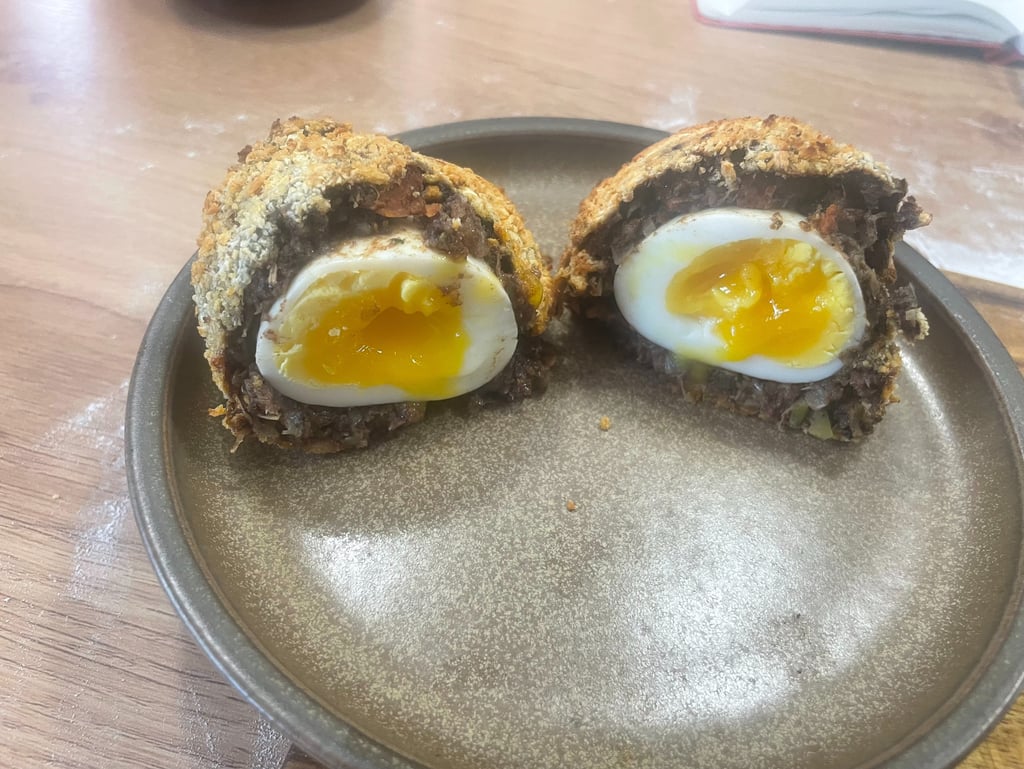
Two flawed rulers. No better one yet. Where that leaves food producers — and us
The food industry runs on two measuring sticks for "is this food good or bad." One asks how the food was made. The other asks what's in it. Neither asks the question most consumers think they're answering when they pick a product off the shelf: will this actually help me?
That gap — between what the rulers measure and what people assume they measure — is the most important thing to understand about food classification right now. Because both systems are flawed, both are under sustained attack, and both are, for the moment, completely unsuperseded. They are the standard precisely because nothing better has won.
This matters to anyone making food, because these two rulers increasingly decide what gets advertised, what gets promoted, what gets a good score on a consumer's phone, and what quietly gets reformulated out of existence. It's worth being honest about what they do well, where they break, and what a producer can actually do about it.
The first ruler: NOVA, which measures processing
NOVA is the system behind the phrase "ultra-processed food." Developed by Brazilian researchers from 2009 onwards, it sorts food into four groups by degree and purpose of processing: unprocessed or minimally processed foods, processed culinary ingredients, processed foods, and — group four — ultra-processed foods.[1][2]
Its power is conceptual. NOVA gave a name and a structure to a feeling millions of people already had: that something about modern food had drifted away from anything you'd recognise in a kitchen. It reframed the conversation away from individual nutrients and toward the architecture of food — fractionation, recombination, additives whose function is cosmetic rather than culinary. That reframing has been genuinely useful, and the epidemiology linking high UPF consumption to poor health outcomes is now substantial.[2]
But NOVA has a structural problem that its own reviewers keep returning to: it explicitly does not assess nutritional content.[3] Processing is the only axis. That produces results that are hard to defend at the edges. Wholegrain bread, fortified cereal, baked beans, tinned fish, a supermarket hummus, an infant formula and a fizzy drink can all land in group four — yet a recent critical review found substantial heterogeneity in health outcomes across UPF subtypes, with sugar-sweetened drinks consistently harmful while some fortified cereals and dairy products behaved very differently.[4] Lumping them together as one category flattens distinctions that matter enormously for health.
There's a second, quieter problem. Because almost anything can be argued into or out of "processed," the definition is contestable — and contestable definitions get exploited. Critics have pointed out that NOVA can function as a language for politicians and corporations rather than the people it was meant to protect, with the classification stretched in whichever direction suits the argument.[5] When a ruler is that elastic, it stops being a ruler.
The second ruler: nutrient profiling, which measures content
The other standard does the opposite. A nutrient profile model ignores how a food was made and scores what it contains. In the UK, the dominant version is the Food Standards Agency's Nutrient Profiling Model, developed in 2004/5 to let Ofcom identify "less healthy" products — those high in fat, sugar or salt — so their advertising to children could be restricted.[6] It tallies "A" points for the things to limit (energy, saturated fat, sugar, sodium) against "C" points for the things to encourage (fruit, vegetables, nuts, fibre, protein), and nets them off into a single score.[6]
Its strength is that it's objective, quantifiable and tied to actual composition. You can calculate it. You can reformulate against it. It rewards adding fibre, protein and vegetables and penalises loading a product with sugar, salt and saturated fat. As a lever for improving the everyday food on shelves, it has teeth — those scores now sit behind advertising bans, promotion rules and shelf-placement regulation.[7]
But it has its own well-documented failures. Because it scores per 100g, foods eaten in small amounts that happen to be energy-, fat- or salt-dense score badly almost regardless of context — peanut butter, cheese, olive oil, yeast extract.[8] It says nothing about processing, additives or the degree of fractionation, so a cleverly formulated product can engineer a good score while remaining deeply industrial. And the UK model is now caught in an awkward limbo: the government's 2025 10-Year Health Plan called the 2004/5 model "plainly out of date," yet the updated 2018 version — which tightens the treatment of free sugars and fibre — still hasn't been written into policy, and parts of the industry are challenging the evidence behind it as "not fit for purpose."[8][9] The standard, in other words, is simultaneously the official tool and openly described as obsolete by the people who own it.
The honest summary: both are flawed, neither has been replaced
Put the two side by side and the picture is clear. NOVA measures how food is made but ignores what's in it. Nutrient profiling measures what's in food but ignores how it's made. Each is blind to exactly what the other sees. A product can be a NOVA group four nightmare with a perfectly respectable nutrient profile score, or a "minimally processed" food that's nutritionally mediocre. Neither ruler, on its own, tells a consumer what they actually want to know.
There have been attempts to do better — hybrid systems, processing-and-nutrition composites, machine-learning models that fold in sustainability.[3][10] Some are promising. None has displaced the incumbents. NOVA remains by far the dominant processing framework in research and policy, and the FSA nutrient profile model remains the operative regulatory tool in the UK.[5][7] For all their flaws, they are the standard, and they will keep deciding commercial outcomes until something demonstrably better wins the argument. Betting your portfolio on their imminent replacement would be a mistake.
So the pragmatic position for a food producer is not to wait for a perfect ruler. It's to understand that you are currently being measured by two imperfect ones at the same time — and to improve your food in the directions that satisfy both, rather than gaming either.
Where UPP sits in relation to both
We didn't design our ingredients to win a classification argument. We designed them to improve everyday food in ways that happen to move in the right direction on both rulers at once. That alignment isn't a marketing accident; it falls out of the underlying approach.
On the nutrient profiling axis, our brassica protein and fibre ingredients push directly on the "C" side of the ledger — the components these models reward. More fibre. More protein. More vegetable-derived nutrition per bite. Used at typical inclusion rates inside familiar formats, they nudge a product's nutrient profile score in the favourable direction without changing what the shopper recognises. We're not claiming a single ingredient transforms a score on its own — composition is the sum of the whole recipe — but we move the needle the way the model intends.
On the NOVA axis, the position is more interesting, and we're careful about it. NOVA is a processing classification, and our ingredients are processed — we won't pretend otherwise. But they're made by mechanical and physical means, with no genetic modification, no synthetic biology and no novel organisms, from a recognisable crop. Crucially, one of the things they can do is replace fragmented additive stacks with a single crop-derived input — for example, displacing a synthetic binder like methylcellulose, one of the canonical markers that pushes a product into NOVA's group four.[5] Fewer cosmetic additives, shorter ingredient lists, inputs that sound like food because they are food. That doesn't magically reclassify a product, but it removes some of the specific features that make NOVA, and the consumers who now use NOVA-flavoured apps, uneasy.
So our honest claim is narrow and, we think, defensible. We are not the answer to the philosophical problem with either model — that's for the scientists and regulators to resolve, and we hope they do. We are a way for producers to improve real products against the two rulers they're actually being measured by today: better nutrient profile scores through genuine nutrition density, and a quieter, less fragmented ingredient list that fares better under processing-based scrutiny. Both at once. Without raising cost, breaking the recipe, or asking the consumer to change a thing.
Closing thought
The debate about how to classify food is important, and it isn't settled. NOVA and nutrient profiling will be argued over, revised, and possibly one day replaced by something that captures both processing and nutrition without the blind spots. We'd welcome that.
But food producers don't operate in the world that's coming. They operate in the one that's here — where two flawed but entrenched rulers shape what can be advertised, promoted, stocked and trusted. The smart response isn't to wait for a better ruler. It's to make food that genuinely improves on both, quietly, upstream, at scale.
Better for producers. Better for people. Better measured — by whichever ruler you're handed.
References
[1] Monteiro CA, Cannon G, Levy RB, et al. Ultra-processed foods: what they are and how to identify them. Public Health Nutrition. 2019;22(5):936–941. doi:10.1017/S1368980018003762
[2] Nova food classification system: a contribution from Brazilian epidemiology. 2025. Overview of the four NOVA groups and associated health evidence. https://www.ncbi.nlm.nih.gov/pmc/articles/PMC12129239/
[3] Definitions of ultra-processed foods beyond NOVA: a systematic review and evaluation. Food & Nutrition Research. 2025. Notes that NOVA explicitly does not evaluate nutritional content and reviews proposed alternatives (e.g. Siga). https://foodandnutritionresearch.net/index.php/fnr/article/view/12217
[4] Are all ultra-processed foods bad? A critical review of the NOVA classification system. Proceedings of the Nutrition Society. 2025. Found substantial heterogeneity in health outcomes across UPF subtypes. https://www.cambridge.org/core/journals/proceedings-of-the-nutrition-society/article/are-all-ultraprocessed-foods-bad-a-critical-review-of-the-nova-classification-system/16D07B81A1587340B3EE847F3C662E60
[5] Ultra-Processed Foods and All-Cause Mortality: Understanding the Nova Classification. NYC Food Policy Center, Hunter College. January 2026. Discusses NOVA's breadth, contestability and dominance in industry. https://www.nycfoodpolicy.org/ultra-processed-foods-and-all-cause-mortality-understanding-the-nova-classification/
[6] Food Standards Agency. The Nutrient Profiling Model (2004/5), with 2011 technical guidance. A-points and C-points scoring per 100g. UK NPM calculator: https://npmcalculator.cdrc.ac.uk/
[7] The Food (Promotion and Placement) (England) Regulations 2021 and The Advertising (Less Healthy Food Definitions and Exemptions) Regulations 2024. NPM scores underpin HFSS advertising, promotion and placement restrictions.
[8] IGD. The Nutrient Profiling Model explained: staying ahead of HFSS changes. 2026. Notes the per-100g penalty on small-quantity energy/salt-dense foods (peanut butter, cheese, mayonnaise, yeast extract) and the government's 2025 "Fit for the Future" 10-Year Health Plan describing the 2004 model as out of date. https://www.igd.com/articles/the-nutrient-profiling-model-explained-stay-ahead-of-hfss-changes/71452
[9] The Grocer. Nutrient profiling model evidence 'not fit for purpose'. April 2026. Industry challenge to the NPM 2018 impact assessment ahead of its application to advertising and promotion rules. https://www.thegrocer.co.uk/news/nutrient-profiling-model-evidence-not-fit-for-purpose/718293.article
[10] Developing an augmented nutrient profiling system in the perspective of healthy and sustainable diets — a machine-learning approach integrating nutritional quality, sustainability and processing. 2025. Example of attempts to supersede single-axis models. (Referenced within [3].)


The Fibre Shortcut: from shelf signal to seamless reformulation
Sainsbury's latest move looks simple on the surface: a new "Full on Fibre" front-of-pack label rolling out across more than 500 products. But the signal behind it runs deeper. This isn't better labelling. It's a shift in how nutrition gets delivered — and it sits at the intersection of three forces reshaping food at the same time: where health and diet are heading, how people actually behave, and where regulation is pushing. Read together, they point to a single conclusion. The work has to move upstream.
Three forces, one direction
Health and diet are shifting from macros to outcomes. For a decade the conversation was protein, calories, and reduction — less sugar, less fat. The centre of gravity has moved toward nutritional density and functional health: gut health, satiety, metabolic support. Fibre sits at the intersection of all three. That's not a trend. It's a structural gap. Only around 4% of UK adults meet the 30g daily fibre recommendation, and even consumers who say they understand fibre struggle to identify where it actually comes from.
Behaviour is the weak lever. If health awareness alone closed the gap, it would already be closed. It isn't, because food decisions sit inside real constraints — time, budget, habit, and what tastes familiar. People won't relearn their diets, sacrifice taste, or trade down on price to hit a fibre target. That's not a failure of willpower. It's how everyday food shopping works. Which means the question stops being "how do we persuade people to eat more fibre?" and becomes "how do we put more fibre in the food they already buy?"
Regulation is turning pressure into direction. HFSS restrictions on advertising, promotion and placement. Sugar and salt reduction targets. The reformulation agenda emerging under MAHA-style initiatives in the US, with additives out and transparency in. Each of these mechanisms points the same way: improve the nutritional quality of everyday food, at scale, without waiting for consumers to change. Fibre is one of the few levers that moves a product in the right direction across all of them — it strengthens the nutrient profile, it carries low regulatory complexity, and it doesn't introduce the kind of synthetic-sounding additives that the same regulations are designed to push out.
Smart labels raise the stakes
Sainsbury's "Full on Fibre" badge belongs to a wider shift toward smart labelling — Nutri-Score, traffic lights, functional nutrient call-outs, and the barcode-scanning apps consumers now use at the shelf edge. These systems don't just inform. They compress a complicated decision into a single heuristic, and they shape what goes in the basket at speed.
That creates a second-order effect that lands directly on manufacturers: what's on the pack has to be backed by what's in the pack. A front-of-pack fibre claim is a promise about formulation. Products without fibre credentials become quietly less competitive. Categories drift toward a higher baseline of nutritional density. And reformulation stops being an occasional project and becomes continuous.
Retailers create the signal. Ingredients enable the response.
The proof: a cottage pie, upgraded without compromise
This is where it stops being theory. In a recent UPP case study, a traditional cottage pie — a staple of the UK's £4.5bn ready meal market — was reformulated to improve its nutritional profile while holding everything that makes the product work.
The approach was deliberately low-friction. Fiba™, UPP's upcycled brassica fibre, replaced a portion of the beef (taking minced beef from 34% to 24%, with 10% fermented broccoli fibre stepping in) to lift fibre and nutritional density. Bynda™, a dried fermented brassica fibre, replaced conventional flour as the binder — delivering the same thickening function while removing gluten from the recipe entirely. The format, cooking process and serving experience stayed the same.
The results, per 100g:
Fibre up 125% — from 0.8g to 1.8g, enough to support a "source of fibre" claim the original couldn't make
16% fewer calories, 20% less fat, 22% less saturated fat — a meaningfully lighter nutritional profile
An allergen removed — out goes gluten, leaving milk as the only declarable allergen, simplifying management across the line
Front-of-pack improvement — moving from "High Protein, Low Sugar" to "High Protein, Source of Fibre, Low Sugar"
And the part that matters most for whether any of this scales: in sensory evaluation, the upgraded pie held its ground. Creamy mash, a firm-but-not-tough savoury filling, well seasoned, rich from the stock and wine — with no overt brassica or broccoli notes coming through. No repositioning. No premium. No consumer friction.
(The nutritional figures here are theoretical, calculated via NutriCalc® and not yet lab-verified — the next step is consumer sensory testing and larger-scale trials before commercial activation. We'd rather state that plainly than overclaim.)
How it works: ingredients that do more than one job
The mechanism isn't headline-grabbing, and that's the point. Both ingredients are designed to operate inside existing products at inclusion rates that preserve taste and structure. Fiba™ adds fibre and density while behaving like food. Bynda™ binds, retains moisture and builds texture — and in doing so can displace a separate additive (in this case flour, and elsewhere binders like methylcellulose), which simplifies the ingredient list rather than lengthening it.
That combination lets a product team add fibre, hold sensory quality, simplify allergen management, and reduce formulation complexity — all at once, and without the trade-offs that usually stall reformulation.
From claim to default
What's taking shape isn't a campaign. It's an operating model.
Retail simplifies the message at the shelf. Manufacturers reformulate existing portfolios at scale. Ingredients do the heavy lifting, delivering nutrition without disruption. The effect is a shift from nutrition as a claim — a premium, a niche, a separate aisle — to nutrition as a default, built quietly into the products people already trust.
Fibre is the entry point because it's uniquely suited to the job: functionally versatile, nutritionally relevant, label-friendly, regulator-aligned, and compatible across formats. But it's only the start. Once the model works, the same ingredient systems extend to deliver protein, density and cleaner labels in parallel, and the line between "healthy" food and "everyday" food keeps narrowing.
Closing thought
Sainsbury's has made fibre visible. The next step is making it ubiquitous — and that doesn't happen through education alone. It happens through formulation: quietly, consistently, at scale.
The future of food isn't built on better choices. It's built on better ingredients, working behind the scenes so those choices don't have to be made at all.
Better for producers. Better for people. Better for the planet.
The buyers have spoken. The money moved upstream of the brand.
Three nutrition acquisitions in four months, and a funding market that looks like it’s cooling. Read together, they’re not two stories. They’re one — and it’s a story about where value is being created in food, and who gets to capture it. There’s a tidy way to read the headlines of early 2026, and it’s wrong.
The tidy reading is that Big Food went shopping. Nestlé took full control of yfood. Danone bought Huel. Lactalis bought Protein Works. Three deals, three logos, a busy quarter for the M&A lawyers. File under “consolidation,” move on.
But that reading misses what the deals actually say. Because the interesting thing about these three acquisitions isn’t that they happened. It’s what the acquirers were buying — and what they were willing to pay for it at a moment when, by most measures, the money has gone quiet everywhere else in food.
Put the M&A wave and the funding data side by side, and a single picture resolves. Capital hasn’t left food. It has changed altitude. It has stopped funding the idea of better food and started buying the proof of it. And the proof it’s paying for is, almost without exception, a story about protein, fibre and complete nutrition — the exact territory the next era of food is being built on.
That has implications. Not for the brands being bought. For the layer underneath them.
What was actually purchased
Look at the common thread, not the logos.
yfood is a “smart food” brand built on nutritionally complete, ready-to-drink formats — protein, fibre, vitamins, satiety in a bottle. Huel is complete-nutrition powders and ready-to-drink meals. Protein Works is protein shakes, meal replacements and active-nutrition formats. Different brands, different countries, different price points. One category: nutrient-dense, protein-and-fibre-forward, complete nutrition.
The acquirers were explicit about why. Lactalis framed Protein Works as a step deeper into “active nutrition.” Nestlé slotted yfood into a newly-formed Nutrition division alongside its existing nutritional-drinks brands. Danone, which had already bolstered its clinical-nutrition arm, added Huel to push further into functional and complete nutrition. These weren’t opportunistic grabs. They were the same strategic move, made three times, by three of the largest food and dairy companies on earth, inside four months.
And the driver underneath all three was named repeatedly in the coverage: GLP-1. As weight-loss medications expand, appetite shrinks, portions shrink, and the demand for nutrient-dense food — more nutrition per bite, protein and fibre that survive a smaller plate — stops being a niche and becomes a strategic priority. The majors are buying complete-nutrition platforms because the consumer is being re-engineered by pharmacology, and the food system has to respond.
We’ve made this argument before, in a different register. Smaller portions expose a big problem. When people eat less, what they eat matters more. The next phase of consumer food is not about eating less food — it is about eating more nutrition per bite. We wrote that about broccoli. Nestlé, Danone and Lactalis have now written nine, twelve and an undisclosed sum of cheques that say the same thing.
The money didn’t leave. It changed altitude.
Now hold that against the funding data, because the contrast is the whole point.
UK foodtech venture funding has been cooling, not heating. On Beauhurst’s numbers, the sector raised around £54m in 2025 — its quietest year since 2018, and a long way down from the £187m peak of 2022. Company formations have thinned. The early-stage, VC-led, “fund the vision” model that defined 2020–2022 has gone into retreat.
If you only read that figure, you’d conclude food innovation is in trouble.
But look up a layer, and the opposite is happening. The same months that produced a near-decade low in early-stage foodtech venture funding produced three nine-and-ten-figure strategic acquisitions in nutrition. The capital didn’t disappear. It moved — out of speculative early rounds and into the strategic acquisition of proven, revenue-generating assets. yfood was doing around €150m in sales. Protein Works around €65m in revenue. These are not bets on what might work. They are purchases of what already does.
That is the structural signal, and it matters more than either data point alone: in food right now, the big outcomes are coming through strategic M&A of de-risked assets, not through serial venture rounds. The market has become a two-speed system. Early-stage capital is scarce and cautious. Late-stage strategic capital is abundant and decisive. The gap between the two is where companies either prove themselves into the second category or quietly run out of road in the first.
There’s a quieter detail in the Beauhurst data that sharpens this further, and it cuts close to home. Agritech told the opposite story to foodtech in 2025 — a record year, around £367m raised, against foodtech’s drought. Same broad space, opposite weather. Where a company is classified — agritech versus foodtech — increasingly determines which funding climate it’s standing in. That’s not a trivium. For a company like ours, with a harvester at one end and a food ingredient at the other, the classification line is a real strategic variable, not a filing detail.
The template is hiding in the Nestlé deal
Here’s the part most people skimmed past.
Nestlé didn’t buy yfood in one move. It bought 49% in 2023, helped scale the business for three years, and then took full control in 2026. Minority stake first. Acquisition second — once the asset had proven itself.
That is not a one-off. It is the dominant pattern by which strategic capital de-risks its way into food. Take a position, build the relationship, watch the performance, deepen if it delivers. The minority stake is the option; the acquisition is the exercise of it. We’ve seen the same shape elsewhere in the sector this cycle, and it’s how patient industrial money has always preferred to enter a category it believes in but hasn’t yet fully underwritten.
For any company on the upstream side of this trend, that template is worth internalising, because it tells you what a serious strategic relationship actually looks like at the start. It rarely begins with an acquisition. It begins with a stake, a partnership, and a test. The companies that understand this don’t wait to be bought — they make themselves legible to the kind of patient, strategic, escalating capital that the Nestlé/yfood arc exemplifies. Legible means proven product, real customers, clean regulatory standing, and a thesis that ladders onto the acquirer’s own strategy rather than fighting it.
Why this is an upstream story, not a brand story
It would be easy, reading all this, to conclude that the lesson is “build a complete-nutrition consumer brand and wait for a major to call.”
That’s the wrong lesson, and it’s wrong for the same reason most food strategy is wrong: it confuses the visible layer with the load-bearing one.
yfood, Huel and Protein Works are finished-product brands. They sit at the shelf, in the consumer’s hand. But every one of them is, underneath, an assembly of ingredients — protein, fibre, functional inputs — that have to come from somewhere, perform reliably, cost the right amount, and survive procurement. The complete-nutrition category the majors are now paying hundreds of millions to own is, at its base, an ingredients demand. More protein. More fibre. More nutrition per bite. Cleaner labels. Resilient, affordable, drop-in supply.
That demand doesn’t get smaller as the category consolidates. It gets larger, more concentrated, and more strategically important — because now it sits inside Nestlé’s Nutrition division, Danone’s functional-nutrition push, and Lactalis’s active-nutrition expansion, each under pressure to deliver protein-and-fibre nutrition at mainstream scale, mainstream cost, and improving Scope 3.
This is the part of the picture we’ve always been built for. The majors buying nutrition brands need the protein and fibre that go into nutrition. They need it non-novel, so there’s no regulatory queue. They need it allergen-clean, so it doesn’t add complexity. They need it drop-in, so it doesn’t break a line. They need it cost-stable and regionally anchored, so it survives volatility. And increasingly they need it to come with a credible carbon story, because the nutrition division and the sustainability target now report into the same building.
We don’t compete with yfood, Huel or Protein Works. We’re upstream of the thing they sell — the ingredient layer beneath the brand layer that just got three emphatic votes of confidence from the biggest buyers in the industry.
What the data is actually telling a company like ours
Strip it all back and the 2026 evidence points in one direction.
The demand thesis is validated, externally and expensively. We’ve spent a long time arguing that the future of food is nutrition density, protein and fibre, delivered into the products people already buy — driven by ageing populations, the fibre gap, and the GLP-1 shift. We could keep asserting it. We no longer have to. Nestlé, Danone and Lactalis have now underwritten it with real money against real revenue. The category we feed is the category the majors are buying.
The route to a large outcome runs through strategic relationships, not venture heroics. With early-stage foodtech funding at a near-decade low and strategic M&A at nine and ten figures, the realistic path for an upstream ingredients company isn’t an endless ladder of VC rounds. It’s becoming the kind of proven, de-risked, strategically-aligned asset that industrial capital wants to partner with — and, on the Nestlé/yfood template, the relationship that starts as a minority stake and a joint development effort is exactly how that begins.
And the unglamorous structural choices age well. Non-novel rather than novel. Mechanical rather than fermentation. Drop-in rather than category-creating. Regionally anchored rather than fragile. In 2022 those choices looked cautious. Against a 2026 backdrop of a cooling venture market and majors paying premiums for proven nutrition assets, they look like the specification of what actually gets funded, partnered, and bought.
The honest caveats
A few, because overclaiming is its own kind of failure.
These are consumer brands with real revenue; we are a pre-scale, B2B ingredient supplier. The deal values — and they were large — are not a read-across to what an upstream ingredients business is worth. We are many stages and a couple of orders of magnitude away from being a yfood. The relevance of these deals to us is directional and strategic — they validate the category, the driver and the route — not a valuation benchmark or a peer comparison. We are an early-stage enabler of the trend these acquisitions represent, not a participant in it at that scale.
The funding figures are Beauhurst’s, ranked by equity raised and updated continually; treat the precise numbers as accurate-as-cited rather than eternal. The deal values reported in the trade press are described as “reported” and in one case undisclosed, so they are indicative, not confirmed final terms. And the connection between these external events and our own model is our analysis — reasoned relevance, not a stated link by any of the parties involved.
None of which changes the shape of the conclusion. It just keeps it honest.
Closing thought
The temptation, watching three majors buy three nutrition brands in a quiet funding year, is to read it as a story about brands and buyers.
It isn’t. It’s a story about where value in food is being created — and the answer, increasingly, is upstream of the brand: in the ingredients, the nutrition density, the protein and fibre that the finished product is assembled from. The brand is the part you can see. The reason it’s worth nine figures is the nutrition inside it.
That’s the layer we work in. Quietly. Upstream. At scale.
The buyers have spoken. They’re paying for better nutrition in familiar formats. We make the better nutrition that goes into the familiar formats.
Not better intentions. Better ingredients.
A note on sources:
The three acquisitions referenced — Nestlé/yfood, Danone/Huel, Lactalis/Protein Works — were reported across the food trade press in early June 2026, with deal values reported (and in one case undisclosed) rather than independently confirmed. The UK foodtech and agritech funding figures are drawn from Beauhurst’s 2026 sector rankings, which are ranked by total equity raised and updated on a rolling basis. Where this piece connects those external events to UPP’s model, that connection is our own analysis.

Two ingredient giants just merged. The deal proves the thesis — and points at the layer it can't reach.
Ingredion is buying Tate & Lyle for £2.7bn to build a one-stop reformulation platform. The logic is exactly right. It also stops at the factory gate — and the most important part of the food system starts upstream of it.
There's a comfortable way to read the news, and it misses the point.
On 8 June 2026, Ingredion announced a recommended all-cash offer for Tate & Lyle: 595 pence a share, a premium of around 59% to the undisturbed price, valuing the equity at roughly £2.7bn and the enterprise at about £3.7bn. The combined group will turn over close to $9.9bn and sit on a combined market value north of $10bn. The board recommended it unanimously. The lawyers got busy. File under "consolidation," move on.
But consolidation is the what. The why is more interesting — and it says something about where food is going that goes well beyond two logos becoming one.
What Ingredion is actually buying
Strip away the deal mechanics and the rationale is a single sentence, repeated in every version of the announcement: build a platform that can solve more of the formulation problem in one place.
Ingredion brings starches, texturants, gums and sugar-reduction technology. Tate & Lyle brings sweetening, mouthfeel and fortification. Put them together and you get something neither had alone — an integrated system that can touch texture, sweetness, nutrition and stability across beverages, dairy, bakery, snacks, soups and sauces. The pitch to manufacturers is not "buy our ingredient." It's "bring us the reformulation brief."
That is a coherent read of where demand is heading. We've made a version of this argument repeatedly: reformulation rarely fails for lack of ambition. It fails because of friction — process disruption, allergen complexity, supply uncertainty, sensory risk, approval cycles. A supplier that can reduce the number of vendors, the number of approval loops and the number of unknowns is selling the thing that actually scales: a lower cost of saying yes.
And notice what the combined group is being built to deliver. Sugar reduction. Fibre enrichment. Protein fortification. Texture that survives a lighter formulation. This is the GLP-1 agenda written into an M&A thesis. As appetite shrinks and portions shrink, nutrition density stops being a niche and becomes the brief. Ingredion is paying £2.7bn for relevance in the next decade of reformulation. We think it has read the decade correctly.
Why now, and why Tate & Lyle said yes
The timing is its own piece of evidence.
Tate & Lyle had spent years repositioning itself out of commodity sweeteners and into specialty solutions — strategically sound, but the market never fully rewarded it. The year to March 2026 brought a roughly 3% revenue decline and a similar EBITDA decline, against a backdrop the board itself described as challenging: weakening consumer sentiment across major regions, subdued demand, and a string of ingredients and CPG companies trimming expectations.
So a transformed-but-undervalued asset met a buyer with a clear thesis and a structural reason to move. Ingredion expects about $130m in annual run-rate synergies by the end of 2030 and the deal to be adjusted-EPS accretive in the first year. The board concluded that a certain premium today beat an uncertain recovery tomorrow. That is not a story about brilliance or failure. It's a story about a category being re-priced — and capital flowing toward the assets that are already de-risked rather than the ones still proving themselves.
We've seen that pattern elsewhere this cycle. The money hasn't left food. It has changed altitude. It has stopped funding the idea of better food and started buying the proof of it. A £2.7bn cheque for a specialty-ingredients platform is the proof being bought.
The part the deal can't reach
Here's where the comfortable reading and the useful reading part company.
Everything Ingredion and Tate & Lyle do happens inside the factory. Texturise the recipe. Reduce the sugar. Fortify the blend. Optimise the mouthfeel. It is real, valuable work, and the combined group will be very good at it. But it is all formulation-layer work — improving the recipe using inputs that arrive at the factory door.
Those inputs come from somewhere. And the somewhere is the part of the food system that decides the things formulation can't: what the ingredient costs, how resilient its supply is, how far it travelled, how much carbon it carries, and whether it sounds like food or like chemistry on the back of the pack.
This is the distinction we keep coming back to. The food system isn't broken — it's optimised. A platform that integrates texture, sweetness and fortification is the system getting better at what it already does. That's worth doing. But the next layer of value — nutrition density that doesn't cost more, fibre and protein that displace a fragmented additive stack rather than adding to it, Scope 3 cut at source rather than offset after the fact — sits upstream of the recipe. It sits in the crop, the harvest, the side-stream, the conversion of biomass that already exists into ingredients a formulation team can drop straight in.
A merger of two formulation houses doesn't create that layer. It increases the demand for it. A combined group whose entire pitch is "more nutrition, less sugar, cleaner texture, at mainstream cost and improving sustainability" needs protein and fibre that are non-novel, allergen-clean, drop-in, cost-stable and carbon-credible — because those are the only inputs that let the formulation promise survive procurement.
Why this points at UPP rather than away from it
We don't compete with Ingredion or Tate & Lyle. We're upstream of the layer they've just spent £2.7bn reinforcing.
When the combined group sits down with a manufacturer to reduce sugar, add fibre and hold the eating experience, it needs ingredients that make that easy. That is precisely what brassica-derived protein and fibre are built to be: recovered from biomass already grown, processed by mechanical and physical means with no novel-food queue and no top-14 allergen burden, designed to integrate at inclusion rates that improve nutrition without changing taste, texture or price. The fertiliser has already done its job. The crop is already in the field. What's been missing is the infrastructure to turn it into something a formulation platform can actually use, at scale, with the documentation and traceability that procurement demands.
There's a sharper, more specific version of that fit hiding inside the deal's own logic. Sweetening is one of the two capabilities Ingredion is paying for — and the next generation of sweeteners in development is heading toward super-high-intensity compounds: sweeteners hundreds or thousands of times sweeter than sugar, used in vanishingly small quantities. Which exposes a problem that has nothing to do with sweetness. Sugar isn't only sweet. It's bulk. It provides the volume, the body, the mouthfeel, the browning, the structure that holds a product together. Replace it with a microscopic dose of high-intensity sweetener and you've solved the calories and created a hole where the substance used to be. That hole has to be filled — and the bulking agents that fill it today are often exactly the kind of fractionated, synthetic-sounding inputs that the wider scrutiny on processing is pushing out.
This is where Fiba and Bynda become interesting in a way that goes beyond "add some fibre." A crop-derived fibre that bulks, binds, holds water and builds texture is a candidate to do the structural job sugar used to do — restoring body and mouthfeel to a super-sweet, low-calorie formulation while adding fibre rather than adding another additive to the label. The sweetener handles sweetness at a fraction of the calories; the fibre handles the bulk the sweetener can't; and the ingredient list gets shorter and more explainable rather than longer. One input doing the work of several is the whole point — and it's the difference between a sugar-reduction product that's nutritionally hollow and one that's quietly better.
We'd state the obvious caveat plainly: this is a formulation-development direction, not a finished, lab-verified claim across every application. Bulking behaviour is application-specific, and the proof is in the trials, not the thesis. But the direction is sound, and it sits exactly at the intersection of the two things this deal is built around — sugar reduction and texture — with the one thing the deal can't supply: the upstream, crop-derived ingredient that lets both happen without a friction penalty.
A bigger, more capable formulation layer is good news for an upstream ingredient designed to feed it. The buyers have just told the market what the next decade of food is about: nutrition density in familiar formats, delivered without friction. We make the kind of nutrition density that goes into familiar formats, without friction.
Closing thought
The headline says two ingredient companies became one. The substance says something narrower and more useful: the industry's biggest players are now organising themselves explicitly around healthier, more affordable, lower-sugar, higher-nutrition reformulation — and paying premiums to be ready for it.
That validates the demand. It doesn't satisfy it. Because a platform that masters texture, sweetness and fortification still has to be fed — with protein and fibre and functionality that arrive cost-stable, allergen-clean, low-carbon and drop-in.
The deal happens at the shelf and in the factory. The reason it's worth £2.7bn is the nutrition the combined group can now promise to put inside the pack.
Making that nutrition is the work. Quietly. Upstream. At scale.
Not better intentions. Better ingredients.
A note on sources:
Deal terms and figures (595p per share, ~59% premium to the 13 May 2026 undisturbed price, ~£2.7bn equity / ~£3.7bn (~$5.0bn) enterprise value, ~$9.9bn combined revenue, ~$130m run-rate synergies by end-2030, adjusted-EPS accretion in year one, completion targeted H2 2027 subject to approvals) are drawn from Ingredion's 8 June 2026 announcement and contemporaneous trade and financial reporting. Where this piece connects the deal to UPP's model, that connection is our own analysis rather than a stated link by either party.
€52 million and six years to a "yes." That's not a milestone — it's the cost of the path.
The Protein Brewery just won the EU's first novel-food approval for a mycelium ingredient. It's a genuine achievement. It also took six years from application to authorisation — and that number is the most important thing in the story.
There's a celebratory way to read the news from 17 June, and it's the right one to start with. The Protein Brewery has done something nobody had done before: cleared Rhizomucor pusillus mycelium through the EU Novel Food framework, earning the first-ever authorisation for a mycoprotein ingredient in the bloc. Fermotein — roughly 50% complete protein, 30% fibre, plus naturally occurring micronutrients — can now be sold across Europe. The company is projecting 600 tonnes from its Breda facility in 2027 against confirmed customer commitments, targeting north of 2,000 tonnes by 2029. That's real demand, a real product, and a real regulatory win. Credit where it's due.
But read the two numbers underneath the headline.
The dossier was submitted to the European Commission in May 2020. It was authorised in June 2026. Six years.
And the company raised the money to survive those six years in tranches as the wait dragged on: founded in January 2020, around €4m of early capital, a €22m Series A, then a €30m ($35m) Series B closed in September 2025 — before the EU approval landed — taking the total to roughly €52m ($60m), topped up with a ~$2.7m EU grant in early 2026. Some €50m-plus raised, and the largest single round of it banked while the European market was still legally closed to the product.
Those numbers are not a footnote. They are the whole lesson.
What six years and €52m actually buys
The Good Food Institute Europe, welcoming the approval, said the quiet part out loud: the timeline shows the regulatory framework needs to keep pace with innovation, and the EU should boost EFSA's capacity so future applicants don't wait as long. They're right to ask. But "fix the regulator" is a policy hope, not an operating plan — and a company has to be built for the world that exists, not the one it wishes for.
So sit with what six years on the novel-food path actually costs a business. It means raising and spending more than €50m before a single compliant European sale. It means a funding clock running in parallel with the approval clock — and over the exact window 2020 to 2026, that funding clock turned hard against the whole category. It means closing a €30m round in 2025 to keep the lights on through a wait you don't control, diluting through every tranche, against a payback period that keeps receding into the next year's regulation.
We've argued before that the thing which actually kills food innovation is rarely the idea. It's the ratio of switching cost and risk to time-to-market and economic upside. A six-year regulatory tail backed by €52m of raised capital is that ratio at its most punishing: the upside is deferred half a decade, the burn compounds the whole time, and the clock runs on someone else's schedule. The Protein Brewery cleared it. The point is how much it had to raise, and how long it had to wait, to do so.
Hold this against the casualty list of the last eighteen months and the point sharpens. Among the seventy-odd alt-protein closures, one of the five composite failure modes we keep coming back to is the novel-food regulatory tail — the approval clock that outlasts the runway. Believer Meats had FDA and USDA clearance and a finished 200,000-sq-ft plant, raised against it, and still never reached commercial production before filing for bankruptcy with $225m of debt. The Protein Brewery is the happier ending of the same structure: it raised enough, fast enough, to outlast the wait. But "raised €52m and survived six years" is a description of the difficulty, not a refutation of it. The biology was never the binary. The clock — and the capital it takes to outrun it — was.
The approval is the achievement. It's also a moat with a meter running.
There's a second detail worth noticing. With authorisation, The Protein Brewery holds five years of exclusive rights to the data behind the safety assessment. That's a genuine reward for going first — a protected window earned by absorbing the cost and the wait. It is, legitimately, a moat.
But it's a moat that cost €52m and six years to dig, and it has a clock on it of its own: five years of exclusivity, won by spending six getting there. That's the trade stated plainly. Novel ingredients can earn defensibility through the approval process — but they pay for it up front, in capital raised and time burned, before the market has confirmed it wants the product at the price the economics require. The exclusivity is real. So is the bill.
None of which is an argument against fermentation or mycoprotein. We've said it before and we'll say it again: the biology is real, the use cases are real, and the survivors of this winter will build durable businesses. Fermotein delivering complete protein, fibre and bioactives from a single ingredient is exactly the kind of nutrition density the next decade of food needs. This is not a knock on the destination. It's an observation about what the road costs.
The other road
Because there is another road to the same nutritional outcome, and the contrast is the entire point.
You can deliver protein and fibre in familiar formats without raising €50m to fund a six-year wait on an approval clock — by starting from ingredients that are already food. That is the deliberate structural choice behind what we've built at UPP. Our brassica protein and fibre are non-novel, produced by mechanical and physical means rather than fermentation, and they carry none of the fourteen declarable UK/EU allergens. There is no six-year dossier between us and a compliant European sale, and therefore no half-decade of burn to underwrite before the market opens, because there is no novel-food question to answer. We're already BRCGS-certificated to Grade A, already shipping, already producing year-round at multi-tonne daily capacity. The regulatory exposure — and the funding requirement that exposure creates — is, by design, absent from our path.
That isn't a claim to superiority over Fermotein on nutrition — it's a different answer to the question of how you get a nutritious ingredient into the food people already buy, quickly, at a cost the line can absorb, without first raising tens of millions to wait. One route earns a time-limited moat by paying a six-year, €52m toll. The other removes the toll booth and competes on the things that compound instead: system-level cost, reliability, drop-in integration at 4–30% inclusion, capital efficiency through modular standardised lines rather than monolithic plants, and a scale-up path from a thousand tonnes toward ten thousand and beyond. We'd rather build defensibility from the aggregate of cost curve, yield and reliability — a dual moat of patented upstream automation and patent-filed side-stream processing — than from a regulatory exclusivity that took six years and €50m-plus to purchase and expires in five.
And it's worth being honest about why this matters beyond any one balance sheet. A six-year, €52m approval path doesn't just tax the applicant. It taxes the whole system's ability to improve food at the speed the health, cost and sustainability pressures demand. Every year and every million spent waiting on a dossier is a year the fibre gap doesn't close and the Scope 3 number doesn't move. If the fastest, lowest-friction, lowest-capital way to get more nutrition into the everyday shop is to start from ingredients that don't need a novel-food clock, then that route isn't the unambitious one. It's the deliverable one.
Closing thought
The Protein Brewery earned its headline, and the people who spent six years and raised €52m getting there deserve the win. The achievement is real.
But the two numbers underneath the headline are the part the industry should actually internalise. Six years from application to "yes," and more than €50m raised to survive the gap — including a €30m round closed while the European market was still shut — is what the novel path costs. For some ingredients there's no way around that toll, and going first earns a moat worth having. For the everyday job of getting more protein and fibre into the food people already buy, there's a faster, cheaper road that skips the toll booth entirely.
The lesson isn't that novel ingredients can't win. It's that the clock and the cheque are part of the business model, whether or not they appear on the pitch deck.
Better for producers. Better for people. And — where it can be done without a six-year, €52m wait — better, sooner.
Not better intentions. Better ingredients.
A note on sources:
Tthe approval details (first EU novel-food authorisation for a mycelium ingredient, May 2020 submission, 17 June 2026 authorisation, five-year data exclusivity, ~50% protein / 30% fibre composition, 600t 2027 / 2,000t+ 2029 projections, GFI Europe's comment on the six-year timeline) are from The Protein Brewery's announcement as reported by vegconomist, 17 June 2026. Funding figures (January 2020 founding, ~€4m early capital, €22m Series A to a €26m total, €30m/$35m Series B in September 2025 to a ~€52m/$60m total, plus a ~$2.7m EU grant in early 2026) are drawn from contemporaneous reporting by AgFunderNews, Green Queen, Nutraceuticals World, FoodBev and others.


Sugar reduction has a bulk problem.
IFT FIRST 2026 had a workshop called "Fat and Fiber, Salt and Sugar: Formulating for a Healthier Future." Read that title again. Fibre and sugar, in the same breath, in the same session. That pairing isn’t a coincidence — it’s the whole problem, and most of the industry is still only solving half of it.
There's a comfortable story about sugar reduction, and it goes like this: sweeteners keep getting better, so the problem keeps getting smaller. Stevia matured. Monk fruit arrived. The next generation of high-intensity compounds is sweeter still — sweet at doses so small they barely register on an ingredient list. Solve sweetness, solve sugar. Move on.
It's a tidy story. It's also solving the easy half and declaring victory.
Because sugar was never only sweet.
What sugar actually does
Pull sugar out of a formulation and you lose the sweetness. You also lose most of the physical substance of the product.
Sugar is bulk. In a biscuit, a cake, a sauce, a cereal, a drink, sugar is a large fraction of the actual mass — the volume that fills the mould, the body that coats the mouth, the solids that hold water in place. It builds texture and chew. It browns under heat, through caramelisation and the Maillard reaction, which is where a great deal of the flavour and colour in baked and cooked food comes from. It lowers water activity, which is part of how many ambient products stay stable on a shelf. It depresses freezing points in frozen desserts. It gives structure to things that would otherwise collapse.
None of that is sweetness. All of it disappears when you swap sugar for a compound that delivers the same sweetness at a thousandth of the weight.
So the high-intensity sweetener does its job perfectly — and leaves a hole exactly the size of the sugar you removed. The calories are gone. The structure went with them.
That hole has to be filled. What you fill it with is now the real formulation decision.
Flavour is not a molecule. It's a structure.
IFT's 2026 keynote — The Science of Flavor: Transforming Culinary Experiences Through Research — gets at something the sweetener conversation persistently under-weights.
Flavour is not a single axis you can dial up and down with a compound. It is an experience assembled from aroma, taste, texture, release, temperature, chew and time. Sweetness perception itself is modulated by the matrix it arrives in — the same sweetener in a thin, watery, structureless base reads differently from the same sweetener in a product with body. Take away the bulk and you don't just change the mouthfeel; you change how the sweetness is perceived, when it peaks, how long it lingers, and whether it finishes clean or metallic.
This is why so many reduced-sugar products fail on shelf despite having “solved” sweetness in the lab. Consumers don't say the sucralose has an unfamiliar temporal profile. They say “I didn't like it.” Or they say nothing at all, and simply don't buy it again.
We've argued before that the most advanced taste tool we have is still a chef. This is the case in point. A sweetener can be validated on a panel and still eat wrong, because the thing that broke wasn't the sweetness — it was everything the sugar used to be holding up.
GLP-1 makes hollow reduction actively worse
The third session of particular note was the Hot Topics Studio: GLP-1 and the Future of Food: Formulating for New Consumer Reality.
Here's why it belongs in a conversation about sugar.
Conventional sugar reduction, done with conventional bulking agents, tends to produce a product that is lower in calories and no better nutritionally. The sugar came out. Polydextrose, maltodextrin, or a polyol went in. Fewer calories, same nutritional thinness, slightly longer ingredient list.
In a world of large portions and high consumption, that trade was defensible. Fewer calories was the goal, and nutritional density could look after itself across the rest of the diet.
That world is going. As GLP-1 use expands, portions shrink and appetite falls — and when people eat less, what they eat matters more. Nutrition per bite becomes the constraint. A product that is calorie-reduced but nutritionally hollow doesn't just fail to help; it occupies a slot in a shrinking daily intake and returns nothing for it.
So the bulking agent stops being a technical afterthought and becomes a nutritional decision. If something has to fill the space sugar vacated, and the consumer has less room in their day than they used to, then the thing you put in the hole had better carry some nutrition with it.
That is a formulation question. It is also, further upstream, an ingredient question.
The market has already bundled these problems
You can see the industry pricing this in.
In June 2026, Ingredion announced a recommended all-cash offer for Tate & Lyle — reported at around £2.7bn in equity value, building a combined ingredients group turning over close to $9.9bn. Read the rationale and the shape is unmistakable. Ingredion brings starches, texturants and sugar-reduction technology. Tate & Lyle brings sweetening, mouthfeel and fortification. The combined pitch is a single platform that touches sweetness and texture and nutrition in one place.
That is not two capabilities sitting side by side by accident. It is an acknowledgement, written into an M&A thesis, that sugar reduction and texture are now the same problem. You cannot credibly sell sweetness reduction without also selling a way to rebuild the body that leaves with the sugar.
The sugar house is hedging — on one axis only
And then there's the signal from the other end of the chain entirely. The end that sells the sugar.
Sucres & Denrées is one of the world's large sugar and soft-commodities trading houses. Its corporate venture arm, Sucden Ventures, invests in early-stage food and agri-tech, with a stated remit spanning sustainability, efficiency, health and nutrition. Among its portfolio companies is Oobli.
Oobli makes sweet proteins. Brazzein, thaumatin, monellin, miraculin — proteins that occur in rare tropical fruits, produced by Oobli through fermentation rather than farming, and roughly 1,000 times sweeter than sugar. The company's own framing is that sweet proteins are a tool CPG companies can add to their sweetener toolkit to “rehabilitate the foods we love.”
So: a business whose commercial existence is built on trading sugar has put venture capital into a technology designed to reduce how much sugar the world needs.
That is not hypocrisy. It is the smartest available read of the situation. The people closest to the commodity have the least incentive to be romantic about its future — and they are hedging. When the sugar house buys into sweetness-without-sugar, the direction of travel stops being a forecast and becomes a position.
But now read Oobli's central claim with real attention, because it is doing something very precise. Sweet proteins, they say, “can replace 60-80% of sugar in most foods without affecting the taste.”
Taste. The claim is scoped — accurately and honestly — to the sweetness axis. And it should be, because that is what a sweet protein does.
Now do the arithmetic on everything the claim doesn't cover. If a compound is a thousand times sweeter than sugar, then replacing 60–80% of the sugar's sweetness requires roughly six to eight hundredths of one percent of the sugar's weight. Which means 60–80% of the sugar's mass simply leaves the product. The bulk. The body. The solids. The structure. Gone, and replaced by very nearly nothing.
The hole is not a side-effect of the sweet protein. The hole is almost the entire quantity of sugar removed.
So the most sophisticated capital in the sugar business has hedged the sweetness — correctly — and in doing so has funded the technology that makes the bulk problem larger than it has ever been. The better the sweetener gets, the bigger the hole it leaves behind.
That is the whole picture. Ingredion and Tate & Lyle merged around the bundle. IFT has programmed three sessions circling it. And Sucden has put money into the sharp end of it. Everyone is racing to replace what sugar tasted like. Almost nobody is claiming what sugar was.
The label trap
Because there's a sting in the conventional answer.
Today, the bulking job goes to a familiar set of agents — polydextrose, maltodextrin, polyols such as erythritol, various fibres and cellulose derivatives. Several of them work well. Several of them are exactly the kind of fractionated, isolated, synthetic-sounding inputs that the rest of the food system is now under sustained pressure to remove.
That's the collision. You reduce sugar to make the product healthier and cleaner. To do it, you add bulking agents that lengthen the ingredient list and read as more industrial, not less. The nutrition panel improves. The back of pack gets harder to defend.
And the back of pack is no longer a soft variable. NOVA gave consumers a vocabulary for processing. Barcode-scanning apps turned that vocabulary into a point-of-purchase judgement — Yuka alone now runs at a scale where a poor score is a commercial event, not a comment. The reformulation agenda, on both sides of the Atlantic, is pushing precisely against the fragmented additive stack that conventional sugar reduction tends to add to.
So the standard playbook runs into its own side-effect: it solves the sugar and creates a labelling problem that the same regulatory and consumer pressure is actively trying to close.
The fibre answer
Here is where the IFT workshop title stops looking like a coincidence.
Fat and Fiber, Salt and Sugar. Fibre and sugar belong in the same session because fibre is a candidate to do the job sugar leaves behind. Not the sweetness — the structure.
A crop-derived fibre that bulks, binds, holds water and builds texture can occupy the space sugar vacates, restore body and mouthfeel to a super-sweet, low-calorie formulation, and do it while adding fibre rather than adding another additive.
That inverts the trade-off. Instead of reducing sugar and lengthening the label with a synthetic-sounding bulking agent, you reduce sugar and the input that replaces the bulk is one people recognise as food — one that pushes the nutrition profile in the direction regulators, retailers and scanning apps are all rewarding, in a category where only around 4% of UK adults hit the 30g fibre recommendation.
One input doing several jobs is the entire point. The sweetener handles sweetness at a fraction of the calories. The fibre handles the bulk the sweetener can't. And the ingredient list gets shorter and more explainable rather than longer and more industrial. Fibre goes up. Additive count comes down. The GLP-1 consumer, eating less, gets more back per bite rather than less.
This is the same logic we keep coming back to: replace a fragmented additive stack with a single crop-derived input, and the label improves as a by-product of doing the job better — not as a claim chased after the fact.
The honest caveat
Now the part we won't overclaim.
This is a formulation-development direction, not a finished, lab-verified result across every application. Bulking is not one problem — it is dozens of application-specific problems. What a fibre must do in a reduced-sugar biscuit (build structure, brown, hold shape under bake) is different from what it must do in a beverage (contribute body without haze or off-notes), different again in a frozen dessert (ice-crystal management, freezing point) or a sauce (viscosity and cling). A fibre that behaves beautifully in one can misbehave in another.
So the claim is narrow. Crop-derived fibre is a strong candidate to take on the structural role sugar leaves behind, in the categories where its functional behaviour fits — and the proof of that is in the trials, application by application, not in the thesis. We'd rather say that plainly than pretend a single ingredient quietly solves sugar reduction everywhere. It doesn't. Nothing does.
What we can say with more confidence is directional. Sugar reduction is bifurcating into a sweetness problem and a bulk problem. The sweetness problem is increasingly well served. The bulk problem decides whether the finished product is nutritionally hollow or genuinely better, and whether the label reads cleaner or more industrial. And the input best placed to solve the bulk problem without a labelling penalty is fibre that behaves like food, because it is food.
Why this is an upstream story
It would be easy to file all this under formulation — a job for the recipe, done inside the factory. It isn't, quite.
Whether the fibre filling the hole is a clean, crop-derived, cost-stable input or a fractionated, imported, synthetic-sounding one is decided upstream of the recipe: in the crop, the harvest, the side-stream, and whether the biomass that becomes the ingredient already exists or has to be grown on purpose. A formulation platform — even a very good one, even a newly-merged one — can only reformulate with the inputs that arrive at the factory door. What those inputs cost, how they're made, how far they travelled and how they read on a label is all set before the brief is opened.
That is the layer we work in. Brassica-derived fibre, recovered from biomass already grown, processed by mechanical and physical means, non-novel, allergen-clean, designed to drop into existing lines. Not a sweetener. The thing that fills the hole the sweetener leaves — in the direction of more fibre and a shorter label, rather than less of both.
Closing thought
The industry has spent years getting very good at replacing the sweetness of sugar. It has spent far less energy on the harder, quieter half of the problem: replacing everything else sugar was doing. Bulk, body, structure, browning, mouthfeel. The stuff that has nothing to do with sweetness and everything to do with whether the product works.
Three sessions at IFT FIRST were circling the same point from different angles — the workshop that puts fibre and sugar in one title, the keynote that insists flavour is more than a molecule, and the studio asking what formulation means when the consumer eats less. Put them together and they describe a single brief.
Solve sweetness with a better sweetener. Solve the bulk with fibre that sounds like food because it is. Do both, and reduced-sugar stops meaning nutritionally hollow with a longer ingredient list, and starts meaning genuinely better — lower sugar, higher fibre, cleaner label, same eating experience.
A note on sources:
Session titles are as listed on the IFT FIRST 2026 programme. The food-functionality points — that sugar contributes bulk, mouthfeel, browning, structure and water-activity control beyond sweetness, and that reduced-sugar formulations rely on bulking agents to replace that mass — are established food science. Ingredion/Tate & Lyle figures (~£2.7bn equity value, ~$9.9bn combined revenue) are as reported in the June 2026 announcement and contemporaneous trade coverage, and should be treated as reported rather than independently confirmed. Oobli’s product description, the ~1,000× sweetness figure, the named sweet proteins and the “60-80% of sugar… without affecting the taste” claim are Oobli’s own, as published on oobli.com; the sweetness-to-mass calculation that follows is ours, and is arithmetic on their stated figure rather than a measured formulation result. Sucden Ventures’ investment in Oobli is per Sucden Ventures’ portfolio disclosures. The claim that crop-derived fibre can perform the bulking role sugar vacates is a formulation-development direction, application-specific, and not lab-verified across all applications; commercial use would require category-by-category sensory and technical validation.
Notes from the floor at IFT FIRST: the thesis travels
We went to find out whether an argument built in British fields and British factories means anything in the largest food market on earth. Three days in, the honest answer is that the American numbers don’t weaken the case. They sharpen it.
There is a particular kind of nervousness that comes with taking a thesis abroad.
At home, in the UK and Europe, we have spent two years making the same argument in as many ways as we can find. The food system isn't broken — it's optimised. Behaviour change is a weak lever. Waste is a design failure, not a moral one. The fastest way to improve food is not to ask people to buy differently, but to change what goes into the products they already buy: quietly, upstream, at scale.
That argument was built inside a specific context. British and Spanish broccoli fields. British labour economics. European regulation. UK retailers, UK school meal budgets, the UK's particular fibre gap.
So, the question we brought onto the floor at IFT FIRST is a genuinely open one, and worth asking honestly: is any of that a UK argument, or is it just an argument?
The American numbers make the case harder, not softer
The first thing you notice is that the pressures we describe in the UK are not smaller here. They are larger, and they are more expensive.
In the United States, suboptimal diet has been linked to roughly $50.4 billion a year in direct cardiometabolic healthcare costs. Diabetes alone cost around $412.9 billion in 2022 — about $1.1 billion a day — with roughly one in four US healthcare dollars going to the care of people with diabetes. Obesity adds nearly $173 billion a year. Set against national health spending that reached around $5.3 trillion in 2024, and a Rockefeller Foundation estimate that the true annual cost of the US food system — once hidden health, environmental and social costs are counted — is at least $3.2 trillion.
And the outcomes underneath those numbers are not marginal. By one analysis, only around 6.8% of US adults had optimal cardiometabolic health in 2017-18. A 2024 JAMA analysis found almost 90% of US adults met criteria for cardiovascular-kidney-metabolic syndrome at stage 1 or higher.
We have never argued that diet is the only cause of any of that. It isn't. But it is not a lifestyle side-issue either. It is infrastructure — and here, more than anywhere, the bill has already arrived.
What that means for a company like ours is straightforward, and slightly uncomfortable to say out loud in a hall full of people selling solutions: the American market does not need to be convinced that food needs to get better. It has already been convinced, expensively, by its own healthcare system.
The open question here is not whether. It's how, without breaking anything.
Which is the same question we get in Manchester
Here is the part that surprised us least and reassured us most.
Stand on a stand for days and you get the same conversation over and over, and it is the conversation we have in the UK. It is not about mission. It is not about sustainability narrative. It is four questions, asked by technical and procurement people who have heard a great many pitches and have a line to keep running:
What does it cost me?
Will it run on my existing line?
Will my consumer notice?
What do I have to declare?
That's it. That's the filter. Every good idea in food dies or lives on those four questions, and it does not appear to matter which side of the Atlantic you ask them on.
We have written before that reformulation rarely fails for lack of ambition — it fails because it introduces too much friction into systems already under pressure. The evidence from this floor is that the friction is universal. The regulatory frameworks differ. The retail structures differ. The crops differ. The four questions do not.
That's a good result for a company whose entire proposition is lowering the cost of saying yes.
Three sessions, one brief
If you want to know what the industry actually thinks the next decade is about, read the programme rather than the press releases.
Three sessions on this year's schedule told you almost everything. A workshop titled Fat and Fiber, Salt and Sugar: Formulating for a Healthier Future — nutrition and formulation named as the same discipline. A keynote, The Science of Flavor: Transforming Culinary Experiences Through Research — a reminder that none of it matters if the food doesn't eat well. And a Hot Topics Studio on GLP-1 and the Future of Food: Formulating for New Consumer Reality — the recognition that when appetite shrinks, nutrition per bite stops being a nice-to-have and becomes the constraint.
Put those three sessions in a line and they describe a single brief: make everyday food more nutritionally dense, without wrecking the eating experience, for a consumer who is eating less.
That is not a brief that gets solved with a claim, a campaign, or a new aisle. It gets solved at the ingredient layer — which is, conveniently and not coincidentally, the layer we work in.
The distinction that lands hardest here isn’t “fermented.” It’s which kind.
The last two years have been brutal for anyone in this industry who bet on a new regulatory pathway. Something approaching seventy alternative-protein companies have closed, been wound down, or been sold in distress since late 2024. Among the recurring failure modes, one shows up again and again: the approval clock outlasting the runway. Believer Meats had FDA clearance, USDA clearance and a finished plant, and still never reached commercial production. In Europe, The Protein Brewery has just won the first EU novel-food authorisation for a mycelium ingredient — a real achievement, six years and something over €50m in the making.
American technical and procurement teams have watched all of that. They are not hostile to innovation. They are hostile to waiting.
Which is why the distinction we spend most of our time drawing is not fermented versus not fermented. It is which kind.
We use a lactic acid fermentation to drop the pH. It is the same class of process that makes sauerkraut, yoghurt, kimchi and sourdough — a technique that predates the food industry by a few thousand years, using an organism the entire regulatory world already knows intimately.
What we do not do is precision fermentation. No engineered organisms. No novel proteins grown in a bioreactor. No synthetic biology. No mycelium. Our ingredients start as broccoli and finish as broccoli — a crop people have been eating for centuries, recovered from biomass already grown, processed by mechanical and physical means with a fermentation step your grandmother would recognise.
That distinction is not cosmetic, and it is not marketing. It is the difference between an ingredient whose regulatory story is a conversation and one whose regulatory story is a six-year dossier. In the UK and EU it means non-novel status and a clean position against the fourteen declarable allergens. In the US it means we are building our regulatory pathway on the most familiar ground available rather than the least — which, in a room full of people who have watched competitors die waiting, is the thing worth being able to say.
Boring, in 2026, has become a competitive advantage.
What this means for our UK and European readers
Three things worth carrying home.
The direction of travel is global, and it is the same direction. The MAHA agenda in the US and the reformulation agenda in the UK and EU come from different politics, different institutions and different starting points — but they point the same way. Additives out. Transparency in. Nutrition density up. School food improved. Whatever one's view of the politics around any of it, the policy substance rhymes. A product designed to be defensible in Chicago is very largely a product designed to be defensible in Cardiff.
The scrutiny layer is converging too. Yuka's fastest-growing and now largest market is the United States. The consumer scanning a barcode in an American aisle is applying broadly the same logic as the one in a British one — shorter lists, fewer synthetic-sounding additives, more nutrition per bite. Producers are increasingly being marked by systems they don't control, in two markets at once, against roughly the same rubric.
And the capital is telling the same story on both sides. Nestlé taking full control of yfood. Danone buying Huel. Lactalis buying Protein Works. Ingredion moving on Tate & Lyle. Four deals, one thesis: nutrition density in familiar formats, bought at premium prices by the most operationally serious companies in the industry. The buyers have already voted. What they have bought is the demand. What still has to be built — and what we're here to talk about — is the ingredient supply that feeds it.
The honest bit
We are a long way from having earned any of this.
We are an early-stage, upstream, B2B ingredients business with a harvester, three products and a thesis. We are not a fixture of the American food system; we're a company on a stand asking whether a model built for British and Spanish brassica can be made to work in a market with different crops, different logistics, different regulation and a great deal more of everything.
But we're not here to have a look around, either. We are standing up a US team from 2027, and California is the obvious anchor — labour constraints that are structural rather than cyclical, water and input efficiency under scrutiny, significant food-waste volumes, and nutrition and sustainability pressures meeting in the same place. Those are precisely the conditions our system is designed for. It's why we joined the Upcycled Food Association. and it's why we were on the floor rather than reading about it afterwards.
And we are doing the unglamorous part properly. A US market is not entered by turning up with a good story; it is entered through registration, food-safety systems, supplier verification and the regulatory work that establishes an ingredient is lawful to sell. None of that is interesting to write about. All of it is being done, in the right order, before we ask anyone to put our ingredients in their product. We would rather arrive slightly later and arrive properly.
So, the trip has a purpose beyond reconnaissance: we want to know which American manufacturers, growers and co-manufacturers want to build that with us, and we would rather find out in a conversation on a stand than in a market-entry deck.
And the answer to the question we brought with us appears to be yes.
The thesis travels. Not because it's clever, but because the constraint it's designed around — a manufacturer under cost pressure, being asked to make food healthier without breaking taste, price or the production line — turns out to be the same constraint everywhere.
Closing thought
We went to Chicago to find out whether a British argument holds up. It does — and the American numbers make it more urgent, not less.
The food system here isn't broken either. It's optimised, at enormous scale, for exactly what it was rewarded for. What's changing is the reward.
A note on sources:
The US health-cost and prevalence figures (≈$50.4bn annual cardiometabolic costs attributable to suboptimal diet; $412.9bn diabetes cost in 2022; ≈$173bn obesity-related medical expenditure; ≈$5.3tn national health spending in 2024; the Rockefeller Foundation’s ≥$3.2tn true-cost-of-food estimate; 6.8% optimal cardiometabolic health in 2017-18; ~90% of adults at CKM stage 1+) are as cited in our earlier piece on diet and healthcare cost, with full references there. Session titles are as listed on the IFT FIRST 2026 programme. The alternative-protein closure count and the Protein Brewery and Believer Meats details are as set out in our earlier analysis of the sector shake-out. Deal values for the Nestlé, Danone, Lactalis and Ingredion transactions are as reported in the trade press and should be treated as reported rather than independently confirmed. References to non-novel status and allergen position relate to the UK and EU regulatory frameworks; US regulatory work is in progress and nothing here should be read as a statement of US regulatory status.


The canary on the field: The fields are telling us something - The map of British food is redrawing.
Heat, water and labour are hitting brassicas first — and the answer isn't to grow less of them. It's to use them better, breed them tougher, change where they are grown, and build the supply chain for the climate that's arriving.
There is a comfortable version of the climate-and-food story. A heatwave arrives. A few crops suffer. Prices tick up. The weather breaks. The system resets. It's comfortable because it treats each hot spell as an event — something that happens, and then stops happening.
This summer's heat, and the reports of British vegetable crops effectively shutting down under it, invite a less comfortable reading. The bad week is not the story. The story is what a run of them, year after year, does to the quiet question every grower and every buyer depends on: can this crop still be grown here, economically, at the quality the market expects?
For a growing list of British field vegetables, the honest answer is becoming: less reliably than it used to be.
That answer, repeated across enough seasons, does not just raise prices in a hot summer. It changes what gets grown, where, and in which varieties — and it moves those changes up the supply chain into the price of food generally. This is not a forecast. It is already underway, and brassicas are where it shows up first.
Why brassicas are the canary
Not all crops feel heat the same way. Cool-season brassicas — cabbage, broccoli, cauliflower, kale, Brussels sprouts — are among the most exposed things Britain grows. They evolved for moderate temperatures. Push them through sustained heat and they slow, they bolt, heads form loosely or not at all, and quality falls away into bitterness and waste. The precise temperature where this happens isn't a fixed number — it varies by variety, by how long the heat lasts, and by whether the plant has water — so any single "growth stops at X degrees" figure is a rule of thumb, not a physiological constant. But the direction isn't in doubt.
And here's what makes brassicas the leading indicator rather than just another casualty: heat hits yield and quality at the same time. A heat-stressed crop delivers fewer marketable heads and downgrades more of the ones it does produce. The grower loses twice on the same field.
In July 2026, the theory became visible. Nationwide Produce reported crops entering a dormant state — shutting down — as plants struggled with sustained heat and dry soil, irrigation under increasing pressure, harvesting windows shortening. Growers had faced a record nine days at 34°C or above this year, after four separate heatwaves in 2025. Cauliflower, cabbage, broccoli and Tenderstem — crops that should be moving through fields in high volumes at this point in the season — had slowed or stopped, their size and appearance affected. Nationwide's chairman, Tim O'Malley, urged retailers to be more flexible on specifications during extreme weather, arguing produce may "naturally vary in size, shape or appearance" without being any less suitable for shoppers. Windy Ridge Veg's managing director, Mark Nundy, called water a "defining challenge" — warning that even growers who'd invested in reservoirs and irrigation couldn't solve the problem on that alone, and calling for more flexible abstraction rules and long-term regional water infrastructure. Potatoes and onions were growing more slowly through the heat too. The soft-fruit season had turned unpredictable, swinging between oversupply and shortage as crops ripened in inconsistent flushes.
The picture for brassicas specifically is sharper still. Reporting on the same conditions, allmanhall's supply analysis noted broccoli growers struggling with a lack of water and bone-dry soils, with yields reduced materially. Without adequate moisture, brassicas bolt or fail to form heads properly, cutting both the volume and the quality of what reaches the buyer. Cauliflower carries a second, subtler problem: it is being hit not only on yield but on appearance. Class 1 cauliflowers are expected to be snow-white, and when the curds are exposed to intense sun they yellow — leaving produce that is perfectly edible, and just as nutritious, being rejected in the supply chain on cosmetic grounds alone. The result across both crops is the same: noticeable fluctuations in size, texture and supply consistency, demand outstripping availability, and prices driven up across the board.
Three squeezes, not one
The reason "shutting down" is a fair description rather than a dramatic one is that the pressure arrives on three axes at once, and they compound.
The crop. Covered above. Heat degrades yield and quality together, and brassicas feel it earliest.
The water. Heat would be manageable if growers could irrigate their way out of it. But the parts of Britain best suited to field vegetables — the east above all — are also the driest, and water for irrigation is a constrained, regulated, finite resource. Abstraction licences are under pressure. So the crops most vulnerable to heat are concentrated exactly where the mitigation for heat is hardest to secure. Rising temperatures increase the need for water at the same moment availability tightens. Both jaws close together.
The labour. This is the squeeze that doesn't show up in a yield table, and this summer made it explicit. The same heat that stresses the plant stresses the person harvesting it. When temperatures hit the mid-30s, it stops being safe to pick through the middle of the day — so harvesting compresses into cooler morning and evening windows. That single fact has three compounding effects. It raises a real occupational risk — heat stress and heat stroke — and with it the grower's duty of care, which rightly removes working hours precisely when the crop most needs to come off the field. It cuts productivity, because the same crop must be gathered in fewer usable hours or left standing to deteriorate in the heat that shortened the window. And, over time, it erodes willingness: field harvesting already depends on a labour supply that's hard to secure, and asking people to do heavy physical work in dangerous heat does not make the job more attractive. A role that is punishing in a heatwave competes badly against the alternatives — and that feeds back into whether the crop gets picked at all.
Stack them. Heat damages the crop. Constrained water removes the obvious mitigation. And the labour to harvest what survives is both limited by the heat and, over time, harder to attract because of it. None of these is the whole story alone. Together, they are why the fields are shutting down.
From field to shelf, and into every trolley
The immediate consequence is the obvious one: less supply, higher prices for the affected vegetables, more reliance on imports to fill the gap. That shows up quickly and visibly.
The consequence that matters more is quieter. British field vegetables aren't only sold fresh — they are inputs. Brassicas, roots and leaves feed ready meals, soups, sauces, prepared salads, and the own-label manufactured food that makes up a large share of a normal shop. When the cost and reliability of that raw supply moves, it moves the cost base of manufactured food — not just the price of a broccoli crown. Heat in a Lincolnshire field doesn't stay in the produce aisle. It works its way into the price of everything those crops go into.
And when domestic supply falters, imports cover the shortfall — importing their own exposure. Much of Britain's out-of-season vegetable supply comes from arid regions of southern Spain that are, if anything, closer to a water limit than the UK. Leaning harder on Spanish supply to cover British heat losses means leaning on a system under even more acute stress. The fallback is not a stable one.
The map redraws: which crops, which varieties, which places
If the pressure were uniform it would simply make food more expensive everywhere. What actually happens is more interesting, and it runs along three axes at once.
Which crops. Land that becomes marginal for a cool-season brassica doesn't become worthless — it becomes better suited to something else. Over time, heat nudges growers off the most heat-sensitive crops on the most exposed land. Rational field by field; disruptive to the national supply of any one vegetable.
Which varieties. Long before a crop is abandoned, the response is varietal. Breeding and selection for heat tolerance, slower bolting and resilience under water stress becomes the near-term line of defence — keeping broccoli and cauliflower on the same land by changing which broccoli and cauliflower, timed differently. This is the quiet, unglamorous adaptation already underway, and it is where much of the real near-term action sits. Not "stop growing brassicas." Grow tougher ones.
Which places. The slowest axis, and the most consequential. As southern Europe turns marginal for certain crops and Britain warms, the geography of suitability shifts — potentially northward. The UK may gain the ability to grow, or extend the season for, crops it couldn't before, even as it loses reliability for cool-season staples it has always taken for granted. Not speculation: sophisticated operators are already repositioning. The clearest example is wine, where Champagne houses have acquired land in southern England as conditions became viable for sparkling wine. Capital following a climate-shifted map. What's happened visibly in viticulture is a preview of what happens, less visibly, across field vegetables.
Where this meets the UPP thesis
We've always argued that the food system isn't broken. It's optimised — for cost, convenience and throughput, in a stable climate. What this summer exposes is that one of the inputs the optimisation quietly assumed — reliable British and Spanish brassica production — is becoming less reliable. The system was tuned for a climate that is leaving.
That is not a reason to grow fewer brassicas. It is a reason to get far more out of every one we do grow, to breed them for the conditions that are coming, and to build the supply chain around resilience rather than around the assumption of good weather. Which is the thesis, applied to its own feedstock.
Three things follow directly.
First, utilisation stops being a nice-to-have and becomes a resilience strategy. When a crop gets harder and more expensive to grow, wasting most of the plant becomes indefensible. A broccoli head is a small fraction of the plant; the stem and stalk carry protein and fibre and today are mostly left in the field. In a tightening market, capturing that side-stream isn't just a sustainability story — it's more food and more value from the same stressed hectare, without asking the grower to plant a single extra plant. Scarcity makes whole-crop utilisation worth more, not less.
The cauliflower story this summer makes the point for us. Heat-yellowed curds are being rejected as Class 1 produce despite being perfectly edible and just as nutritious — and initiatives like Waste Knot, which allmanhall observed on a Vale of Evesham farm visit, exist precisely to stop that food being thrown away over appearance. That is the same logic we build on, one step earlier in the plant: the problem is rarely that the nutrition isn't there. It's that the system isn't designed to use it. Cosmetic rejection of a whole head and in-field abandonment of a whole stalk are two versions of the same design failure. In a climate that makes every head harder to grow, designing that waste out stops being optional.
Second, the labour squeeze is an argument for automation that harvests in the cool. If workers can only safely pick in shortened morning and evening windows, a harvest that doesn't depend on manual picking through the day is not a marginal efficiency — it's a way to get the crop off the field in exactly the windows the heat allows, at night and in the early morning, when the crop also comes off cooler and needs less energy to chill. Solving the harvest-labour problem and lowering the heat exposure of the crop turn out to be the same problem.
Third, the UK–Spain dynamic is a hedge before it's a risk. A model that already works across British summer and Spanish winter is a model with two shots at a viable growing window as the map moves — provided it treats varietal resilience and water exposure as design constraints in both geographies, not afterthoughts.
None of this makes brassica production immune to climate. It doesn't. What it does is change the response from "hope for a cooler summer" to "build for a hotter one" — tougher varieties, more of each plant used, harvest that fits the hours the heat allows, and supply spread across the geography the climate is redrawing.
The honest version
We won't overstate our own position. UPP sources from the same UK and Spanish growers this article is about, which means our feedstock carries the same climate exposure as everyone else's — and pretending otherwise would be exactly the kind of overclaim this sector has been punished for. The advantage isn't immunity. It's that a model built on utilisation, automated cool-window harvest, heat-resilient varieties and a two-country supply base is built to bend with these pressures rather than break on them.
The fields are shutting down one hot week at a time, and each week is a signal, not a crisis. The map of what Britain can grow, where, is being redrawn. The useful response isn't to treat every heatwave as a surprise. It's to build — in varieties, in practice, in harvest technology, in how much of each crop we actually use, and in where we source — for the climate that's arriving rather than the one we were used to.
A note on sources:
Temperature-response points are directional rules of thumb, not fixed physiological thresholds; heat tolerance varies by crop, variety, exposure and water. The July 2026 conditions and the named growers (Nationwide Produce, Tim O'Malley; Windy Ridge Veg, Mark Nundy), the nine days at 34°C+, and the shortened safe-harvesting windows are from the Grocery Gazette report of 20 July 2026.
The broccoli and cauliflower detail — >50% yield reduction (attributed by allmanhall to the BBC), bolting and head-formation failure, the snow-white Class 1 cauliflower standard and sun-yellowing of curds, and the Waste Knot / Vale of Evesham example — is from allmanhall's "Brassicas under pressure" analysis.
The occupational-heat-risk and willingness-of-labour points extend from the Grocery Gazette statement that workers cannot safely pick through the day — reasoned implications, best supported by an additional source on agricultural labour availability.
The Taittinger/Kent example was reported by the BBC.
Get in touch
© 2026. All rights reserved.
Upcycled Plant Power ('UPP') Limited
trading as "UPP" and "Freya"
Company number: 14171122
VAT Number: 428 2222 17
Registered address:
Agri-Tech Centre
Poultry Drive, Edgmond,
Newport, Shropshire
United Kingdom TF10 8JZ
Connect with us
Broccoli is a natural source of vitamin K and contains folate, potassium and beta-carotene, a provitamin A carotenoid. Our Fiba, Bynda and Prota products are a source of fibre, making them nutritionally valuable ingredients.
"Allergen-free" refers to the absence of the 14 allergens requiring declaration under UK/EU FIC. See here for our Allergen statement.




+44 1952 327 357