Our Certifications
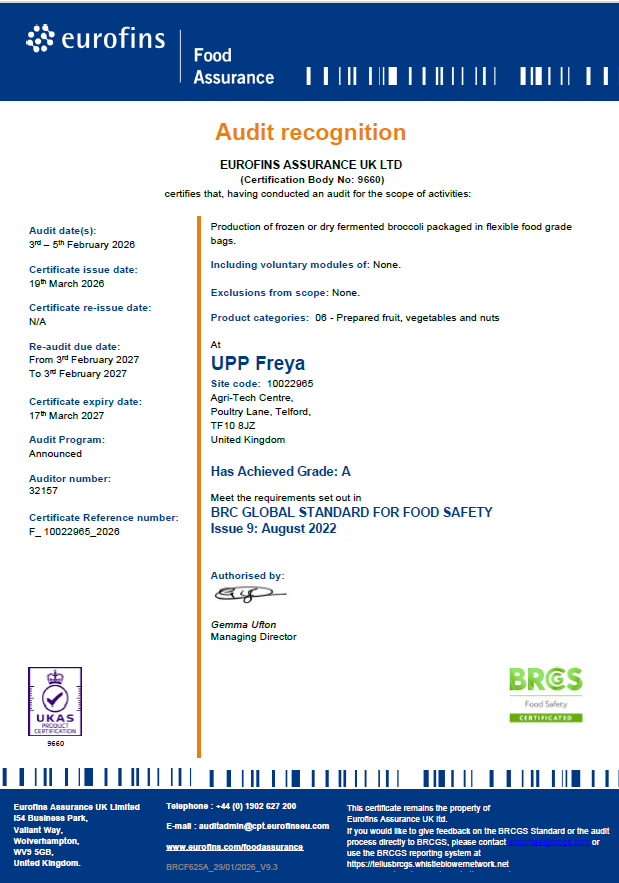
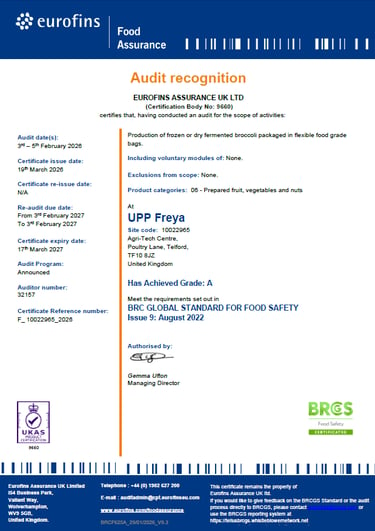
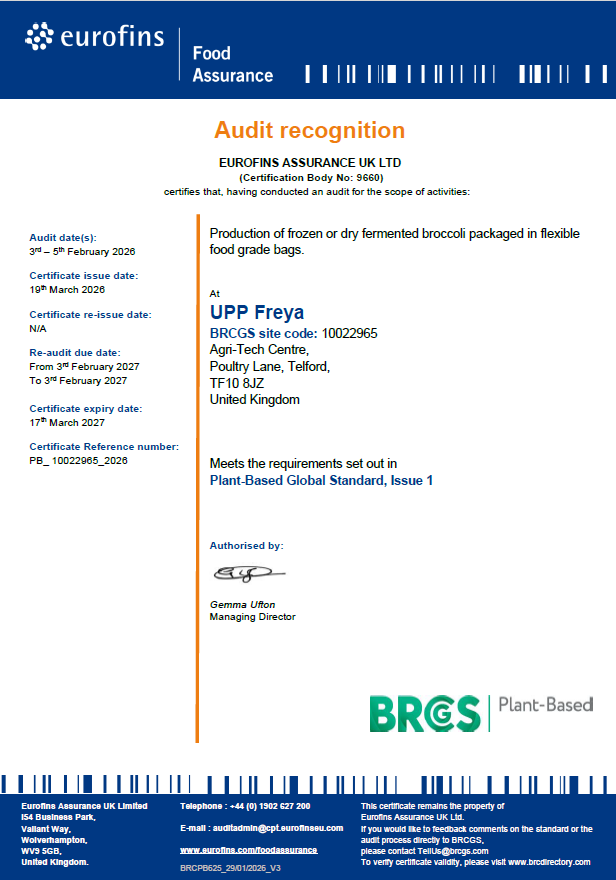
UPP was audited against BRCGS Standard Issue 9 and Plant-based Issue 1 by Eurofins on 03-05 Feb 2026 and was awarded a Grade A on the first audit.
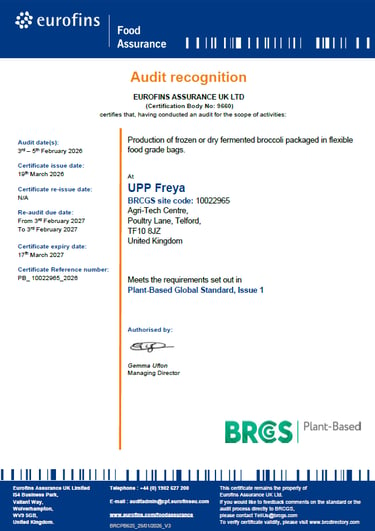
Certification can be confirmed at the BRCGS website under Site Code: 10022965 and Audit ID 100691792. The Issue 9 certificate may be downloaded here, and the plant-based certificate here.
BRCGS (Brand Reputation through Compliance Global Standards) is a certification programme benchmarked and recognised by the Global Food Safety Initiative (GFSI). Organisations certified to the BRCGS Global Standard for Food Safety meet the rigorous requirements set by GFSI for food safety management systems, demonstrating compliance with internationally accepted best practices. A GFSI recognized certification strengthens supply chain confidence and satisfies the food safety expectations of major retailers, manufacturers, and brand owners worldwide.
We chose to move directly to BRCGS Food Safety rather than first pursuing ISO 22000 or FSSC 22000, because for an ingredient manufacturer supplying large food producers, BRCGS is a highly credible, GFSI-recognized standard with strong retailer and brand recognition.
Our products are vegan: no animal-derived ingredients, animal-derived processing aids or animal-tested products are used. However we will not pursue the Vegan Society Trademark as the substantive verification it provides is largely covered by BRCGS Plant-Based Issue 1, and also as the brand value the Vegan Society Trademark provides is consumer-facing, which is not consistent with UPP's B2B ingredient supplier model.
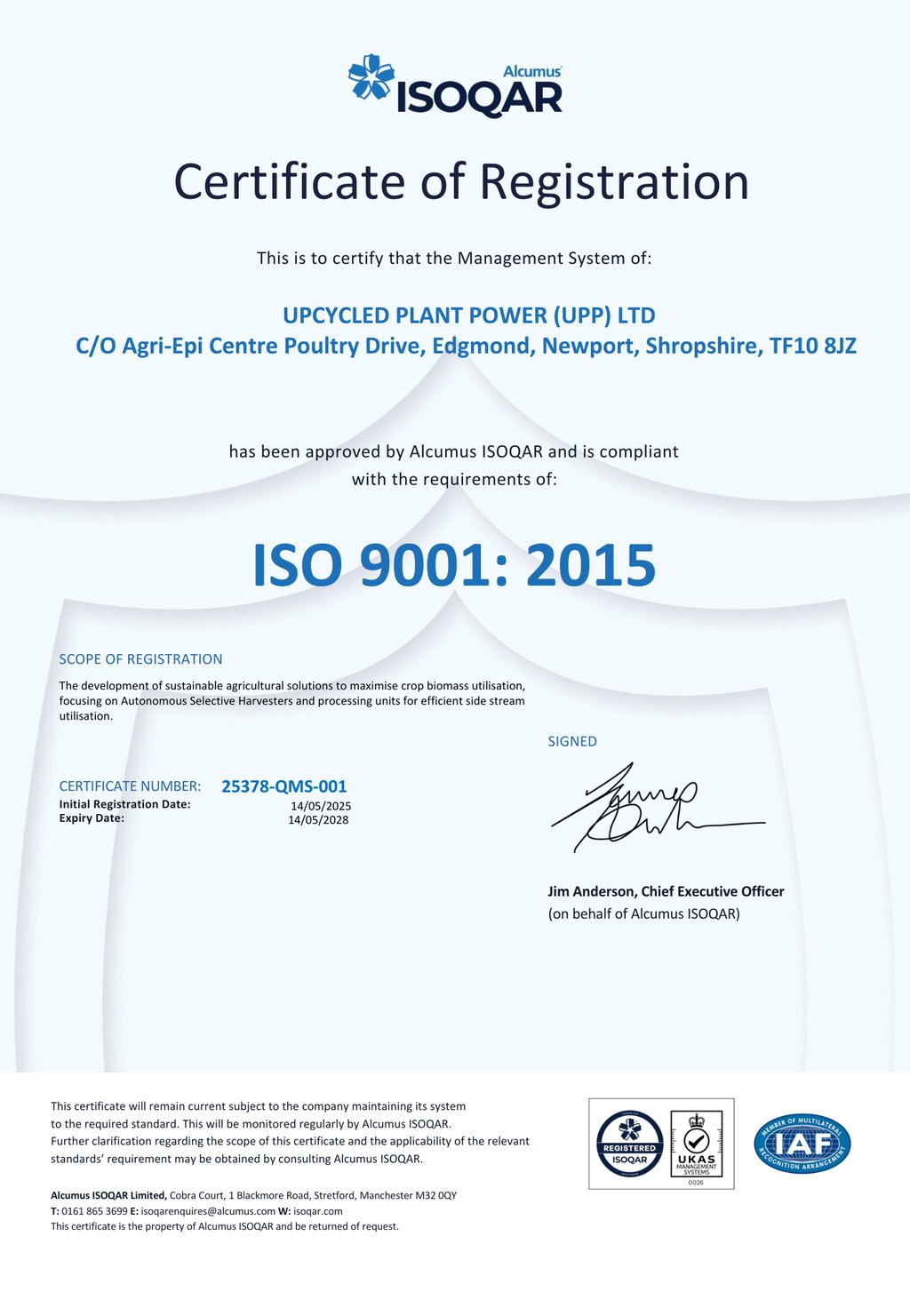
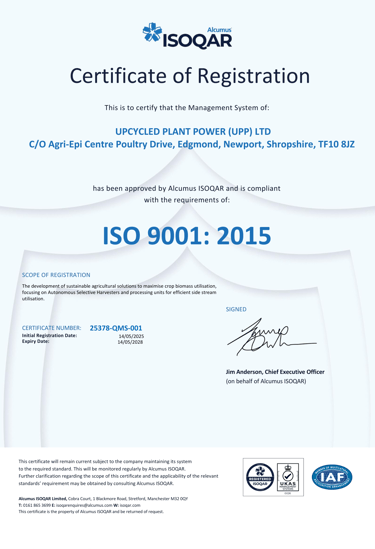
ISO 9001: 2015 Certificate number 25378-QMS-001, issued by ISOQAR Alcumus which can be validated here
UPP is a registered Sedex member (company membership number ZC_5000063281). Our Sedex Self-Assessment Questionnaire (SAQ) has been completed and submitted. Customers who are Sedex members can request a link to our profile on the Sedex platform to view our SAQ and site data directly.
A SMETA (Sedex Members Ethical Trade Audit) is planned to align with our scaled facility coming into operation, with the report published to the Sedex platform on completion.
Environmental Management System
UPP is implementing an ISO 14001-aligned Environmental Management System (EMS), with formal certification targeted for completion ahead of our 10,000 tpa modular facility going into operation. The certification will be designed into the operational template rather than retrofitted, and will propagate across replicated production units as we scale.
Why now: Environmental management infrastructure — effluent controls, emissions monitoring, waste segregation, energy and water metering, chemical storage, and the documented procedures around them — is materially cheaper and more rigorous to design into a new facility than to retrofit. We are taking ISO 14001 forward at the template stage so that every modular unit inherits the same EMS rather than requiring per-unit rework.
How it fits: The standard is the recognised environmental management complement to our existing ISO 9001:2015 quality management system, and shares the same Annex SL management system structure. UPP's integrated management system covers both standards under a common documentation, internal audit, and management review framework, with BRCGS Issue 9 operating alongside.
Scope: The EMS covers our production site, our supply chain environmental controls, and the operational environmental footprint of Harvesta field deployment. Significant environmental aspects, performance indicators and operational controls are documented in line with the standard.
Relationship to our LCA work: The interim Life Cycle Analysis already published on this site is the foundation work for our EMS — boundary setting, allocation approach, and environmental aspect identification. ISO 14001 formalises that work into a managed system with audited data discipline, supporting the next iteration of the LCA and providing the underlying data quality our customers' Scope 1, 2 and 3 reporting requires.
Forward roadmap: Initial certification audit is scheduled to align with the BRCGS recertification window for the new facility. ISO 45001 (occupational health and safety) and ISO 50001 (energy management) are under consideration as additions to the integrated management system, sequenced to customer demand and operational readiness.
For documentation, the EMS scope statement, environmental aspects register, or planned certification timeline, please contact us under NDA.
UPP's products are non-GMO
This reflects the structural reality of our feedstock and process rather than a separately certified claim.
Feedstock:
Our products are derived from brassica oleracea (broccoli, with cauliflower and other Brassicaceae on our roadmap). There are no commercially cultivated GMO varieties of broccoli or cauliflower anywhere in the world. UPP's farmer feedstock contracts are with UK growers producing conventional broccoli for the human food supply chain.
Process:
UPP's fractionation process is mechanical with subsequent fermentation of Fiba.
No genetically modified micro-organisms, enzymes, or processing aids are introduced at any stage.
For fermentation we use non-GM vegan cultures.
Regulatory position:
UPP operates within the UK and EU regulatory framework on genetically modified food and feed (retained EU Regulation 1829/2003 and 1830/2003). Our products do not contain GMOs above the 0.9% labelling threshold and require no GMO declaration on inputs or outputs.
Supplier verification:
GMO status is included in our supplier qualification documentation under our BRCGS-aligned supply chain controls.
Identity preservation through the supply chain is supported by our traceability system from raw material intake through finished ingredient.
Testing capability: PCR-based testing for GMO DNA is available on request to satisfy customer-specific verification requirements.
Forward roadmap:
UPP intends to pursue Non-GMO Project Verified certification for core ingredient SKUs ahead of US commercial launch, to support customer requirements in the North American market where formal third-party non-GMO certification is the recognised industry standard.
In UK and EU markets, where the regulatory framework treats GMO presence as the disclosed exception rather than absence as the affirmative claim, UPP currently maintains documentary verification rather than a separate certification.
For documentation, supplier qualification records or test reports related to GMO status, please contact us under NDA.
Organic status
UPP has a source of UK-grown certified organic brassica feedstock and is positioned to run certified organic production on a campaign basis, triggered by customer demand reaching the minimum economic campaign size. This reflects the structural fit between organic production requirements and our mechanical process, and our approach of sequencing certified production to commercial demand rather than carrying continuous organic overhead ahead of it.
Feedstock:
Our organic feedstock supply will be contracted with UK growers producing certified organic broccoli for the human food supply chain, under the same conventional/organic dual-track model used across UK horticulture.
Process:
The narrow input scope means the organic audit perimeter is correspondingly narrow — the substantive controls required under organic regulations apply primarily to segregation, cleaning, traceability and mass balance, rather than to a re-sourced input chain.
Organic production will operate on a campaign model: scheduled runs against accumulated organic orders, with documented changeover including deep clean, verification, and a flush batch downgraded to non-organic.
Regulatory position:
UPP will operate within the UK organic regulatory framework (retained EU Regulation 834/2007 and implementing acts, as applied in Great Britain) under a Defra-approved organic control body. For EU market supply, certification will be held with an EU-recognised control body. For US market supply, certification will be held under USDA NOP ahead of US commercial launch, with the UK+EU / US organic equivalency arrangements applied where in scope.
Segregation and traceability:
Organic and non-organic feedstock, work-in-progress, and finished goods will be segregated through intake, storage, processing, and despatch, with parallel mass balance reconciliation.
Identity preservation through the supply chain is supported by our existing BRCGS-aligned traceability system, extended with an organic ledger and campaign changeover records.
Cleaning, changeover, and flush-batch protocols are documented and will be appropriately validated.
Certification approach:
Site-level organic certification will be put in place ahead of the first commercial organic order rather than triggered by it. The annual certification fee is modest relative to the commercial optionality it creates, and the certification timeline (typically several months from application) would otherwise extend lead times on first orders unacceptably. Campaign production will be triggered by customer demand reaching the minimum economic campaign size, defined in our commercial terms for organic SKUs.
As with our wider certification roadmap, the organic certification posture is designed into our operational template rather than retrofitted, and will propagate across replicated production units.
Customer engagement:
Organic SKUs are quoted with a campaign lead time rather than from continuous stock. For manufacturers with specific control body preferences, retailer-driven certification requirements, or audit access expectations tied to campaign windows, please contact us to discuss. Where customer SAQ requirements pull for additional or alternative organic certifications, our roadmap is responsive rather than fixed.
For documentation, supplier qualification records, organic certificate copies, or planned campaign cadence, please contact us under NDA.
Halal and Kosher status
UPP's products are compatible with halal and kosher dietary requirements. This reflects the plant-based, allergen-free nature of our feedstock and the mechanical and fermentation character of our process. All production is conducted under conditions compatible with halal and kosher requirements, and nothing is run on the line that is intrinsically non-halal or non-kosher. Formal third-party certification is part of our forward certification roadmap, sequenced to commercial deployment.
Substantive position:
Our ingredients are derived from brassica oleracea (broccoli and related Brassicaceae) using a mechanical fractionation process followed by fermentation of the Fiba. No animal-derived ingredients, animal-derived processing aids or alcohol-based extraction are used at any stage. Cleaning agents and incidental contact materials are documented and verifiable through our BRCGS-aligned supplier qualification system. For fermentation we use non-GM vegan cultures that do not generate alcohol.
Halal relevance:
As a plant-based ingredient with no animal-derived inputs and no alcohol exposure in the core process, our products meet the substantive ingredient and processing requirements of halal dietary law. The relevant operational controls — supplier verification, segregation, cleaning, and documentation — are aligned with our existing BRCGS Plant-Based Issue 1 certification.
Kosher relevance:
As a plant-based ingredient with no dairy or meat contact, our products are pareve in kosher terms — neither meat nor dairy — and can be used in both meat-line and dairy-line product formulations by manufacturers operating kosher-certified production. Pareve status is the most operationally flexible category for ingredient suppliers serving kosher manufacturers.
The principal kosher certifying bodies classify brassicas including broccoli and cauliflower as miut hamatzui — produce where insect infestation is consistent enough that checking is required under rabbinic obligation. Insect infestation in brassicas is concentrated in the floret structure; our process predominantly uses stalk and stem material, which is structurally far less prone to infestation and our current wash process has a specific element (a 'witches wheel' within the flume wash) designed to remove insects prior to processing.
The primary additional requirements for kosher certification for our process are the kosher-certifiication of the wash and potentially heat treatment and manual inspection (if required). The primary questions are whether processing predominantly stalk and stem and minimal floret means the feedstock remains miut hamatzui, and whether halachic checking obligation transfers cleanly from the feedstock to a fractionated concentate. We will engage with a rabbinic coordinator at the point a customer requirement is in view.
Certification approach:
Formal halal and kosher certification will be pursued from globally recognised certifying bodies, sequenced to align with the geographies where our customers require it. We will design process capability for both in parallel, as part of a single programme during design, as this is meaningfully more efficient than sequencing them. Our planned certifications are:
Halal certification: certification from a recognised halal certifying body whose recognition supports both UK/EU and the planned North American commercial expansion, reflecting the regional structure of halal certification. Halal certification will be in place at our scaled production facility, designed into the operational template rather than retrofitted, and will propagate across replicated production units.
Kosher certification: certification from a globally recognised Orthodox certifying body, providing pareve verification accepted across kosher product lines. Due to the costs of annual compliance and supervision, kosher certification will be gated by demand.
Customer engagement:
For manufacturers with specific certifying body preferences, or with religious-dietary requirements outside the scope of our planned certification roadmap, please contact us to discuss.
Where customer SAQ requirements pull for additional or alternative certifications, our certification roadmap is responsive rather than fixed.
For documentation, supplier qualification records, ingredient declarations, or planned certification timelines, please contact us under NDA.
UPP's Pet food (animal feed) regulatory status
This reflects the regulatory position of UPP's ingredients for use in pet food and animal feed applications, where a customer requires it.
Regulatory position
Within Great Britain and the EU, UPP's ingredients are, for feed purposes, plant-derived feed materials rather than feed additives. Feed materials are subject to notification and compliance requirements under the applicable feed legislation (assimilated Regulation (EC) 767/2009 on the marketing and use of feed, and the Catalogue of Feed Materials under Regulation (EU) 68/2013) rather than pre-market authorisation.
UPP will confirming the catalogue status of each fraction and complete any required notifications as part of engaging with customers.
Establishments supplying feed are registered as feed business operators under assimilated Regulation (EC) 183/2005, operating feed-safety HACCP. UPP's feed-safety systems will build on the same quality infrastructure as its food-grade operations, which are certificated to BRCGS Food Safety (Grade A, first audit).
Composition and safety
UPP's ingredients are supplied against specification, including compositional data relevant to feed use. Compliance with maximum levels for undesirable substances (assimilated Directive 2002/32/EC), including glucosinolate-related parameters relevant to brassica-derived materials, will be established through analytical programmes at customers' intended inclusion rates.
Assurance approach
Feed-sector customers typically require feed-specific assurance certification (such as FEMAS, UFAS or GMP+) in addition to general quality systems. UPP intends to pursue FEMAS certification of relevant sites, building on its existing BRCGS and ISO 9001 systems, timed against customer demand.
Species suitability
Formulation support, including palatability and digestibility information for companion-animal applications referenced against FEDIAF nutritional guidelines, will be developed to support customer product development. UPP's ingredients are allergen-free and non-GMO, as set out elsewhere on this page.
Forward roadmap
For the United States, feed ingredient recognition (GRAS, FDA consultation, or AAFCO definition pathways) will be progressed in line with UPP's US market entry. Timelines are demand-led and confirmed with customers directly.
Customer engagement
For manufacturers with specific feed or pet food requirements, our regulatory position and certification roadmap is responsive rather than fixed. Where customer requirements call for additional verification or certification, our roadmap is responsive to demand.
For documentation, supplier qualification records or test reports related to feed status, please contact us under NDA.
Get in touch
© 2026. All rights reserved.
Upcycled Plant Power ('UPP') Limited
trading as "UPP" and "Freya"
Company number: 14171122
VAT Number: 428 2222 17
Registered address:
Agri-Tech Centre
Poultry Drive, Edgmond,
Newport, Shropshire
United Kingdom TF10 8JZ
Connect with us
Broccoli is a natural source of vitamin K and contains folate, potassium and beta-carotene, a provitamin A carotenoid. Our Fiba, Bynda and Prota products are a source of fibre, making them nutritionally valuable ingredients.
"Allergen-free" refers to the absence of the 14 allergens requiring declaration under UK/EU FIC. See here for our Allergen statement.

+44 1952 327 357